Chassis: Speed vs Torque

Actually it isn’t a swerve drive. It’s just a variable drive. It uses 5 motors (I believe)- four for the wheels and 1 for the transmission from x-drive iteration and tank drive iteration. The way it works is one motor is placed in the middle that would change the angle of the wheels using a chain and sprocket system.

This is a much different concept from swerve drives. It’s a really cool video. :slight_smile:

If a team is actually playing defense on you, then you can’t just ignore it. Especially at the end when you have to get back into you loading zone to score driver loads and lift.

Just going by what my FRC compadres tell me it is called. Yes, there is difference in central steering motors of yours vs independent ones at the wheels these guys use. Blindingly fast acceleration in any direction is the main benefit I see either build.

You can see this piece of engineering here and the full benefit/drawback list they have:
http://wiki.team1640.com/index.php?title=Swerve_Central

It isn’t actually a swerve drive. A swerve drive has independent wheel positioning, like this:

The one I showed above just changes positions from tank to holonomic positions.

Edit: I just noticed that @Don said the same thing. Sorry, I hadn’t read down that far yet.

Yes your right, I didn’t really mean ignore them completely, but it did look that way. So I edited the post.

the only problem with having a speed setup is that if someone tries to push you and they have torque they will push all over the field , and also you have to think about not putting too much stress on the motors because we had turbo motors on ours and every time some one would bump us or we would hit the wall etc. the motors would overheat and we would have to wait the ten seconds for them to work again

That’s where a simple break can come in handy. That way, if someone tries to push you, their motors will stall out pretty fast.

Your centering system is higher quality than your drive train

As the age old speed vs torque vs necessity of transmission argument shows up in NBN, I’ll put in my two cents.

I love transmissions, and I think people who know me know that. And I’m gonna offer a perhaps crazy strategy that involves a transmission and pneumatic brake.

I’ve always wanted to build a pneumatic, linear motion kit directed gear shifting 6 - 8 motor super fast super powerful transmission. Always been a fan of Green Egg’s brutality when it comes to pushing, although never got the opportunity to build one in VEX. Skyrise was a game of lift, not base.

NBN’s been interesting so far. Teams seem to be able to crank out a lot of scoring by aligning themselves using the low goal bar. Aside from standard cross field launching, I personally believe the alignment/shooting is the best offensive strategy so far, because it’s easy, which makes the shooting reliable. Yeah yeah you can shoot from the mid field or anywhere else without aligning, but from what I observe, not very reliable. Not even 100 percent for Robosavage’s rubber band shooter. And as we all know, they are good. Or at least theoretically, the VEX ultrasonic sensors are just not powerful enough to make it reliable at this point. If you made the tracking program’s error low enough to be useful, congrats programmer genius.

So there’s the strategy, and also there’s counter strategy. Like the final match video posted few responses above. Well, the counter strategy is to simply block you with a stronger drive train and not let you align with the bar. Humm.

So, here’s what I think might work. Counter-counter strategy. Crazy, but would be absolutely cool to see:
If there’s a robot blocking your alignment with the bar, you pin that robot against the bar using your strong drive train. Given mostly robots are around 17 inches in higher level matches, use their robot’s width as alignment. Well, they may realize and push back, but you can always make a pneumatic brake to lock yourself down. The pin can’t be above five seconds, but I assume it would take less for you to fire four balls accurately, given the alignment is there.
So to make this work, you tune your launcher to have two settings, either directly aligned on the low goal bar or offsetted by an approximately 17 inch robot. The entire point is to shoot only on tuned settings with certain alignment to reduce inconsistency factor and requirements on the driver.

So there’s a justification of the use of transmission. Sure, you need that speed to fetch balls and get into position. But unfortunately if the opponent defends, you can still switch to low gear, pin them against the bar with shear torque, lock down, shoot within five seconds and back off, assuming that you tuned your launcher and your accuracy would be noticeably improved if you aligned yourself using an opponent robot.


Again, think about Green Egg. The highest intellectual excitement of VEX is not making what everybody thinks is the “best” robot, the infinite perfect limit of design convergence. It is winning with a strategy that counters exactly that limit of design convergence. And as long as significant robot interaction is allowed in a game, there’s a possibility for such a strategy. Green Egg in Round Up. Robosavage in Gateway. Green Egg in Sack Attack. Transmissions in Toss Up. Skyrise is a little shaky, but that Cube/skyrise specialization in Skyrise and the prediction that an ideal alliance would be skyrise builder+cuber+cuber. And a lot other epic strategies in VRC history.

So there it is. If I were to play NBN I would build a 1:3/3:1 transmission (crazy enough ratio) to align my shooting using an opponent defending robot.

Dunno for sure. Some strategy food of thought. Drive train talk in my opinion is usually a strategy talk.

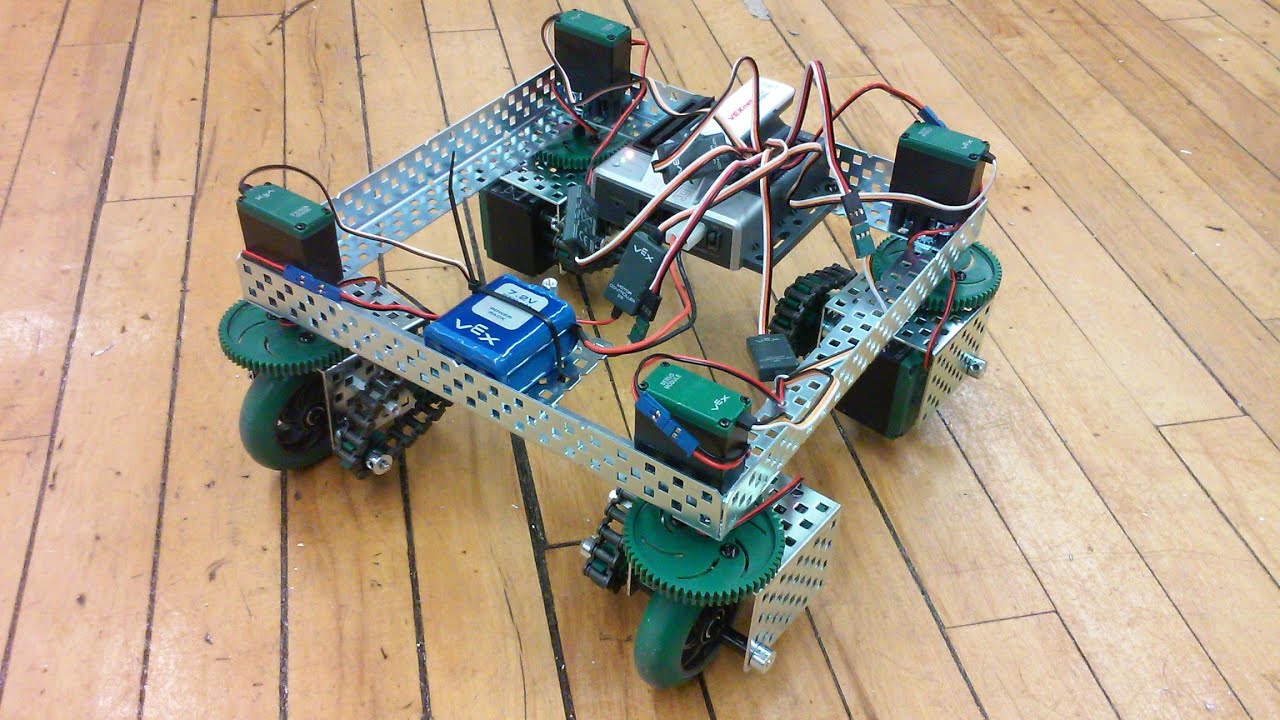
I agree that drives with transmissions are effective. However, it really depends on the possibility of controlling the transmission. For example, on our robot (and I’m ignoring the fact that I’m not even sure how we would build a transmission with the space we have left), we have 4 motors for the drive, 4 motors on the shooter, 2 motors on the intake, and 2 on the lifter. That leaves us with no way to actuate a transmission without removing a motor from something else.

Remove the lift motors, throw on a transmission on the drive. Apply a PTO on that same transmission to repower the lift with 4 motors to make up for gearing inefficiency and friction

We decided to go with speed instead of torque, as we felt that maneuverability and the ability to collect balls before the opponent is crucial. Also, as launching mechanisms develop and have reduced recovery times, preloads will be fired in a very short amount of time. A robot dedicated to shooting preloads and then lifting (likely to have torque chassis), is not very practical as there will be a lot of time where it won’t be doing anything useful. Further into the season, I think that a defensive robot would not be very effective, as the faster robots will have methods to outmaneuver the defensive robot and will probably not have a particular location where it can shoot balls, deeming a defensive robot useless.

This is kind of unrelated.
I’m going to make a faster tank drive train, and I have 4 motors left.
Does anyone know if I could use a 3:1 ratio? Or would that stall. I know that we could use a 2:1 ratio, but I want it to be as fast as possible. We only have 4" omniwheels.

Just to clarify how many motors total? I don’t think 4 motors could do2:1 and definitely not 3:1.

I saw 4 motors doing 2:1 quite a few times at the last competition without it stalling. Maybe I could find a way to add two more motors.
Edit: I want to clarify that they were default torque motors, not high speed or turbo.

Why not use elastics for the lift and have a simple pneumatic release?

SPEED ALL THE WAY!!! If you need to just chill, and shoot, activate pneumatic brakes. That way, it is virtually impossible to get blocked (depending on the height of your launcher).

Now someone is talking my language

For speed drives, how well would they fare when climbing ramps? Would they not stall out if the ramp has a high-grade (30+ degrees)?

I’d imagine a low-gear drive would help more than a speed drive, which would need a bit more momentum to get up.

Again, just speculating. Just wondering what you guys are thinking.

That depends though, if I am running an 8 motor turbo drive, I think I could still get on most ramps (that are viable). That being said though if I was using a 4 motor turbo(or close to turbo) drive than I don’t think it will be enough for the ramps I have seen.