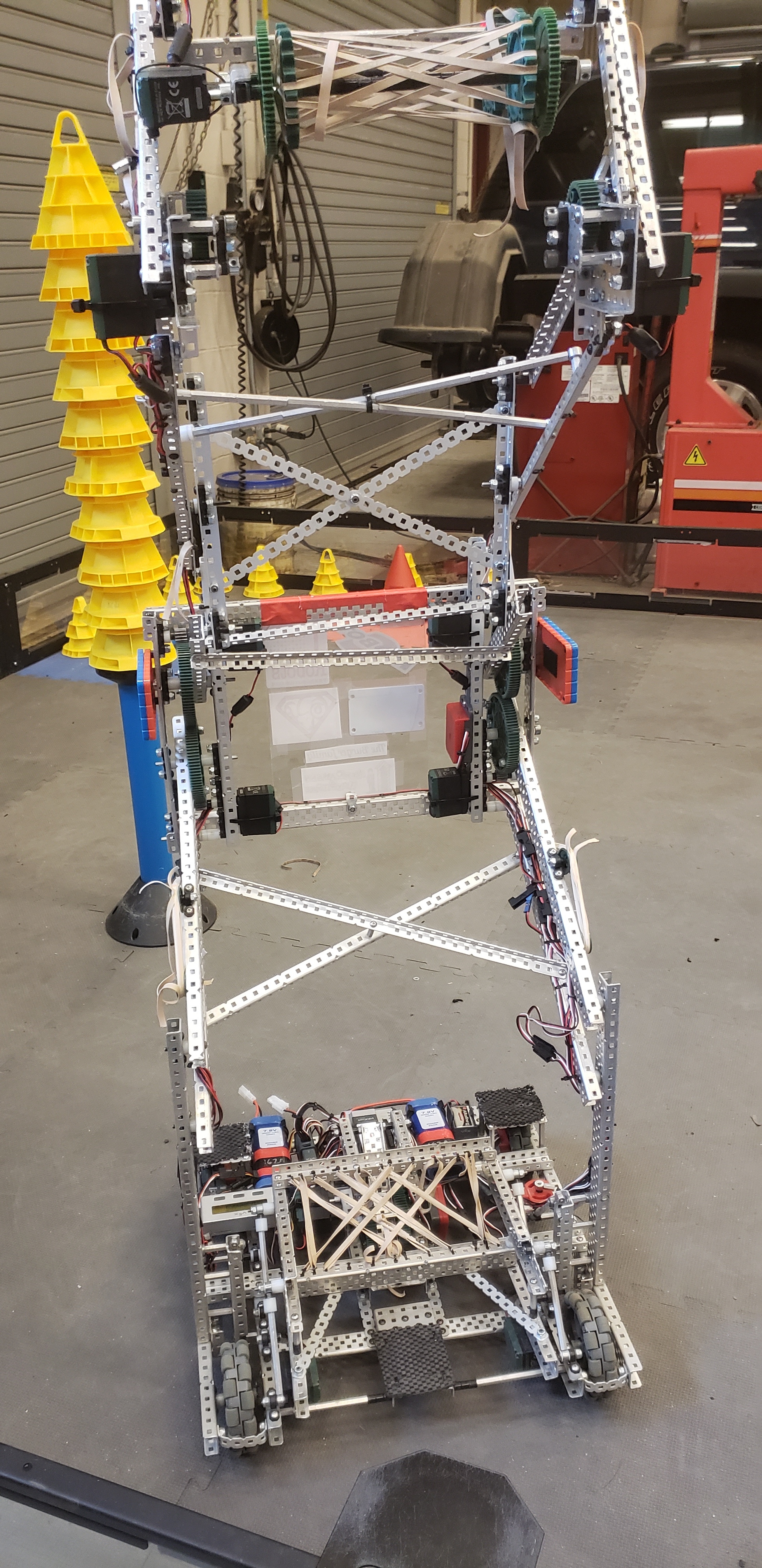
@Masterchief24 This is a great start but I there is always room for improvement so I will suggest some stuff at the end. The reason why it would be leaning to one side could be due to many reasons but will most likely go away if you employ these strategies:
- Make sure your lift is as symmetrical as possible. I noticed you are using aluminum angle as the bottom bars on 1 side and c-channel on the other. I would change that to c-channels on both sides. Also make sure your angles are exactly what you want them to be (ex. 90 degree angles for a rectangular gearbox, if it isn’t than the holes won’t be exactly lined up causing more friction).
- Speaking of friction try to eliminate that as much as possible. Any little difference between the sides can cause one side to need more power and therefore sway. This could be caused by the symmetry difference, bent gears, bent axles (even the slightest bend can cause a huge difference), etc… what I like to do is disengage the lift from the motors and feel by hand how smooth it is… it should be extremely easy to lift with just a finger. Also once everything is extremely smooth I add some white lithium grease just to make it even smoother (you would be shocked at how much this helps)
- On the bottom bars I noticed you have a random 84 tooth gear on the bottom most bars on each side. There is no need for them so I would just take them off.
- I also noticed you are using axle joints on those bottom bars, you should always use single rotating screw joints. There are a lot of forum posts already about these but essentially one piece of metal has the screw directly attached to it so it only rotates with the metal and the other piece of metal has the bearing so the screw only rotates in that bearing keeping it low slop and low friction. Make sure to keep joints as small as possible also.
- Take the other’s advice with the X-braces! Those are SO helpful! I attached a photo of an old robot of mine showing the x-braces to see what they are but they really stabilize the lift. You can try linking the gearboxes but these actually help way more.
- Once you are done mechanically stabilizing… very important that it doesn’t actually need this but as a backup I used to like to use encoders on each side of the lift to sense its position and correct for it using independent PID for stabilization, but this is not necessary and you should only implement once it is mechanically stable as a backup.
EDIT: Also make sure your motors are running properly and in the correct direction!