friction is negligible. i never remember the friction becoming a problem. ever. u have a point about chain snapping. That i’ve seen plenty of. But that only occurs when you make the chain SUPER tight. Just add another chain link if it’s too tight
friction, is definitely not negligible, especially on a drive. also, what advantage is there to chaining it all together?
instead of each wheel providing the power of one motor, each wheel can now have the power of two motors. Also makes sure they’re both spinning at the same speed. For programming at least it’s nice to know both wheels on one side are spinning at same rate
no, both wheels share the power of 2 motors. due to friction, each wheel will actually be slightly weaker than with my method.
They’re actually harder to push than an omni drive in most cases, since robots are usually pushed from the side. Since omni wheels have the side rollers, they easily get pushed, whereas if you have a mecanum drive and are pushed from the side, you can slightly strafe toward the opposing robot, and you won’t move because your opponent would have to have enough power to force all 4 drive motors to spin in the opposite direction which is extremely difficult. This takes a lot of practice though, and my team didn’t have enough time to fully master it. 7k was very good at this technique in TP however, and they dominated.
one issue all of you have neglected is weight distribution. say your bot is heavier at the back and lighter in the front. if you have four motors each driving a wheel and they are not connected, the strain on the back motors is going to be heavier than that on the front ones. That’s the reason we connect the front and back wheels.
EDIT:for Mecanum drives this would result in not strafing straight but there’s not much to do except to slow the lighter side motors down.
The vertically placed motor is for moving the front wheels?
What about mounting the mecanum drive system. Is it significantly more difficult to do so?
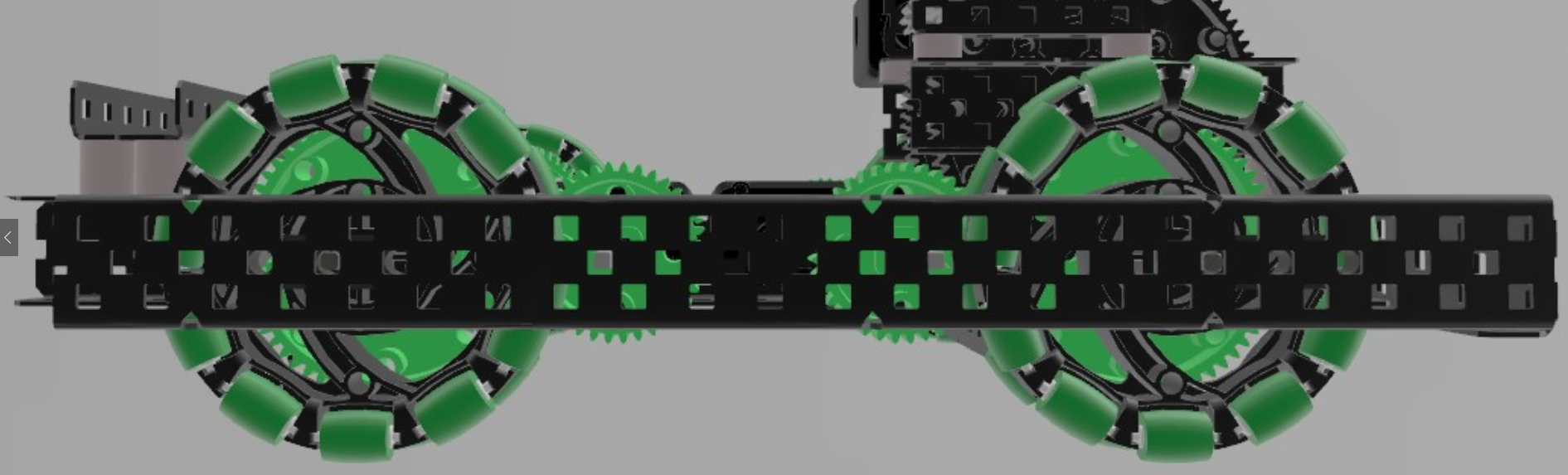
I personally run a 3:5 600 RPM base on 3.25" wheels to increase the overall speed of my base. In terms of drivetrain layout, it’s 25x25 holes with the motors allocated near the center of the robot. This paired with the brain and battery being very close to the center of the robot, I don’t have to rely too much on anti-tips to prevent my robot from tipping. maintaining a centered COG is always a good thing.
Does using 3.25" make a difference between using 4" wheels? I’ve only tried 4" wheels.
Personally, I prefer 3.25" wheels because they are a smaller overall size and they can be run slightly faster than the normal 4" wheels. Plus, they have mounting points on the wheel spokes that allow you to directly mount a gear or sproket to reduce slop in the base.
What about running over the goal zone barriers?
3.25" wheels put less strain on the motors, but 4" wheels travel farther for each revolution of the motor.
Which one has a better power to speed ratio? As well as functionally such as climbing over the field barrier to more precisely place cubes?
If you’re wanting to climb over the barrier than 4" wheels will be better because they have a smaller angle to get over. You could make 3.25" wheels with a faster gear ratio though because it takes less work for the motors to move them than 4" wheels.
I’m not sure what other functionalities to which you are referring.
Both motors move both wheels because you’d chain all three sprockets together