I thought the event in question was an in-person event??? That seems like physical contact would be a thing.
This is ridiculous. 1727G is not guilty of anything. They built a good bot and there shouldn’t be DQed for that. Those teams who were pushed around were to blame for their own loses because they decided not to build a strong bot.
although, please, go easy on rookie teams. Getting your first bot smashed by another team is horrifying. But none of the teams complaining were rookies.
If you are going to voice your opinion in this thread, at least get the team number right (it’s been mentioned here a bunch of times). It’s 1721G, not “1729G”.
There was still an expectation/hope in some regions that there would be some in-person events, even though Worlds wouldn’t be in-person, and many teams chose to optimize their robot for these events instead of LRT’s.
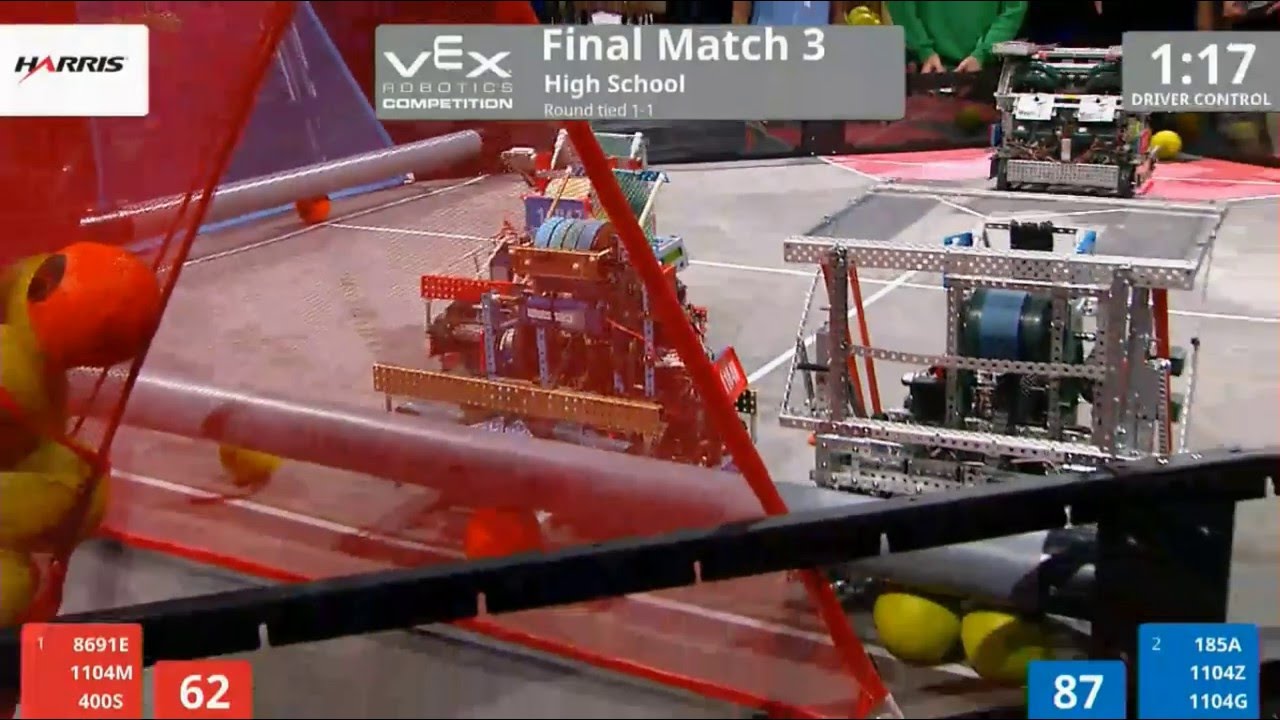
1721G was one of these teams who optimized for in-person events, but since this was a Showcase Event, they were also competing against teams from other regions who may not have had any in-person events, or may have chosen to optimize their robot for LRT’s or Skills.
I agree that damaging your opponent intentionally or by carelessness is unsportsmanlike, and that it would hurt your performance in any future matches where you’re allied with them if they are unable to fix their robot in time (or even in their matches with your desired elimination round alliance partners depending on how the rankings turn out). It might also make them less willing to ally with you in the future, although this would depend on how that team feels about your strategy. (If they would consider doing the same type of defense, for example, then they would be okay with you doing it, as long as they felt you didn’t go too far.)
In 1721G’s case, they did not intend to damage their opponent, although I do feel like there is a possibility that the number of times they unintentionally damaged their opponent in this tournament should have made them reconsider doing that exact type of defense in future matches, at least against similar robots. Nevertheless, I do understand why they would feel that their defense should be allowed as long as it’s legal, and would continue doing it, since all teams are supposed to be prepared for defense, and if theirs is within the bounds of what can happen at other tournaments, then other teams should be prepared for it.
This season was unusual in that a large number of teams might have designed their robots solely for remote competition, and could have gone to Showcase Events and other World Qualifiers without themselves or even other teams in their region having any experience with this year’s defense (except maybe from their teammates as practice). Most years will have some regions with more defense than others (or stricter rules about it), but this year was probably more extreme.
[Edit: 1721G, not 1727G.]
I refer you back to:
@Yuanyang1727G - It’s also worth noting that the referees were recruited for that tournament, that morning.
I was viewing the matches and noticed that multiple robots had defensive spikes and skirts.
Other teams were clearly prepared for some defense.
Were they playing much of the defense?
Were they playing defense as aggressively as 1721G?
Did refs say anything to them?
Also, come on, Taran.
The difference between 1721 and 1727 is like less than 0.35%.
Any engineer knows you can disregard such a small discrepancy. 
1727 is yy’s old school team and he had to reg as 1721 because his school was not doing it. They are the same.
This unfortunately I can confirm as one of the emcees during the event.
I would like to discuss the merits of the effective defensive strategies, but separate from the circumstances of this specific event. There are good reasons why RECF has procedures to address such specifics privately.
I could totally imagine that if I was a liaison for one of the VRC sponsors, like US Army or Air Force, and I saw defensive performance of 62A or 1721G at the Dome, I would be calling RECF to express my delight and excitement.
I would congratulate them on developing a great game that is well balanced. Where, to win on the highest level, you need to tackle both defense and offense and think both strategically and engineeringly outside of the box. And this is exactly the kind of thinking required for the designers of our future systems.
On the other hand, if I was a middle school teacher, taking my first year teams to the states. And I was teaching them all season long how to analyze the scoring and design the robot to play the game, and they were just starting to understand gear ratios, and were almost having their intakes working, and were beginning to be proud of their season’s work and, finally, starting to gain some confidence…
And then a team showed up with 8 motor pushbot and destroyed everyone at the competition, causing my students to come to me almost crying and saying that they don’t think they will be returning back to robotics next year…
Well, I would definitely not be delighted because, just as my students were making fragile progress and building some confidence, somebody slapped together a pushbot over the weekend and threw all our season’s hard work and progress under the bus. And it caused damage to me, personally, by taking away my students’ motivation to participate in VRC, which is an important tool in my teacher’s toolbox in getting them to learn about engineering design process, gear ratios, levers, programming, etc…
You could say that this is an over-dramatization and not all students will quit, some will learn from this, and come back next season, determined to build better robots. And, if students are not ready to learn about game strategy, maybe they should stick with VEX IQ, where everyone is nice and friendly, and winning strategy is teamwork and not an aggressive driving.
To which I will reply that sometimes IQ is not an option, and not all first year students are ready to talk strategies, and that GDC should have done a better job balancing the game at the beginner level, so that dumb aggressive pushboting is not going to get you enough points to be unstoppable.
I don’t think anyone is going to disagree that VRC mission is not to find the “best” robot, but to guide students through the process of learning and to provide motivation.
This should work for the beginners, where skills and progress are fragile, and all the way up to the expert level, where skills are robust end everyone is ready for heavily strategic and defensive play.
However, then we arrive at the contradiction, because all VRC teams compete in the same environment, governed by the same set of rules listed in the Game Manual, but we would like to have slightly different environments, best suited for each skill level, to achieve our main goal of optimal students’ motivation and education.
One way to avoid such contradiction is to design the game with intricate scoring levels and protections. Another way is to have people running the events understand very well both the game rules as written and the ultimate goals and mission of VRC and how they could achieve them by exercising some freedom and discretion within the official rules interpretation.
But you have to be honest: not everyone who is associated with VRC has fully read and understood the Game Manual and watched all VRC training videos. Many people, some of whom are charged with running competitions, think that they know better and come with preconceptions about the game rules, that may be totally wrong, and without realizing it. Also, it is not helping that VRC terminology is sometimes very confusing to outsiders.
For example, even after many years of spectating VRC, it still confuses me that aggressive driving and contact gameplay is called “Defense”, while the peaceful attempts of the robots to mind their own business and score game objects is called “Offense”.
Also, I find it extremely confusing that the “Design Award” has almost nothing to do with the effective robot design and is actually documentation award and, as of recently, “Innovate” award is no longer for innovative robots but is a second place documentation award.
My point is: despite RECF attempts to communicate VRC rules with Game Manual, training videos, volunteer guides, and certification programs, there will always be individuals who misunderstand game rules thanks to their preconceptions about how the game should be played.
I am not really sure what else RECF could do to improve consistency of applying game rules by the volunteers, who may have signed up the morning of the competition, and are tasked to judge or enforce the rules, while having very vague understanding of what’s going on.
P.S. I did in fact witness a middle school team who’s driver was ready to burst into tears after being pushed around by a basic multi-motor pushbot. It was perfectly legal, but wasn’t amusing, wasn’t cool, and was painful to watch as the “offensive” robot was struggling to score.
On the other hand, when my son’s high school team went to U.S. Open with a robot specifically designed to resist heavy defense, it was still mercilessly pushed for the whole duration of one of the qualification matches by a skillfully driven defense bot. And that was, actually, ironic and fun to watch.
We aren’t here to teach snowflake engineering principles; while this opinion is unpopular with many, you must teach how to plan for real world interactions rather than hypotheticals on paper.
I agree with this. I watched the live stream for the event (thank you to the EP and all volunteers for a great event) and it seemed that a lot of the robots that were breaking were the same robots throughout the day. As a competitor in Vex for 7 years now, I know that there is a progression that you go through as a competitor and one of those steps is learning to build stronger and more reliable. If encountering a robot-like 1721G forces you to speed that process up(as it did for several teams this year (we changed some stuff after competing against them), that isn’t an awful thing.
I wouldn’t put all of the blame on these certain teams, some of it does stay with YY and 1721G (which they respectfully acknowledged) but I feel that the robot that is being defended against should take some responsibility. Especially if they have exposed chain or rubber bands at the height of someone’s intake. That is just asking to be broken and isn’t really another team’s fault IMO.
“consistency and repeatability is a hallmark and pillar of all engineering”
Now for some side notes:
- Thank you again to the EP, and all volunteers for hosting this event (although I did not attend, I appreciated the live stream)
- YY (and 1721G) congratulations on divisional finalist and a great season overall.
100% Agree. Don’t build bad and complain when u break.
- Aryan, you might be right here but this was phrased in a mean way
- @technik3k I fully acknowledge what you are saying and completely understand. In my 6th-grade state finals(SR), we lost to a 8 motor push bot with the claw bot arm on it. But I also think that this forced us to progress our design for the next season (we decided on a holonomic so we could “push from the side”). But yes, it is unfortunate when you learn this from a defensive robot