I think those would count as traction wheels
there is literally zero point to this as locking the rollers does not change the friction coefficient at all. Basically I’m looking for legal ways to increase this coefficient.
EDIT: grammar mistake.
you cannot legally change the coefficient of friction of the 3.25" omni rollers.
is your center of mass roughly centered on your robot? if not, try climbing with the center of mass oriented towards the platform, sort of like how a biker would lean forward when biking up a hill.
Using light pine tar on the wheels would increase their traction and reduce slippage and would be virtually impossible to detect, much like any naturally sticky substance that might be present on the tables, tools, etc
Applying pine tar to your robot’s wheels would be a clear violation of R6 and possibly also R4.
Applying pine tar to your robot’s wheels while knowing it’s illegal and hoping no one will notice would arguably also violate the REC Foundation Code of Conduct.
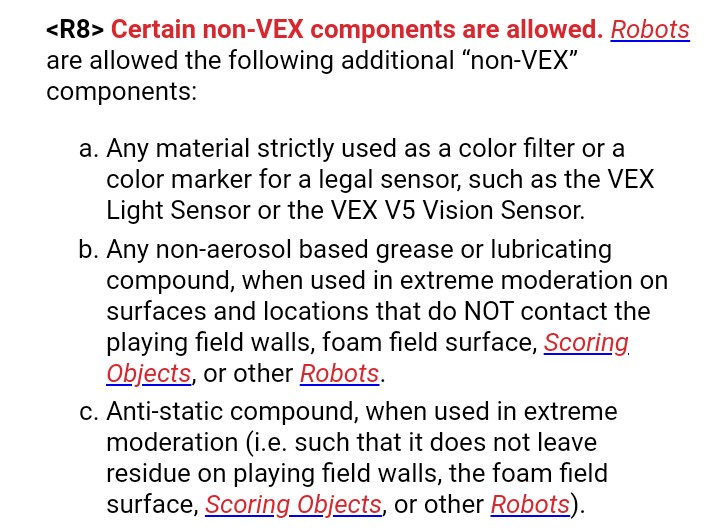
If pine tar has antistatic properties it would be vrc legal under R8c:
I am not suggesting to boil your wheel rollers in a bowl of antistatic tar, but there is something irresistible appealing in that idea.
Seriously, as @Xenon27 said you, probably, have center of mass issue. If your robot is back heavy, did you try to drive up the ramp backwards to see if that helps?
Using it to remove the crud/dust/hair from the wheels would be illegal? Isn’t it just a form of cleaning the rollers that typically are less prone to slipping when they don’t have residue from the field on them?
Ok actually I can see why my statement was misleading;
*because it is able to remove the crud stuck to the wheels that comes between the rollers and the surface.
*because in light amounts the stick won’t provide any significant value that the rollers don’t otherwise have when they are clean. For example, if the wheels contact a sticky surface on the table, it is hard to detect because of how little it impacts the traction. This is why I said:
Light pine tar pulls general smudge off the wheels that interferes with the traction between the wheel and the surface, while having minimal impact on the wheel. Used lightly it can be effective in this regard, but to use it to the extent that it is inherently better than a clean, fresh rubbered omni with no pine tar would be quite obvious due to the marks it would leave on the tiles
Assuming it did have anti static properties, which I’m sure it does not, to use it to an extent that it would actually be useful would very likely leave marks on the field which would be obviously illegal.
Ok, I had read that and thought, “That doesn’t sound like @JD6…”
If you’re just using the pine tar to clean the wheels (i.e., return them to the same coefficient of friction they had when they were new), and no pine tar remains on the wheels after you’ve done that, then I think that’d be OK.
If you’re applying pine tar to the wheels as a sticky material that will stay on the wheel and thus increase its coefficient of friction, that would violate R6.
That’s definitely the idea, but it isn’t unreasonable to expect a small degree remain on the wheel, much like if the wheel was to rub against a table that had glue on it. The robots don’t exist in a perfectly isolated environment