Indeed, we have a lot of real world examples that can do better in the civility department. Alas, they are outside my network of contacts.
Yep, lots of people out there getting G1 fault cards on a regular basis. One of the best things about VRC/VIQ is the cooperation factor. We did an event that the robot team didn’t have a robot, lost in the luggage. Teams gathered spare parts and built a pretty good replica of the robot they had shipped. They got to compete, and did pretty well all things considered.
Mom always said “It’s nice that you are important, it is more important that you are nice.”
For a lack of a better place to put this, I disagree with the ruling in this Q&A Low Goal Barrier Trapping : Robot Events. The TLDR of this Q&A is that if a robot is being trapped against the barrier but is faced such that the wheels are in position to drive over the barrier, it is not a trap regardless of whether the robot can or cannot drive over the barrier.
One issue I have with this is when it says, “A Robot that cannot cross the Barrier in that configuration has taken a calculated design risk, whether consciously or accidentally.” If we take this to the logical extreme, any robot being trapped could have made a “calculated design risk” to not be trapped in any particular scenario. For example, if someone’s robot was a base plate with license plates and and electronics, they couldn’t be trapped, having wheels is a “calculated design risk” that allows teams to be trapped. Or a more applicable example, there are two robots in my region that have transmissions, if a robot is being trapped, not having a transmission to push themselves out is a calculated design risk. Or in last year’s game, if a teams robot was smaller, it could have avoided being pushed under the platform.
Even if we ignore all of that with G3 as an excuse, another large issue is the actual gameplay. Vex has always been about the offence, with scoring robots getting the benefit of the doubt, this ruling contradicts that. Spin up already has a lot of defense(depending on the match), now if a team is able to push another against the barrier, they can effectively take each other out of the match. This can give a huge incentive for teams to do nothing but play defense.
One other things that makes no sense, is the reference to wheel orientation. First of all, not all robots have to have wheels. Second of all, how can you determine if a robot’s wheels are perpendicular or parallel to the barrier in the case of an X-drive or meccanum drive?
Another thing is, if you have to design your robot to not be trapped, here is another scenario. Red robot is keeping position in the corner of the field. Blue robot is stuck. However, blue should have considered building their robot short enough to drive under the roller therefore there shouldn’t be a trapping call.
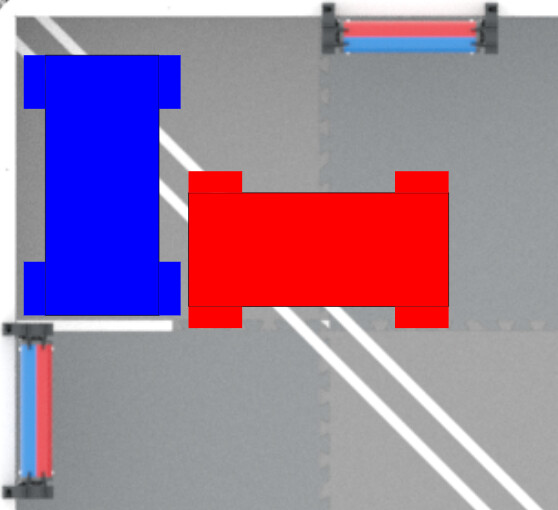
Might be worth asking a follow up. Very much seems that the GDC is trying to say there is a correct design. No where in the game manual does it say that there is any advantage to driving over the barrier.
Or they can push a team onto the barrier and drive away. I get the concern about refs ruling on wheel orientation in the moment, but imo the fundamental issue here is that teams should account for the fact that there is a barrier in the game. Ignoring the barrier while designing a robot then seeking protection from defense aimed at that design decision (or being alarmed that this defense might ruin the game) is not reasonable.
Last year teams made low clearance bots to avoid getting caught on ringles. This year they look at the discs in the same way (with good reason) but seem unconcerned about the barrier. Both discs and barrier must be accounted for in drive base design.
The way I see it, the team did account for the barrier, they are not getting stuck on the barrier. And regardless of the design that a team team chose
I think if a robot cannot go over the barrier, that is not an avenue of escape, just like how if a team cannot push their way out of a trap, that is not an avenue for escape.
So, if it is a design issue that the teams are getting trapped when their wheels are perpendicular to the low goal (I don’t agree, but I can see that argument), isn’t it also a design issue if you are trapped with your wheels parallel to the low goal? Why did you design all of your wheels go in the same direction? There are many drivetrain options that allow for movement in all directions.
This is really relevant to me as a coach, EP, and Ref.
It looks like they are correct, as dumb as it feels.
“Trapping” - … s restricted an opposing Robot into a small, confined area of the field, approximately the size of one foam field tile or less, and has not provided an avenue for escape.
Yeah so if you provide an avenue for escape, but the robot is incapable of making said escape due to design choices that made the robot’s performance unreasonably limited, then it is not trapping.
If you push an opposing robot up onto a disc and they get stuck, you did not put them into an unreasonable situation. Same with the ramps.
Also, pushing a tank drive robot against the wall such that they are parallel is not providing them with a reasonable avenue for escape, so trapping begins, assuming the trapped robot attempts to get away (and isn’t like aiming or something).
This game has the best and most honest defensive options. Boxing out a wall roller provides for some great 1v2 moments, ramming robots, boxing in to the low zone, and walling out endgame. So much good stuff.
I am reffing a league night tonight. Lets see how this goes.
Wasn’t a tank drive a design choice that doesn’t provide them with a reasonable avenue for escape?
For that matter, wasn’t not building a low-torque drive that allows a robot to “out-push” the trapping robot a design choice?
Turtles, all the way down…
Your robot could have easily escaped if you had made a 20 hole by 20 hole 100 rpm 2.75 inch x drive.
Its starting to look like trapping can’t exist, because for every trapping scenario, a hypothetical robot could escape. Therefore, you made a design choice not to build this hypothetical robot and the trap is your own fault.
That said, I’m actually fine with the GDC’s ruling here, though admittedly it leaves open how to rule for an X-Drive, where this situation actually cropped up in a finals match. I wholeheartedly agree with the ref’s ruling, and tip my hat to the detailed analysis and explanation

This happened at a recent tournament in Taiwan. The referee discussion is mostly in Taiwanese Mandarin, but you should get the just if what he is saying:
Edit: snubbed by @ Mentor_355v. But as he said, I do agree with what the head ref did to reach this ruling. Instead of simply saying “design choice” and moving on, he actually got 66799A to show him that their X-Drive has some troubles crossing the low goal barrier. He also used another robot (after the match was scored) with a different drivetrain to show how they could cross the barrier (thereby confirming the “design choice” decision).
(Also holy crap there was a lot of ref discussion it was hard to decide what to put without making the video too long if you want to see the full ref decision I’d suggest you watch the livestream).
Hi, head ref of that match.
Though this wasn’t the exact scenario in the Q&A, I had to use it as a way to give a fair enough ruling.
The trapping was from inside the low goal so there is that slight ramp, instead of the flat surface.
66799A is an X-Drive so parallel and perpendicular doesn’t really apply.
This whole discussion here was basically what was going through my head during this match.
And a whole lot of other quirks and details. I also can think of many other ways this could go very wrong. There is also the consideration of indirect trapping. Anyways… Not the way I’d like a finals match to end, but it is what it is.
Quick translation:
A badly made h-drive perpendicular to the low goal barrier that cant climb over the low goal will not be considered trapping.
The x-drive could partially climb the low goal. So it is then basically the same idea as a badly made h-drive. And as i know how to build robots, I could see that if they just added one more spacer or just a flat bar, they could have crossed the barrier.
Also, as we cannot expect all head referees to be people who know how to build robots, any other head ref could only say it is a calculated design risk. As they cant really determine how well the robot should be able to preform these tasks.
Yeah, I’m very torn here. I’ve seen a match where there was a robot pinned to the low goal for over a minute. The other robot just held them there.
Definitely two schools of thought - 1) Don’t make your robot susceptible to that. 2) If it looks like trapping, feels like trapping, smells like trapping … common sense is that it is likely trapping (especially when you are supposed to rule in favor of the offensive robot).
Very torn, but will absolutely ref as the Q&A was answered (a blend of #1 and #2 above). 
The cleanest answer would be to state trapping against/on the barrier is not possible. That would solve the issue of ref’s having to assess design decisions and robot build choices. There are bound to be G3 cases where trapping does happen at the barrier, so the GDC tried to give guidance which this thread is picking at with “turtles all the way down” scenarios.
The reason you might make a blanket no-trapping-at-barrier rule is that the barrier is a known factor in the design process, and avoiding being trapped on the barrier is a solvable problem. Avoiding being trapped against the perimeter is not a solvable problem. In past games there were field elements you could be trapped near because they were too tall to drive over. That is not the case this year.
Clearing a 1" vertical face is a trivial design problem with vex parts. Seeking an out to solving the design problem by pointing at trapping is not reasonable. A core problem of the game is dealing with the discs and the 1" vertical face.
The thing is any team could argue that because a team used a certain drive configuration, a certain speed of gearing, amount of motors on drive, could allow the team being trapped to escape. The point is that a team’s decision to not use a high torque, high traction, holonomic drive is a calculated risk in terms of trapping.
This is a bit more unreasonable but a team could argue that since a robot could not hop over certain field elements, they took a calculated risk that they wouldn’t be able to escape in the case that they were completely boxed in by elements.
These are ridiculously exaggerated scenarios but kinda show what the problem with this ruling is.
Time to abuse this until they overturn it… I guess
This wouldn’t be trapping even without this ruling because you have to be trying to get out of the trap

I think the best way to point out the obvious flaw with the justification is that a robot that was made for speed and not torque being pushed against the wall, with wheels perpendicular to the wall, would not be being trapped under their logic because they took a calculated design risk of not having a lot of torque