In their 974x reveal thread @Cyber brains mentioned that they have switched from IME to QuadEncoder for better flywheel control:
I figured out it will be easy for me to do this experiment. I connected quad encoder to the axle marked with 650 RPM on the diagram in the previous post. The IME encoder gear is the one on the axle marked 3185 RPM so you can see how many components there are in between.
My setup is not as clean as 974x’s. While my encoder is just one chain link away from the flywheel, it is still in the power delivery path. In contrast, 974x have placed their encoder away from the power path and should get very clean readings physically smoothed by the flywheel.
In my setup IME velocities and accelerations are computed the same way as in the earlier code (few posts above). Raw-QE velocity is reported every 5 msec, and computed based on the difference between current quad reading and the one it had 20 msec earlier. Then Smooth-QE is computed by exponential smoothing Raw-QE values with a=3/4.
Here is the resulting graph:
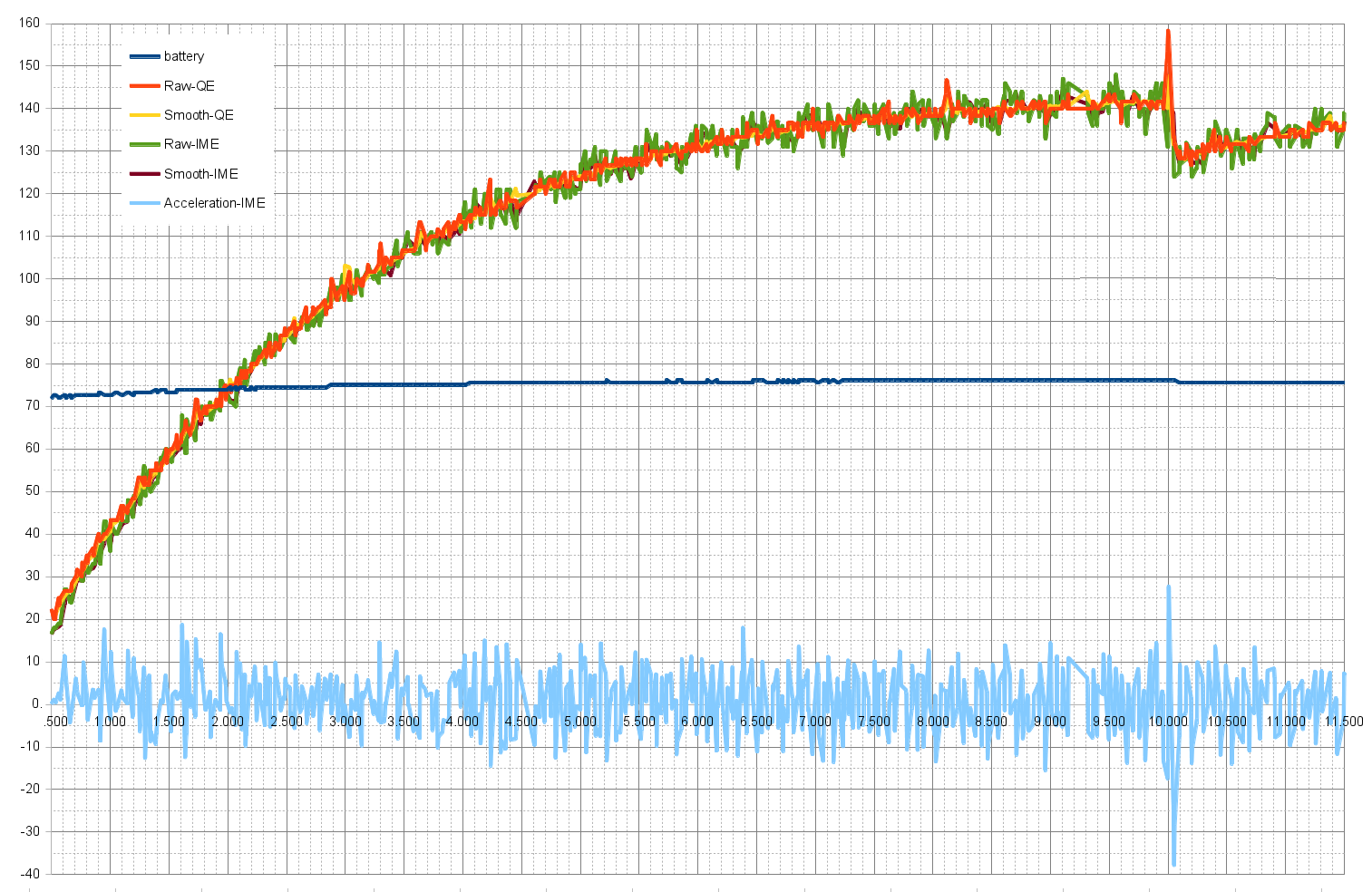
You can immediately see that there is less noise in the velocity reported by the quad encoder (red) then by IME (green). However, some noise is still present, including few spikes.
Now lets zoom into the portion of the graph where the ball is being launched:

It looks like Raw-QE velocity (red) has at least half the noise of the Raw-IME (green) and is on par or slightly better than Smoothed-IME. However, if you look at Smoothed-QE line (yellow) you could see that it is much more stable and noise free than any other curve.
So, if anybody wants to have super accurate flywheel telemetry, they should take @Cyber brains advice and mount Quad Encoder away from the power path or, at least, as close as possible to the flywheel and apply some sort of smoothing in software. Just be aware that encoders should not be run above 1133 rpm or you risk damaging it or getting incorrect values.