This is some impressive work. Well done and thanks for sharing.
For the worm gear/screw, how many revolutions does it take to traverse that length? And does that translate nicely into IME counts or quad encoder counts which then gets you to a launch angle (which would depend upon placement of the worm gear)?
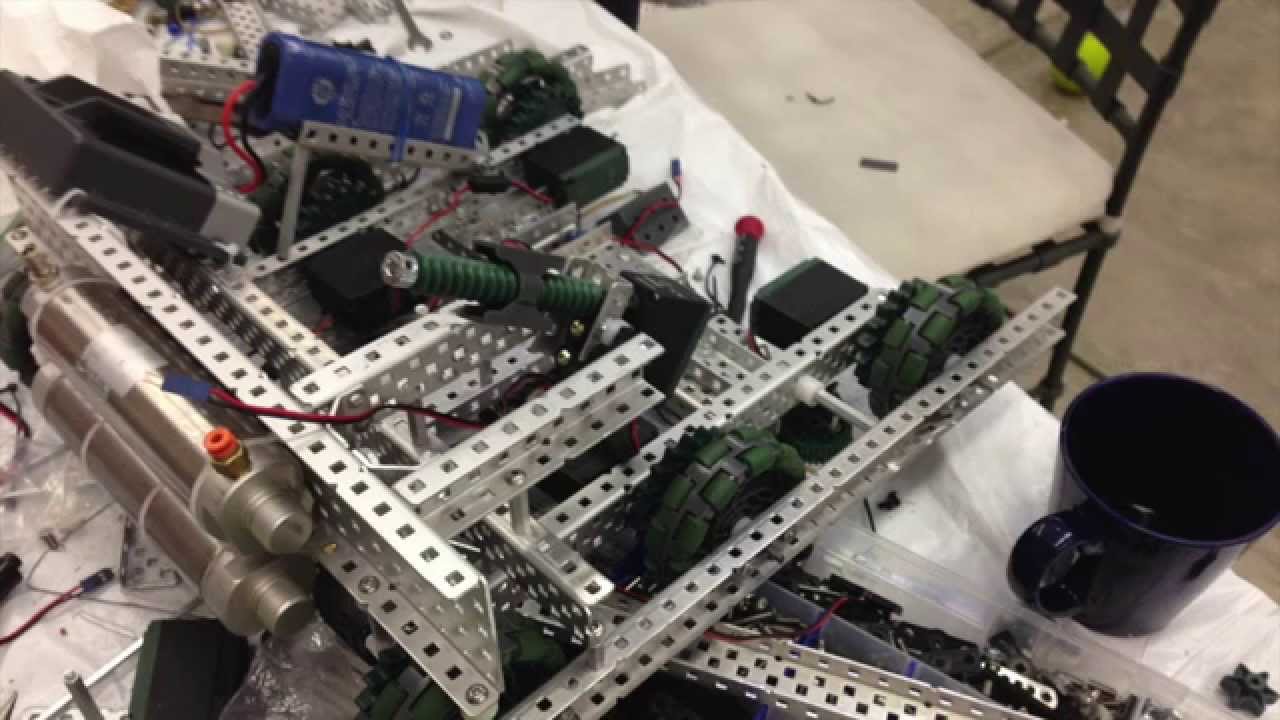
We went with the worm gear for a few reasons. We weren’t too concerned with speed since as long as you can get to the correct position in less time than it takes to intake a ball and line up, then it is fast enough. The most important thing about the worm gear though is that the recoil from the shot won’t be able to backdrive the tilt and affect the shot. Not sure how many rotations it takes since we didn’t play around too much with sensors but it takes around 3-4 seconds for the whole travel. The nice thing about the screw drive is that no PID is required and encoder values translate nicely into position and since it takes a lot more revolutions than a normal pinion and spur gear you can have a much wider range of error.
While talking about strategy, we decided that we should shoot our 4 preloads and attempt to get a stack of balls on the field and shoot them for the earlier competitions. We did not have enough time to complete autonomous programming during the three days. However, we will be improving this robot, including programming autons, over summer for sure.
If this were to happen, we would probably have multiple autons that would go where the opponent is not. On top of this, we might program some autons to play defense and interfere with the opponents auton. Once we update the robot and program a successful auton, I will post a video of it. 
Hey guys awesome robot! I really like the rate of fire on that thing. But I was wondering about its accuracy compared to a flywheel. It was hard to tell from the video and just thinking about it it seems like this method would not be quite as accurate as a flywheel because its just hitting the ball with no spin. Wondering if you could fill me in on its accuracy? Thanks
I would suggest watching this video.
The accuracy of a flywheel depends on the battery voltage heavily, this does not.
The accuracy of a flywheel is effected negatively by increasing the rate of fire, this is not.
The accuracy of a flywheel depends on the traction of the tire on the ball being the same with different balls and over time, this does not.
I would say the accuracy of the flywheel is dependent upon maintaining flywheel velocity over voltage. Measuring velocity and only deploying when the velocity is back at the right level should help. Whatever full power gives you torque wise may be different.
So I was trying to estimate, but couldn’t tell. How far can it shoot? Also how long does it take to get 4 balls?
The accuracy of a flywheel depends on the battery voltage heavily, this does not.
The accuracy of a flywheel is effected negatively by increasing the rate of fire, this is not.
The accuracy of a flywheel depends on the traction of the tire on the ball being the same with different balls and over time, this does not.
I have to disagree quite a bit.
While yes, the consistency of a no-feedback wheel-type shooter would be affected by varying battery voltage, all it takes is a simple encoder to determine the actual RPM, and a simple control loop to maintain a desired RPM, to get the consistency that is desired. And in that sense, the pinball-type shooter requires an encoder already to change the angle in order to achieve varying ranges, so a wheel-type shooter needing one to maintain an RPM is not very different at all.
The second point you make is completely wrong. Did you watch the original video? At [1:13 they show an example of a “rapid-fire,” and the accuracy of the shots was quite terrible. Obviously, there needs to be a certain amount of delay between shots in order to allow the balls to settle before firing. I believe that there are (and have seen) wheel-type shooters that can shoot much more accurately at a much higher rate.
The last point you make is true. However, I believe that if you increase the traction of the wheels enough, the small change of traction due to wear on the ball will not affect shooting accuracy enough to cause a problem. I could be wrong, but I doubt any balls used in competition will be allowed to have enough wear on them to cause a significant reduction in accuracy of such a shooter.
In no way am I trying to say this pinball-type shooter is a poor design, or even that it is worse than a wheel-type shooter. I just don’t think that the particular points that Griffin made to say it is better than a wheel-type shooter were rather unfounded or incorrect.](“https://www.youtube.com/watch?v=aInhRRiSF7E&t=1m13s”)
This is a nice implementation of a roller cam-follower powered piston launcher,
and its great to see alternatives to the zillion wheel launcher calculations.
A possible enhancement would be to have the two motors drive the two cams + 2 springs independently, that some how allows spring strength to vary, instead of using pneumatics. Or control the shape of falling cam step such that motor speed at release can change launch characteristics.
Where did you get the shape of the cam?
Did you calculate the shape with the spring geometry and hook’s law to make the motor torque requirements constant per cam rotation?
If you didn’t do this, I’m guessing the cam radius grows too slowly at the start, and too rapidly at the end to be optimal; But its not obvious by the motor sounds in the video, so its probably not an important optimization to make, other than impressing some judge in the notebook competition.
Fantastic work.
I wouldn’t say the accuracy was “terrible” in that shot. 3/4 of the balls landed in the same spot and the one that went off to the right was because it hadn’t settled before it fired. We did tests from 20 feet with 7 different balls and marked where they landed with sticky notes and it consistently hit the same post it note (6/7 times). Also remember that our long shots will be fed from a separate hopper for driver loads which will remove a lot of the bouncing around caused by the intake flicking the ball into position. Our short shots happen from right in front of the goal, so we could shoot much faster without worrying about variance much.
It is way too early to say which is better, but I think both have their advantages and disadvantages. Remember that we only had one day to prototype and three days total, so many improvements could be made to what we came up with.
What is the exact sizing of the nautilus gear compared to the one provided by VEX?
In your explanation video you showed closer photos of the launching system and from what I can tell the screws that hold the rubber bands on the piston part seem to be bending quite a bit. Do you think this will effect the consistency of the shots over time? And if so would this be an easy fix during competition?
The site you provided for the rubber bands comes to 17$ after shipping one box of the alliance sterling rubber bands while the total price on amazon is 16$ without shipping, now if you have prime that’s all you pay. So it would be smarter to buy through amazon with prime. I’m planning on buying them from amazon or eBay from a buyer that offers free shipping. Also from the bulk supply website there are no costumer reviews, you have to pay return shipping and there may be a 20% restocking fee. The safest would be through amazon with prime.
I forgot to mention, the website I linked to has multiple locations across the US and you can pickup if you call them. I haven’t ordered from them, but it would probably only be much cheaper if you buy lots or pickup. As a side note, #32 rubber bands are usually used for mail and newspapers, so if you’re not looking for the high quality ones you can probably get a bag for free if you ask the right person.
Terrible probably wasn’t the right word I was looking for, but it definitely wasn’t ideal. The first and third balls appeared to land roughly 8" left-right of each other, however the second ball didn’t make it past the cardboard you had set up. I do understand that this can be improved with modifications, and similar issues can come from an early build of a wheel-type shooter.
However, the claim that increasing the rate of fire with this type of shooter doesn’t decrease the accuracy of shots, while it does for a wheel-type shooter is quite simply wrong. The only reason that this type of a shooter would be more consistent is purely because of how slow it is. If a wheel-type shooter is given a similar amount of time to be brought back to speed, I am confident that it could achieve similar accuracy.
I agree that both shooter types have their advantages, and I’m excited to see what happens now that you guys have put this out there, especially after nearly everyone has seemed to jump to wheel-type shooters as the only option. Since I don’t think I said it already, great work on this robot. It would be impressive if you had spent the whole season so far working on it, let alone 3 days.
bah. 3 days? how about robot in 3 minutes using raw materials.

FTC legal although not this coming season because we’re moving to Android devices.
I can’t say for sure (as I didn’t design the robot), but most of the time, just fixing a little piece, or even a simple assembly, is quite easy and doesn’t alter the consistency at all. At states last year, we even rebuild one of the stages to our elevator lift, and continued to do fine. Given the inherent flexibility and flimsyness of a lot of the VEX parts, this sort of thing happens all the time, and it usually isn’t a big deal. Hope this helps.
It shoots about 20 ft. It can shoot a ball every 1.3 seconds.
While this is true, it means that you have to run the motors under max power, so that when the battery voltage drops, the program can increase the power to compensate for the voltage drop of the battery in order to achieve constant velocity over the time period of the match. This means that if you want your velocity to be the same through this program, you are not going to get %100 of the power out of your motors. With the pinball design, you can always run the motors full power and get the maximum efficiency out of them.
The second point tabor made was not “completely wrong”. This video was made in a couple hours rushing. If you watch the video at that point, you can see that it is very possible to feed the balls into the shooter without having to slow the shooter down. In order to time this right, I have developed a program that uses a couple of sensors to feed the balls in perfectly. In fact, we are now thinking of speeding the shooter up because the balls feed in so flawlessly. If i get some time, i will take a video of this new system.
I have only seen one flywheel that can shoot faster, however it used 3 motors. If we are comparing shooters, we should take into account the number of motors. This flywheel had 33% more power, meaning that it should theoretically shoot 33% faster. I would be interested in seeing a flywheel that is more accurate. You can not compare the rapid-fire shots in the reveal, because the balls didn’t settle. It would be similar to feeding the balls in wrong to a flywheel. If you watch the documentary on the ri3d you can see that the balls are very tightly grouped together. If you come upon a 2 motor flywheel that is more accurate than this, please share!
I agree with wear of the balls not effecting the flywheel, however I do think that the density of the balls will greatly effect the shooter. I have head some people on the forums that state that the density on the balls can cause their shooter to shoot “from 20 to 5 feet”. While it might not be this dramatic, I do believe that it will noticeably effect the shooter.
We used an online nautilus gear calculator and photoshopped the gear teeth off. The “drop” on the nautilus gear is 4 1/4"
This was actually an early problem, however “boxing” the steel c-channels that the rubber bands were fixed to solved this problem. The slight upwards bend on these screws are caused by the screw going through the “boxed” c-channel.
This is not true, the piston will fire the same distance and velocity every time you shoot, no matter how fast you pull it back. This is a much different story with the flywheels, they lose momentum every time you shoot. While it is true you can semi-counter this by adding more weight to the wheel or have a program that compensates for this, the fact still remains that you will not get the exact same distance and velocity with every shot.
This is completely wrong, based on our testing we found that, even if you feed the balls in very slow, the flywheel still tends to have more variables, resulting in a less accurate shot. Our testing could have been completely wrong, we only had 3 days. Please change my view on this and show me a 2 motor flywheel shooting at this speed and consistency.
I think it is too early to make so many assumptions, and obviously I was only going based on what was shown in the video you created.
Since most of your points were in regards to the number of motors used, I will answer to that. You neglected to mention that a pinball-type shooter requires (and on your robot you used) a third motor in order to have a completely variable range of fire, whereas a wheel-type shooter can simply vary the speed at which the wheels spin, so motor comparisons between 3-motor wheel-type shooters should be fine to make. In your second video, you seemed to have similar results between a wheel-type shooter with backspin and your pinball-type shooter, although the wheel-type did not shoot far enough. However, your test was with 2 motors, whereas it could have used 3 motors, which (as you admitted to seeing) allows for a good consistency and a long enough range.
If we can agree on that, then running the motors at a lower power is irrelevant if a 3-wheel shooter is able to make a full-field shot at a slightly lower power. Technically, this isn’t necessary anyway, especially if a bike wheel type ratchet system is used, that can allow the motors to slow down without actually slowing the speed of the wheels, then apply more power when firing.
As for the variability caused by the density of the balls, you didn’t seem to have very much trouble with that with your own tests with a wheel-type shooter (at least not anywhere near 15’ of change), and most other teams have not reported that much variability. The person who experienced this had probably not built their shooter very well.
My point about increasing the rate of fire decreasing the accuracy was made based on the video you created. If balls are required to settle before an accurate shot can be made, obviously some amount of delay must occur between shots. Unless this pinball shooter can be sped up quite a lot, I still believe that wheel-type shooters can be faster. If you do get video of a faster pinball-type shooter, feel free to upload it. 