V5 brain ports break continually

Just had port 8 die on my brain… sigh
900mm stock cable, no visible damage to the cable or either port. Cable was not zip tied at all and was really loose (didn’t ever get snagged). Motor was barely ever used, and was not being used at all when port died (was in active braking move though, but was not binding up against anything).

Edit: And now the motor on port 6 has randomly reversed itself!? A reboot fixed the issue, for now, but what the heck?

In my opinion, anti-static spray is a mistake. It gums up the fields and doesn’t even do that good of a job at reducing static for extended periods of time. The correct solution is to electrically ground the fields. Since the Virginia State Championship switched to electrically grounded fields mid-event two years ago, there have not been any issues at that event or any other events that I know of that electrically ground their fields.

-Mike

I agree. I’m just scratching my head that anyone would consider anything different. This works like a champ and has zero impact on robot performance. This is fundamentally the correct way to eliminate static since potential voltage can accumulate on ungrounded surfaces.

how did they do that?

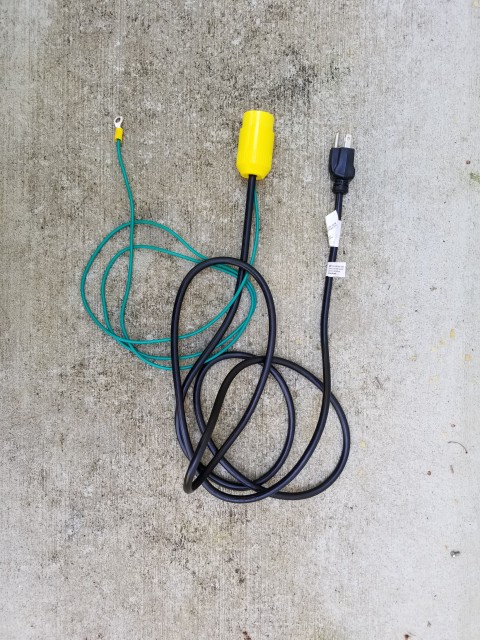
I think with cords like this:

With a cord similar to this one (the green wire is attached to the perimeter via ring terminal where the monitor attaches). This particular cord also serves as a monitor extension cord.

If I have time today I’ll find a photo of the grounding wire they use, which is located on the back of the monitor where the Pis sit.

I’ll find a photo for it.

The only issues with static and disconnects in VA, conveniently came at the tournament that doesn’t use standard equipment.

okay if this is working, why isn’t it standard??

I know for a fact that the information was communicated at least to RECF, if not both RECF and VEX when it was discovered, so your theory is as good as mine.

-Mike

I have a lot of theories and ideas on that one, and remembering the conversation when this was brought up last month.

This may ground the perimeter, but won’t help the ESD problem for the tiles. However, if a robot bumps into the perimeter often enough it could discharge through that, which is good. I am not saying don’t do it, why not, can’t hurt. But it won’t solve all of the issues.

Wouldn’t this be the location you are most likely to discharge onto? Thinking in terms of playing on a indoor soccer field the walls were what we would get shocked by most often.

I believe his thought is that you build up charge running around on the tiles, so it doesn’t matter what potential the field wall is so long as it is different than what a bot builds up by running around. The same reason you could run around at your indoor soccer match without ever discharging, but then would discharge as soon as you got to something with a different potential (the walls). The way to avoid static is to prevent its build up in the first place.

I’m confused by what people are talking about here. It seems to me that the ultimate solution would be to use field tiles that can conduct electricity (via inherent mega-ohm resistance) to a grounded line along with grounding the metal perimeter. But such tiles are probably very expensive. And I’m even wondering if grounding the perimeter is such a good idea from an ESD standpoint: it seems to me that just makes the voltage potential that much greater so the discharge from the robot to the perimeter would be higher.

Yep, that would be the best solution and dragging a chain would help even more, since your wheels are still insulated.

I have an ESD floor in my garage lab that is a roll out material. It’s incredibly heavy, but certainly could be used as a competition surface. Very durable. probably not practical.

One nice thing about the grounded perimeter is you could get kids used to touching it first before touching their robot, which is good. Another thing to do is make sure kids touch each other before handing the robot to each other, touch their hand or wrist first. Definitely do some of these things before touching the brain or motors. I would not, however, fully endorse what VEX is recommending in their ESD notice:

“Discharge static from your body prior to working on your robot by touching something conductive and grounded, like a power strip”

Not sure I am going to tell MS students to go touch a power strip to discharge, LOL :slight_smile:

Today during practice, I had the field spay anti-static (staticide) and the kids (all three teams with V5) stated that the field works better? I don’t know what that means but they said that they can feel that the robot response better on the field? The robot’s wheels and the field were sprayed with anti static (Heavy Duty Staticide) that VEX Recommended.

I will update again after this Saturday’s competition.

side note: That anti-static (Heavy Duty Staticide) stuff does smell a little and it drys up within 30 minutes.

I just got my parts shipment from DigiKey with a spool of 1/4" of Flexo Anti-Stat braid and SM712 TVS Diodes. The funny thing is that diodes came in the anti-static bag. :slight_smile:

Some teams considered copper braiding, which is cheaper, but I find copper more suitable for shielding of the cables that are not suppose to move, because once it is bent it tends to stay that way. But that may depend on the thickness of the wires. Also, according to TechFlex comparison table, nylon anti-stat braid should be able to expand much better.

In any case, I was hoping that stock pre-made cables with RJ11 connectors could be pushed through expanded 1/4" braid, but that didn’t work. Unfortunately, they are too large and too square to be either pulled or pushed:

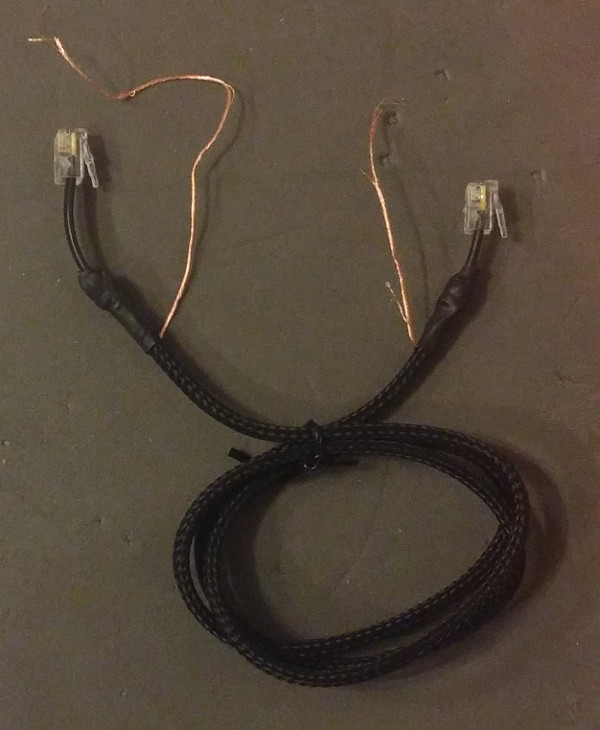
However, there is no problem pulling 1 or 2 strands of the bulk cable through the braid. Here is the ~900mm cable that I custom made with this sleeve:

The resistance between copper leads is about 6k ohm (2k/foot), which should be enough to drain any static charge.

I was told by one team that they used to burn a port every 3-4 days, but once they applied anti-static spray to their practice field, they only lost one additional port in about a month. So having additional line of defense against ESD would make sense.

It is still not 100% clear where the static electricity accumulates, but the main suspect is that every time the claw or another end manipulator (that is not electrically connected to the chassis) touches floor tiles it picks up some additional charge.

Then, when charge and, as a result, voltage difference between the end manipulator and the rest of the robot is large enough it could discharge through the motors and cables into the poor 485 driver chips on the V5 brain killing them.

Similarly, if the robot, that somehow accumulated large charge on the chassis, runs into the field perimeter with its end manipulator then it could discharge into perimeter that presumably has very large surface capacitance (or is grounded) and could sink a lot of charge.

The final hypothesis is that static electricity could somehow accumulate on the non-conductive surface of the V5 cables… and the robot could receive ESD while it is being off the field.

In all cases conductive cable sleeve protects the surface of the cables and you could electrically tie all metal parts of the chassis and end manipulators together and to the V5 brain’s ground.

This all is perfectly legal under <R7j>:

[quote]
Commercially available items used solely for bundling or wrapping of 2-wire, 3-wire, 4-wire,
or V5 Smart Cables, and pneumatic tubing are allowed. These items must solely be used for
the purposes of cable protection, organization, or management. This includes but is not
limited to electrical tape, cable carrier, cable track, etc. It is up to inspectors to determine
whether a component is serving a function beyond protecting and managing cables.
[/quote]

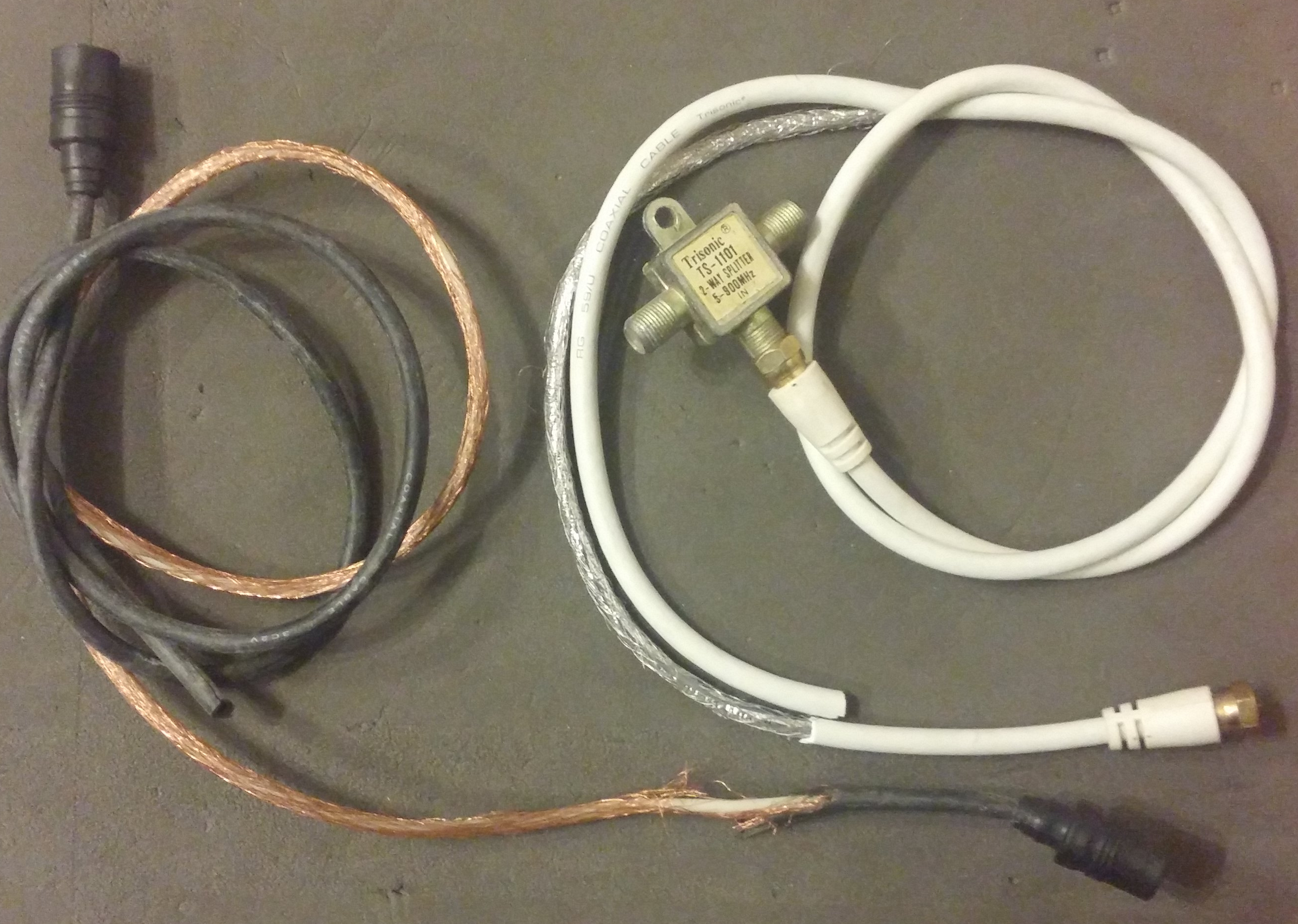
Low- or no-cost alternative for those who cannot share the cost between multiple teams would be to strip some old thick printer or coaxial cables.

However, your luck could vary depending on the size of the bin of the discarded cables that you have access to. I stripped a couple and I didn’t like the braid quality on any of them. Also, newer cables tend to use aluminum foil to substitute for the denser copper braid that you could find on the older cables.

It would be a pain to use any of those two to protect V5 cables, but given enough time and effort it is possible.

Another alternative is just to connect robot’s metal subsystems with any regular electric wire and loosely wrap it around V5 cables, but then you may encounter difficulties explaining to some inspectors how it is legal under <R7j>. I would certainly have no problem letting it pass the inspection, since it is used to protect the cables (and the rest of the robot) from ESD events.

Update: Dec 8th competition.

Here is an update on three VEX Teams with V5 that used Heavy Duty Staticide on the wheels (sprayed last night) for today’s competition. the original team (lets call it Team A) that had 7 ports broken on the V5 Brain got their new V5 Brain swapped out two weeks ago. Last week’s competition, they had one port half die (the brain recognized the motor is connected but won’t generate enough power to move the motor) on the new swapped out Brain. Today’s competition, they didn’t have any port issue. The team also told me that they felt that the competition field had more static today then at other competitions that they have had.

Team B also with V5 didn’t have any issues with port today. They have two ports that are connected with long wires (2.5 feet and one about 4 feet long).

Team C had two ports broke today. Team C has had this V5 Brain since September and never had any issues with the ports until today. Their robot has the same wires and same motors since October and have gone to several competitions. They lost one of their competition because one of the port (for the lift) decided to give up. They also lost another round due to the white screen which I will explain later.

So, did staticide help? Maybe. Did other Teams with V5 had issues? Well, I believe we are the only three V5 teams that use longer cables (i.e. 2.5 feet and 4 feet) on the robots at this competition. I didn’t hear any other V5 Teams have any issues with blown out port, but again, they don’t use very long cable (because they don’t have a lift).

Now, onto the white screen of death. Team B and Team C both experienced the white screen of death today and that caused them losing the match. They believed that the white screen is due to the port connection being loose (even with adhesive foam on the connector to make the connection tighter). They pushed in the connections on the brain and they heard a click. After that, they didn’t experience the screen of death throughout the match. The weather was also very bad today, with the high being 43 degrees and raining, but it was an indoor competition.

We, team 8931J, have now had two ports die within the last month. The first we thought was an accident. Since the second one died just this week I decided to look on here for any help. The ports that have died have died being connected to a wire that is about three to four feet long, we made it. In these ports, the brain recognizes that the motor is there but it is not moving the claw. We are making a desperate move, we are changing our arms so that they do not need such a long cord. As for the weather, it is not very good at the moment. We also have had little no static this year, unlike my other two years of robotics, Starstruck and In The Zone. However, we just found that we damaged the wire in the slightest, with a dremal accident. We thought that we had only taken off the black outside covering, we actually took off a little of the inside wire coverings and some of the copper wire is exposed. We now do not know if we were short-circuiting the wire or if it is the same problem you are all having. I can say this, the part that was damaged was not touching the metal at any point, we also used electric tape to cover the now exposed wires, and it still does not work.

Now, another team in our club has had the exact opposite problem as us. They have had to switch all of their wires to custom length because some of the vex given wires have burned out their ports. I do believe that they burned out only one port before they decided to switch to all custom length wires. I have not heard of them having any more problems with ports. This team is also a senior team so it was not a rookie mistake as far as I know.