Actually do it, don’t put it off until 3 hours before the competition. Do it every time too, find someone who likes doing it.
My sister isn’t even a millennial and she is still like this lol
Thank you for your input. I hear you as a judge, but at the VEX IQ and VRC level, we want to make sure that the kids are doing the work.
As a side note, Congratulations for being a rookie on Battlebots. Bloodsport was amazing. You give us all hope!
@vexnerd As a judge, what is the most common notebook mistake you see that most notebook writers overlook or don’t even think about?
Edit: also, are there any things that Notebook Managers think is good to have but actually isn’t/ makes their notebook worse?
As a judge, the most common mistake is to ignore the rubric in the judge’s guide. There’s a link to last year’s in one of my earlier posts on this thread.
Here is a link that outlines what you may want to include in your notebook.
I would also say the same with documentation on programs/codes. You don’t need to include every single variation of code you make when debugging, but you also want more than three pieces of code in your entire notebook. I find it’s good to include the initial code, any major changes to the program, and then perhaps the last change made before a competition and definitely initial and major updates for autonomous programs. (For auton, if anything is majorly changed usually I name it a different name because it is usually changed to score more points. Ex. Three point autonomous program → major change → five point autonomous program
It was recommended I repost these ideas for improving notebooks (and interviews) from an email series.
- We get parents or teachers who are not mentors or coaches to come in a critique notebooks and interviews, going over the rubric with the teams in detail
- This year we had coaches and students review past notebooks, score them with the rubrics and discuss. This was quite eye opening for the older students and the mentors who are not as fanatical as we might be

- We talked about expanding the above to including other teams/organizations but that hasn’t happened yet.
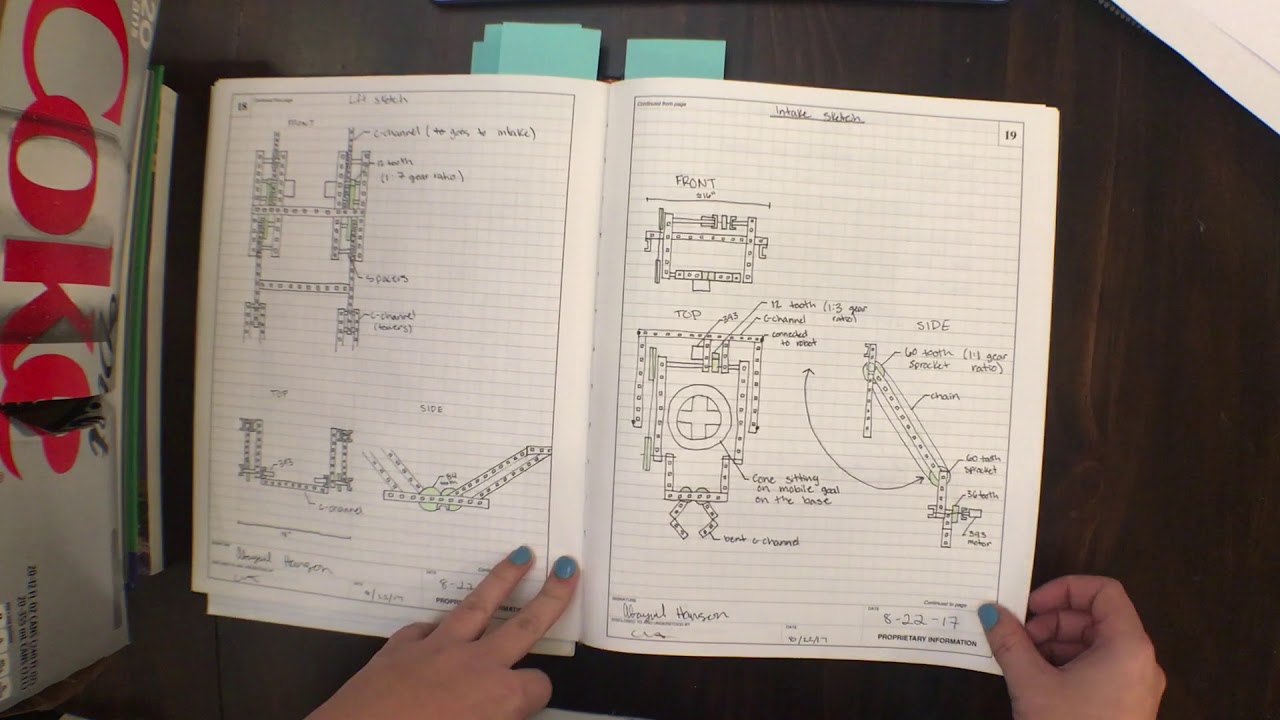
Daily logs are good, sentences are ok. But keep them short and to the point so no paragraphs. If anything let pictures and sketches with labels do the explaining while you write down details ab what your team did to make them. A big part of how they judge notebooks is “can I recreate your robot based on what’s documented?”
and … can you connect it to your documented design process? That is a difficult challenge - to make your robot development authentic to the process you said you were going to follow… Cloning your robot is easy - explaining why you made informed design decisions is harder… doing it naturally earns you the Design Award in many cases and differentiates you as an engineer from the tinkerer who happened to stumble across a solution that works.
This is the hard part of the design award …
Do they allow it when it’s not on written paper. Is it eligble for the extra 3 points? Even if some judges allow it/ Do all judges allow it. Is that something the judges brought up?
Currently, only paper versions of engineering notebooks are permitted. If the notebook is a bound one you can get 5 extra points (new rubric will be out soon and it was discussed that the points will be 0-5 scale – wait for new rubric to be published soon).
In the future, there may be provisions to allow electronic documentation. What that looks like is not yet defined.
just the question our team had too. glad someone asked
The Design Award rubric for notebook and interview can be found in the Judges Guide
Read it carefully (the guide as well, it explains the process for Design and Excellence Awards and why some events may opt not to award it early season).
Hi! Our team found it best for just one or 2 people to be in charge of the notebook fornthe sake of consistency. Ours were handwritten, and included student drawings of their ideas for the game. Have lots of photos, attached to the page assigned to the day it was taken, and make sure all team members are familiar with the notebook!
Good luck!
I agree with @helpfulalumni. My team has only one person in charge of the EDN (me) and I can enlist the help of others if I need it.
As this is my 2nd year as an EDN overseer, my best piece of advice would be to stick to clear, easy-to-read formatting. This makes it easier for judges to read your notebook, especially if you have placed markers for special pages and/or competition summaries. It also makes it easier to write if you have an agreed-upon format.
Good luck everyone!
I have seen posts about “notebookers” - the problem with this approach is that it does not demonstrate that all team members are all invested in all aspects of the design of the robot nor the process. It is actually incredibly telling to the judges when a notebook only has one person doing the documentation and the rest of the team can not explain the process for making decisions. If you want collaborative approach to problem solving, do not make it one person’s job to document, but rather make all team members take ownership to the outcome of the process. I would also encourage those who think they are not good enough to document to step it up for the team and get better - and in some cases that may mean getting better at penmanship, drawing, organizing…
I am not impressed by teams who delegate the documentation role to only one person. If you want to impress judges, show you are getting better as a team, even at things that are outside your comfort zone.
What we tend to do is that everybody does the notebook but we have one person do it more often so everybody is notebooking but we still have somebody who wants to notebook (and is good at it) doing it.
Ideally, everyone who develops a part of the robot documents it thoroughly. This will show that all members understand the process of problem solving with the context of the current game. This is why just being able to have scaled drawings of the built robot is insufficient to show mastery of engineering design. You need to identify the problem being address, possible solutions and the how and why the chosen solution was pursued. All of these indicators are in the design rubric used by judges - it is not the “neatest” notebook, but the one that is true to problem solving process that is awarded the Design Award. Usually the team that is consistent in this will have robots that are consistent in competition, and ultimately earns Excellence at events.
Gtk I think I’ve had way too much importance on neatness in the past