I sort of expected you’d offer examples like those (conventional automobile drivetrain, planetary gearset, etc.). But if you consider them more carefully, they all require (at least) two inputs to achieve more than one set of outputs.
Consider the familiar automobile differential, or the similar VEX set. If all you do is drive the (input) driveshaft, you have no way to achieve more than one output combination; the two output half-shafts will always turn at equal rates, ceteris paribus. To achieve a difference in the speeds of the output half-shafts, you must have a difference in torque (created by different inner and outer turn radii, or wheelspin, or unequal friction in the drivetrain, or something else).
Similarly, in a planetary gearset, you can drive the sun gear, but you also have to drive (i.e., apply torque to) the ring gear or the planetary set to vary the input-to-output ratio.
You can argue that some of these cases only use a single “motor”; but, one way or another, they require two “inputs.” Which is the point I’ve been trying to make. None of the cases or references you cite will achieve the objective of variable relative outputs otherwise.
Don’t understand why a single motor is not equivalent to 1 input?
And I have also mentioned that the concept and implementations of differential gearing system in VRC has evolved.
What I am doing here is to give you an understanding of what is differential gearing and its purpose from the engineering point of view (which is much much broader than VRC).
And you have asked for examples of one input differential gearing systems, which I did answered you.
But looks like you are not exactly appreciative of all the resources that I have pulled out. Guess I shouldn’t have bothered to reply.
Like I have mentioned it in my “summary” in the earlier post - if you want to use 2 motors for 2 outputs, then it might make more sense to dedicate 1 motor to 1 separate output (taking into account of energy efficiency and mechanical complexity). With V5 motors, and with the correct gear ratio, it is powerful enough to accomplish most tasks.
Anyway, nothing stopping any teams to do a Goldberg machine just to perform a task
It is the team’s decision - i really don’t see what’s there to argue about.
Don’t understand why a single motor is not equivalent to 1 input?
As I tried to explain, the (obvious) motor is not the only input.
What I am doing here is to give you an understanding of what is differential gearing and its purpose from the engineering point of view (which is much much broader than VRC).
And you have asked for examples of one input differential gearing systems, which I did answered you.
To repeat, the examples you cited involve more than one input. (And I do have a good understanding of differentials.)
But looks like you are not exactly appreciative of all the resources that I have pulled out. Guess I shouldn’t have bothered to reply.
It was helpful of you to show that information. But it all bears out my point.
Like I have mentioned it in my “summary” in the earlier post - if you want to use 2 motors for 2 outputs, then it might make more sense to dedicate 1 motor to 1 separate output (taking into account of energy efficiency and mechanical complexity). With V5 motors, and with the correct gear ratio, it is powerful enough to accomplish most tasks.
The differential gear system (i.e. bracket + bevel gears) provided by VEX IS 1 input. Admittedly, the bracket is cumbersome and the directions of the outputs might not be how the users want it. But it is 1 input (that sticked close to the original design and intent of differential).
And looking at it again, I suspect I know why the “confusing” or conflicting views that we have - using this specific setup, then yes - you are right that it will need 2 motors in order for the power-sharing ability of differential to work.
But if you are looking at the other possible differential setup (eg. the differential system by VEX), it is not a must to have 2 motors to have the power-sharing ability.
And honestly, the need to have 2 motors to power-share to 2 outputs defeat the purpose of power-sharing in the 1st place, unless the torque required is too much for 1 motor.
And the above are my 2 main points.
Anyway… I don’t see any more value-added in replying to this thread anymore.
I have already provided my viewpoints.
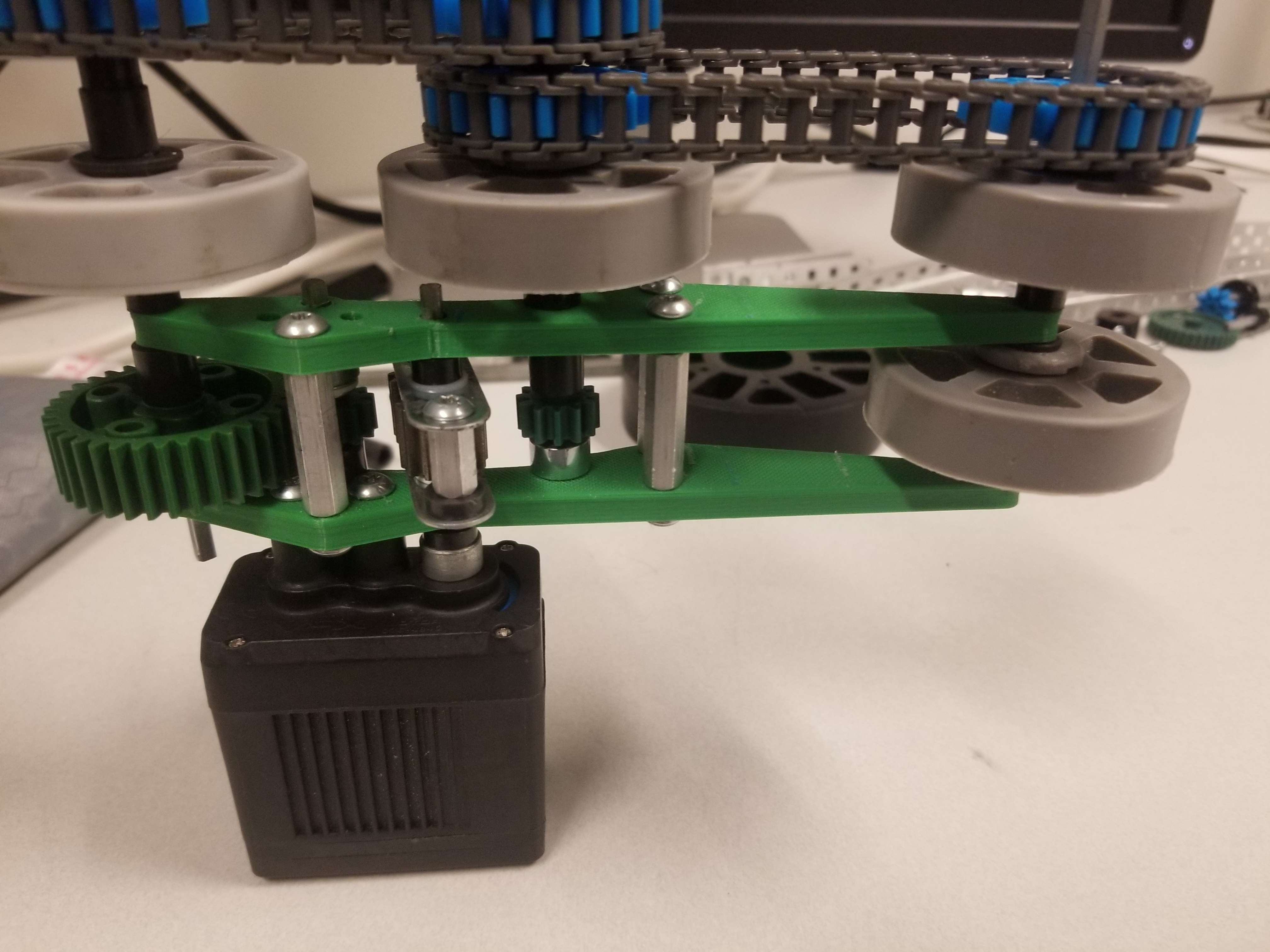
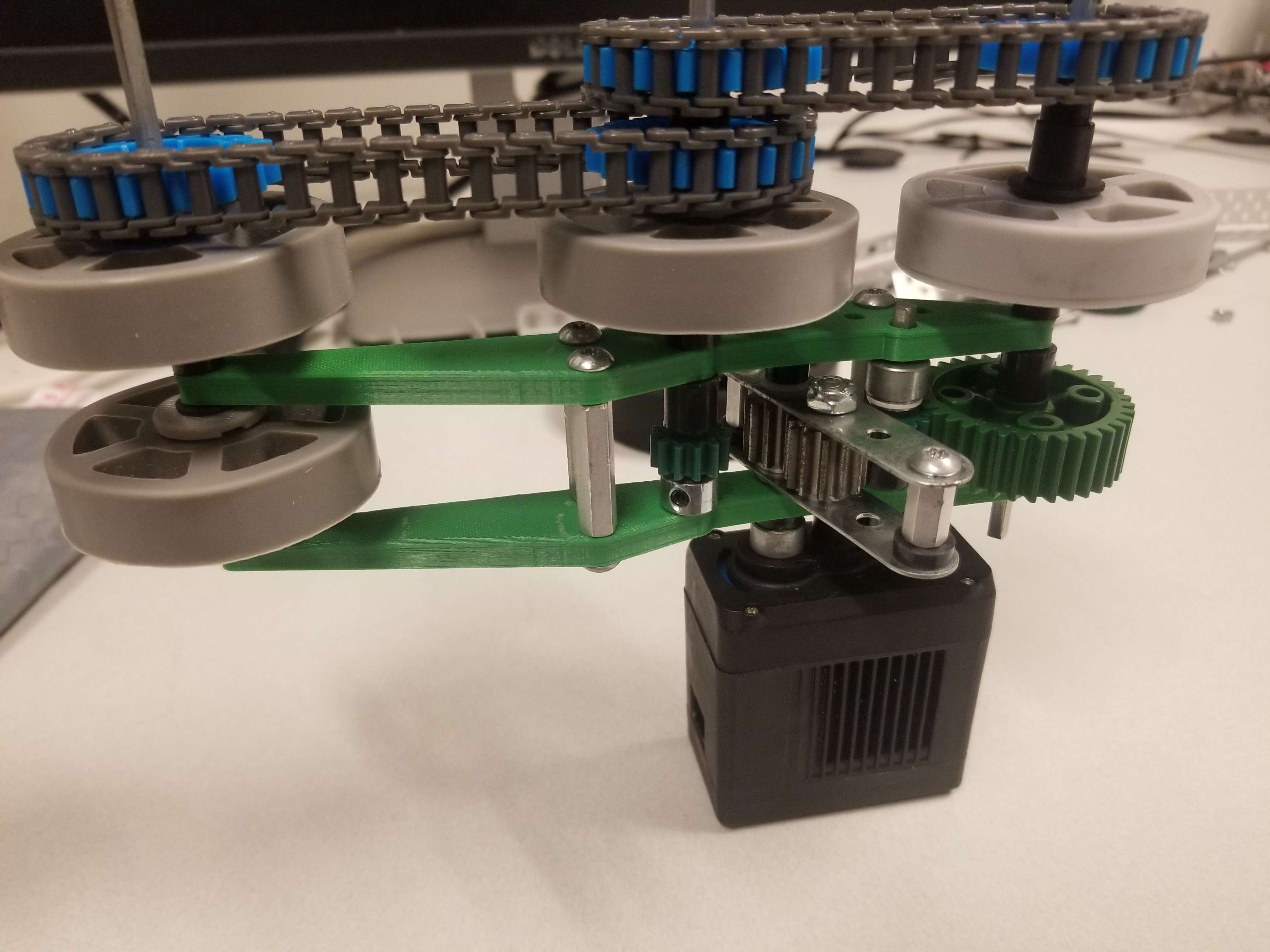
I think it is an interesting idea attempting to use a single mechanism for multiple purposes, and as I understand it, this post isn’t really about the design of the overall robot more of just, is there a way to get two different output forces using a single motor, and the answer is “yes, kinda”
One way to do it is to have the motor spin one direction and control one gear set and spinning the other direction mesh with a different gear set.
So as you can kind of see in this image, the motor is connected to a gear and another gear is connected to that one in a method not unlike planetary gears. As the motor spins one direction, the gear will move into mesh with the other gears and spin them one direction, but when the motor is reversed, it comes into contact with a different gear ratio for the same system.
Something of note to remember is that you cannot get 4 outputs with a binary input. So you would not be able to go up and down with 2 different gear ratios, but if you have something passive such as rubberbands pulling in one direction, when your motor is not applying a force to either side, the entire system can default to up or default to down so that it is still usable.
Technically this could still work moving up quickly and lowering the arm slowly, but if you want a fast up and down movement you might get a little fancy with rubber bands.
I hope I explained that well, our team has used them a couple times, but has not been able to find them in use in other places. So if you have any questions or found this useful, (or not useful but interesting) lmk if you need more information.
The differential gear system (i.e. bracket + bevel gears) provided by VEX IS 1 input. Admittedly, the bracket is cumbersome and the directions of the outputs might not be how the users want it. But it is 1 input (that sticked close to the original design and intent of differential).
You’re ignoring the meaning of the word “differential.” Sure, the VEX diff set can divide power and direct it in two directions. But it cannot do so in a controllable varying proportion without an additional reacting torque – in other words, a second input.
Sure, if you want to divide power in a constant ratio, a single input is all that’s needed. But if you want to divide it controllably, you need (at least) two inputs. As in 5062F_Adam’s example.
But if you are looking at the other possible differential setup (eg. the differential system by VEX), it is not a must to have 2 motors to have the power-sharing ability.
You’re confusing power sharing in a fixed proportion with power sharing in a controllable proportion – which is the function of a “differential.”
Let’s look at the Wikipedia article you cited. In the figure https://upload.wikimedia.org/wikipedia/commons/6/61/Differential_free.png, the two output shafts turn at the same speed. In the figure https://upload.wikimedia.org/wikipedia/commons/5/5a/Differential_locked-2.png, they turn at different speeds. Why? Because there was a second input – a torque that opposed the turning of the left shaft.
You can reproduce this by playing with the VEX diff set.
In engineering terms, the VEX differential distributes torque equally between the two outputs, but the power is divided in proportion to the ratio of rotation speeds.