Lets look in some details at the angular velocities and torques acting on the inputs and outputs of a differential.
In this example the load (probably a wheel) is attached to the left side of the differential, two motors M1 and M2 are driving the casing, and motor M3 is connected to the right shaft:
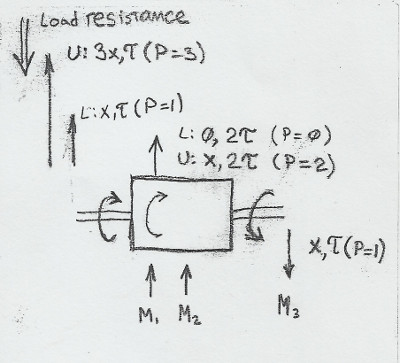
Assuming that each motor could run at nominal angular velocity (x) delivering nominal torque (T) we could say that it produces one power unit (P=1) according to the formula P=x*T. When differential casing is not moving we mark it L: (locked) and when it is moving we mark it U: (unlocked).
For example, if motors M1 and M2 are not running, and M3 runs in reverse (down) the output will be the opposite of M3 running with angular velocity (x) and one unit of torque (T) with total power (P=1).
If we run motors M1 and M2 forward (U:) they deliver combined torque 2T at a speed x. The output shaft will run at (3x) with one unit of torque (T). To understand this you need to pretend you are riding on a case of differential. From your point of view shaft of the motor M3 runs backwards with the speed (2x) and will drive output shaft forward with the speed (2x) relative to the differential casing. Since the casing runs forward with the velocity (x) itself the total velocity of the output will be (3x).
The torques are a bit trickier. Since the output shaft is balanced by the M3 there is no way we could deliver more than one unit of torque (T) at the output. If load starts pushing back with more than a (T) it is going to backdrive M3. However, this is fine because torques are balanced: resistance from the load and torque from M3 are both directed backward and total -2T, which is countered in forward direction by 2T from M1 and M2 motors.
To verify the balance in the high speed we check that total power output from motors (P=3) equals to the power delivered by the output shaft P=3 (3x*T).
In order to achieve high torque mode you would need to run all three motors forward to counteract 3T torque that could potentially come from the load. There is no problem running all motors forward, but because of the way this differential works anything more than 1T coming from the output shaft would simply backdrive M3. Or, in this case forward drive it, pushing M3’s velocity over x.
One solution to prevent this would be to place a ratchet (1, 2) between output shaft and differential casing. This would prevent output from driving back M3 and will ensure that both high speed and high torque modes work.
However, the problem with using a ratchet is that it only works in one direction. If you try to reverse all motors and run the load in opposite direction you will find that it doesn’t work.
The alternative to that would be to use worm gears that could prevent backdriving without imposing preferred direction of the operation.