Theoretically, you can make defensive plays at the line, as long as you aren’t contacting tiles on the other side. Also, conveniently, the manual only stops robots from touching balls and tiles on the other side of the field, but you can still touch a robot as long as the mechanism you’re using to touch the opposing robot is above the ground and doesn’t touch a ball.
But yes, the line would stop most defensive plays.
I still think that there is an easy compromise. Keep bo1 for regional tournaments, it makes them much easier to run, and allows as many teams to participate in elimination rounds as possible in the same amount of time.
But for any event that qualifies teams for worlds, I think bo3 in eliminations is beneficial. These are high stakes events, unlike regional tournaments, where even the best teams can suffer from an unlucky fluke that can end their entire season.
That said, making all elimination matches bo3 does take a significant amount of time.
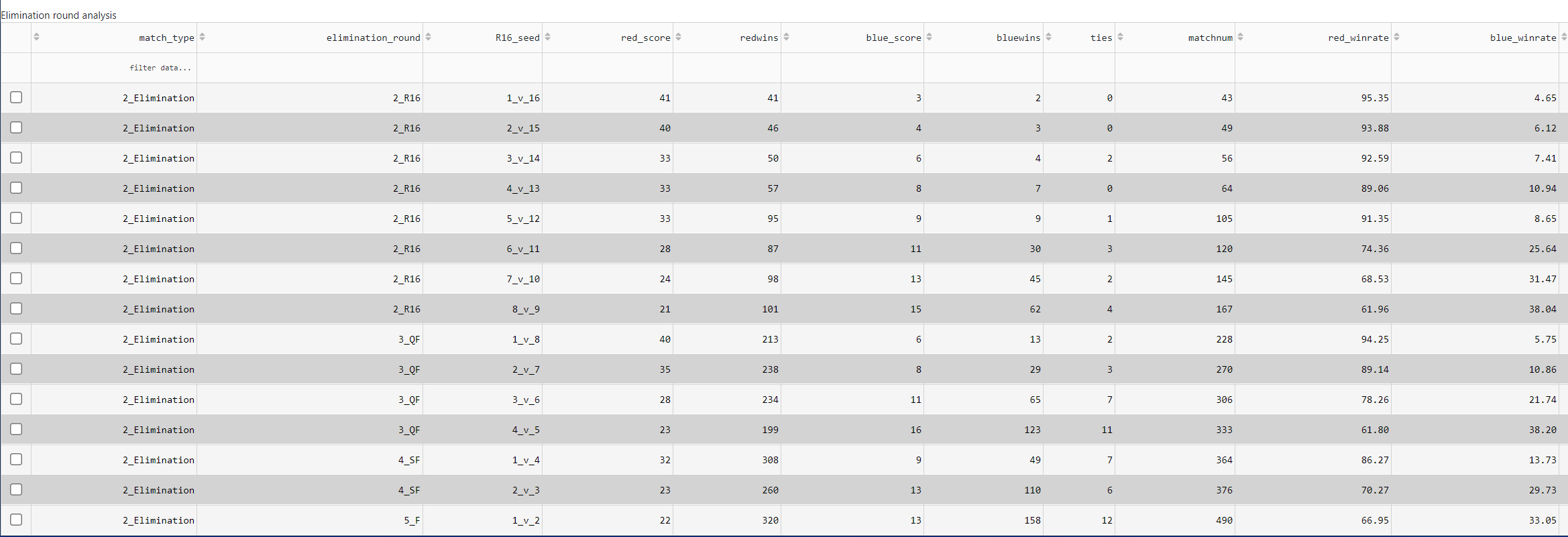
If we take a look at the statistics @Mentor_355U brought up earlier, we see that roughly 70% of bo3 matchups are determined in the first two matches. That means that bo3 matchups will on average take 2.1 matches, just over double what bo1 matches would. With this in mind, a full elimination bracket with bo3(all ro16 matches are filled) would take on average 31.5 matches compared to just 15 in bo1.
Now, that’s going to end up taking more than twice the time to run, and while we could get that time by reducing everyone’s qual count by one, I think that a better way to cut down on the time is to run ro16 as bo1. I don’t have the numbers on this, but the teams that are most likely to win the tournament probably don’t get knocked out during ro16 very much, and running them as bo1 instead of bo3 would reduce the average match count in elims to 22.7. This means that running bo3 for quarters and up would cost an average of 7.7 extra matches for the total event, which seems well worth the benefits to me for a high-stakes event.
Despite the fact that most Bo3 eliminations are decided in the first match they are beneficial for reducing the chance of error in high-stakes matches.
I don’t know if anyone has suggested this previously; apologies if they have. What do you think about using Bo3 on matches that qualify for worlds. (This could be extended to regional state competitions) So if in an event, the tournament finalists and champions qualify for worlds, then the semifinals and finals would be Bo3 and the rest of elimination Bo1. If only the champions qualified, only the finals would be Bo3. This would only be 1 or 3 Bo3 matches per tornament and I don’t think it would take too much longer, although maybe it would.
Would love to see the RECF actually take team’s feedback on this instead of deciding what we want for us (and then lying to us about the feedback on their decision)
IMO either cutting R16 or doing half of an R16 (top half gets bye round) makes a lot of sense
true, although I think that the extra 8 ro16 matches are important in order to give any many teams at the event the chance to experience eliminations. I think keeping them as bo1 is preferable for this reason.
This. I’d rather give as many teams a chance at alliance selection / eliminations as possible. I’ve seen double digit alliance pairs win so that’s a pretty big deal.
The other end of the spectrum is just picking two alliance pairs and doing a BO5.
I have in the past, I don’t know that I have the by-seed question for prior years. I do have win-rates by round - these have been consistent going back several years (I can’t recall if it was Turning Point or a season or two prior)
I’d hate to say a double-digit seed “never” wins Tournament Champion, but would be comfortable saying it is “extremely rare, possibly only at something like a Signature Event where there are a significant number of top-teams at similar levels of quality”
Why did we bring this back? It’s only a matter of time until a repeat of the last one happened.
Also, at the end of the day, it is VEX and the RECF that we are buying a product from. If we dislike the product, we can make suggestions or not participate. However, it is not our position to demand anything.
That’s actually such a terrible take. Why would you not want to improve VRC? The RECF is not immune from criticism, and if people want to suggest ways to improve their competition, then that’s a good thing.
Part of this may be because tournaments were a lot smaller this year. I only attended in tournament over 24 teams. Also, they don’t have to win to make finalist or shake up the rankings.
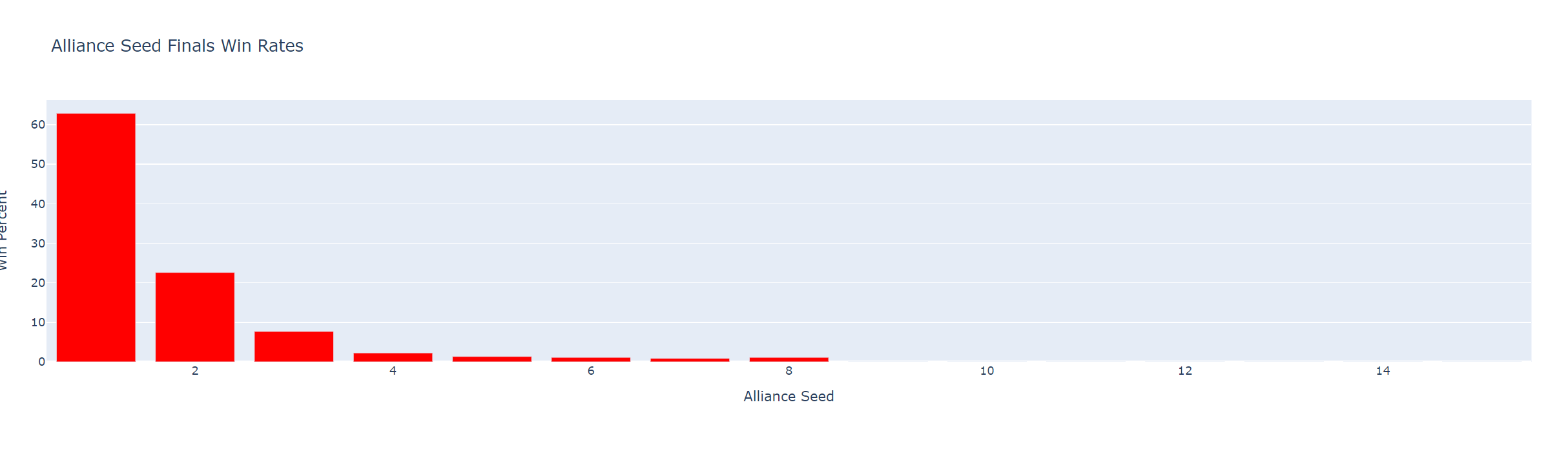
It’s certainly true that there probably aren’t as many tournaments this year with a full R16 as past years. That said, given that the #1 alliance has more than a 60% chance of winning Tournament Champion, and the #2 alliance has more than a 20% chance (combined for an 85% chance between these 4 teams), and I’m not sure that there’s a high frequency of “low seeded alliances” unexpectedly winning early-elimination-round matches shaking up the tournament.
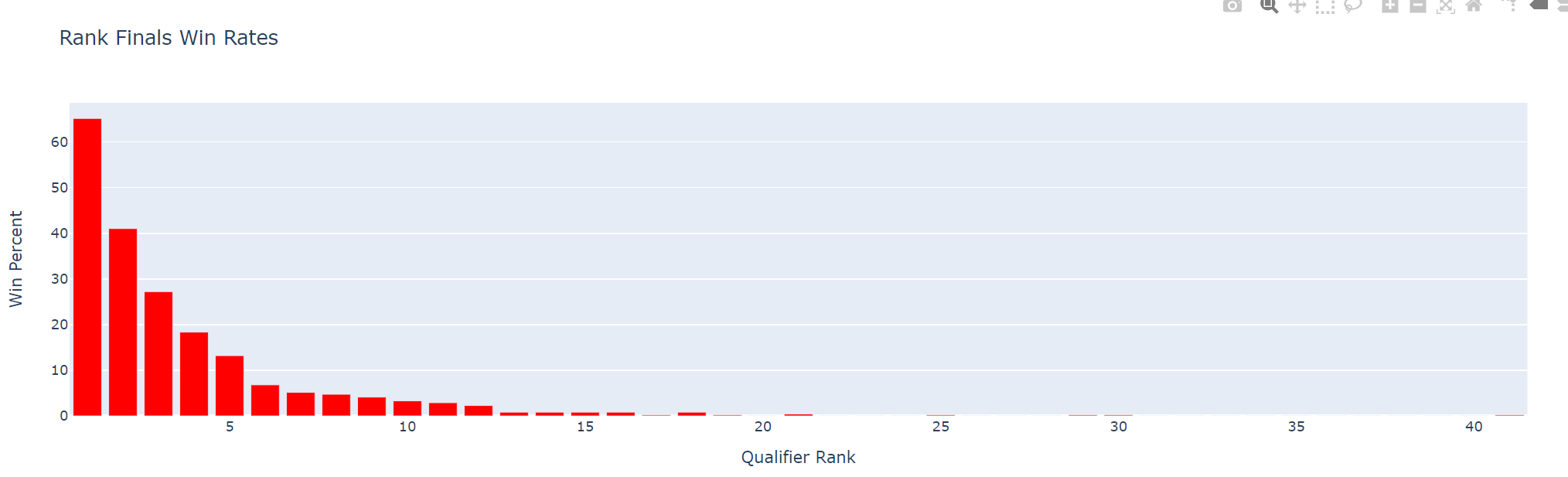
When you look at the seeds after qualifiers of Tournament Champions, a reasonable pattern emerges:
(Above should add to 200% since there are 2 teams per winning alliance - the reason the #1 seed here and in the Alliance chart are different is because of the way I’ve (mis-)handled tournaments with divisions).
All this demonstrates that qualification match success is a good predictor of elimination-round success, while also allowing for human-based observation to detect outliers (e.g. lucky claw-bots, elimination-round optimized robots, etc.).
This particular tournament format produces significantly fewer upsets than the NCAA men’s basketball tournament. My personal interpretation of that is that Vex’s elimination-round seeding is “more fair” that the March Madness Selection Committee’s.
Both are probably trying to satisfy a “multi-variate” balancing act - money/ratings are surely a factor in the March Madness tournament (along with travel, avoiding conference matchups, etc. - scheduling is HARD!). Certainly both want to reward “excellent teams” (which may or may not be the “best” team) as “Champion”. My main point in comparing the two is to illustrate that the “best” team is more likely to be the winner of a Vex tournament than the “best” team to win the NCAAs