Saisay,
This is a hard balance, and maybe one of the harder variables we juggle each year.
On the Game Design Committee, we approach every decision we make trying to understand every perspective that is affected. This includes Teams/Students, Coaches, Teachers, Event Partners, Volunteers & Referees, etc.
While designing a game, we obviously want “cool” elements. Verticality, visually striking elements, cool colors, dynamic elements, etc.
We want these elements to last the entire year. Having to replace field elements after an event as an EP is stressful. Going without a practice field because parts broke right before a competition is not ideal.
We want these elements to assemble with ease, disassemble just as easily, and transport in a variety of ways. Every hour a teacher spends wrangling a field is an hour not spent on building, programming, and problem solving.
And we try to do all of this inside a relatively static budget, to prevent drastic swings in field costs from year to year.
I promise all of these are things we weigh every single Game Design cycle.
We gave a lengthy presentation at this summer’s EP Forum about our processes, how we approach Game Design, some of the challenges we face each year, etc. One of the parts we made sure to emphasize is exactly this balance. Full disclosure: we were very upfront that we feel we have fallen short in some seasons.
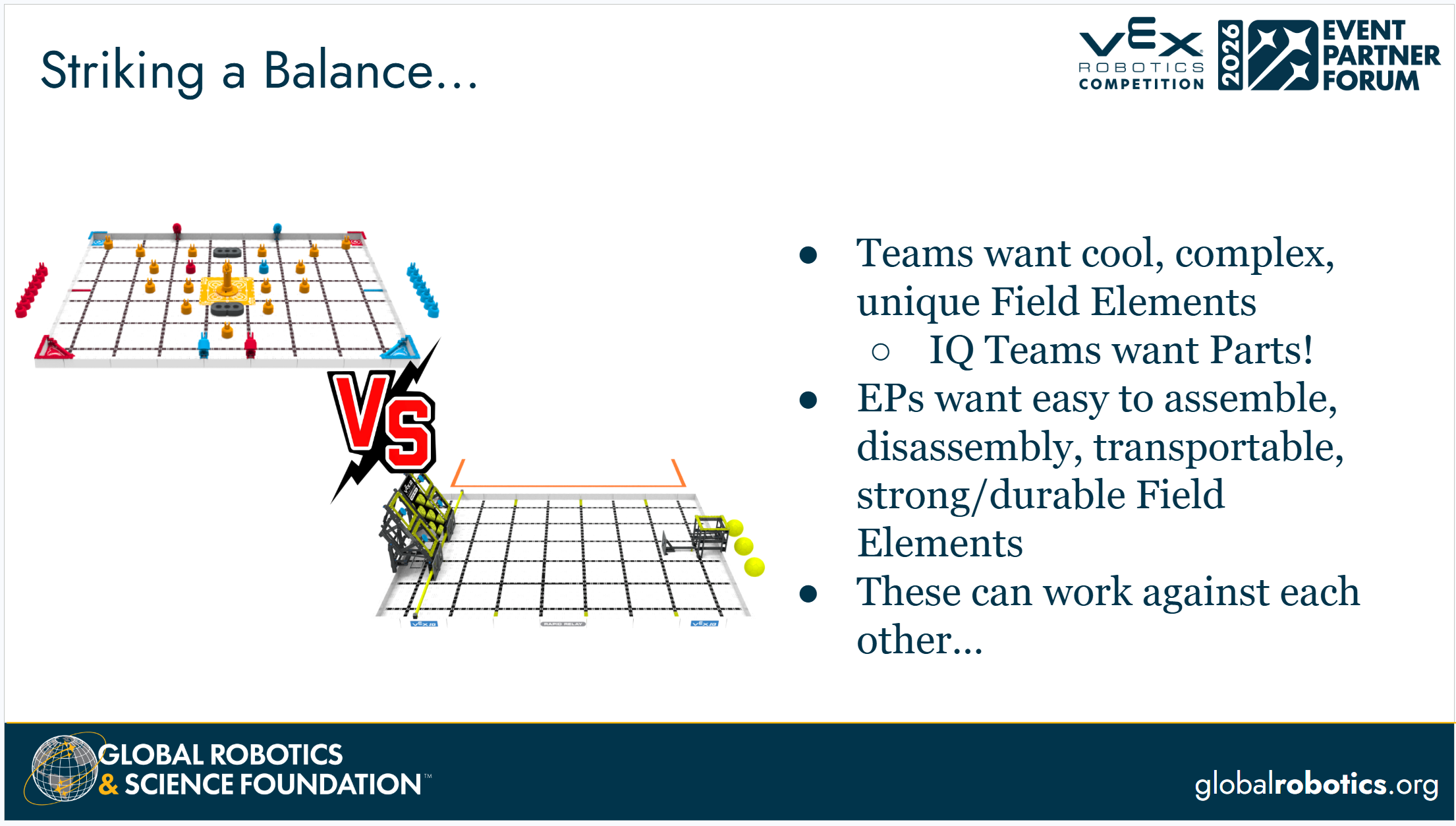
This was a slide from the presentation:
The examples used are two recent IQ Games that were, in some ways, polar opposites from this perspective. Rapid Relay was a brutal build. The Goal Wall was complex, and while the field had a reasonable transport configuration, it was one of the bulkiest IQ fields to transport in recent memory. By contrast, Mix & Match was a simple field with little to no building, and some of the feedback we received was that teams and coaches wanted more reusable IQ parts and a more visually striking field, rather than one that looked open and empty once the match was over.
With all of that in mind, I want to highlight the last bullet of the slide.
“These can work against each other…”
Many times, these directly conflict, and we have to accept that one perspective may benefit more than another, or struggle more with some detail of the implementation than another. We try to balance these so that no one perspective “draws the short stick” every time.
We had an extended discussion with the Event Partners at the Forum about how some of the solutions we implement work great for some users, while others prefer their own solutions, or find that ours don’t work for them at all. I would consider this one of the more valuable discussions on the topic from the Forum: we heard from multiple EPs who had implemented different solutions, and who could explain why one approach works better for them than it might for someone else.
We also walked through specific places where we have gone out of our way on this front: designing transport configurations for complex builds (Rapid Relay), keeping fields simple (Mix & Match, High Stakes), and using thicker, more durable parts (the Push Back Goals were the thickest sheet metal to ever appear in a V5 game), among others. I think it was valuable for them to hear that we take this seriously, that we admit we’ve been better some years than others, and that we are committed to doing better.
So I’ll re-commit to it here: we will continue paying close attention to these variables, how they interact with each other, and how they directly impact our users.
If you have specific examples of where you’ve struggled with assembly, disassembly, transport, storage, etc., from Level Up, Override, or any recent game, please share them here or email us directly at [email protected].
Thanks for your post, and I hope this gives some useful context.
Best,
Bailey