The animation is made in blender, but I wouldn’t recommend it if you want to design robots. It isn’t a cad software. The reason I used it is because I needed a complex animation, wanted good graphics and already knew how to use it.
thank you @Codec i am new to vex edr i did iq the last 2 years i won my state and competed in worlds bolth years and am trying to get a grasp for edr/vrc without wasting my clubs money i recently downloaded inventor2020 and vex coding studio is there anything else i should consider
RobotMesh studio/mimic, its free and online. It’ll have just about everything you need
Also download vexcode, VCS is pretty suck
thank you @Deicer , if you dont mind my asking why is vcs “pretty suck” i thought it was nice and fresh and good for the new v5 system
completely friction based. This looks promising.
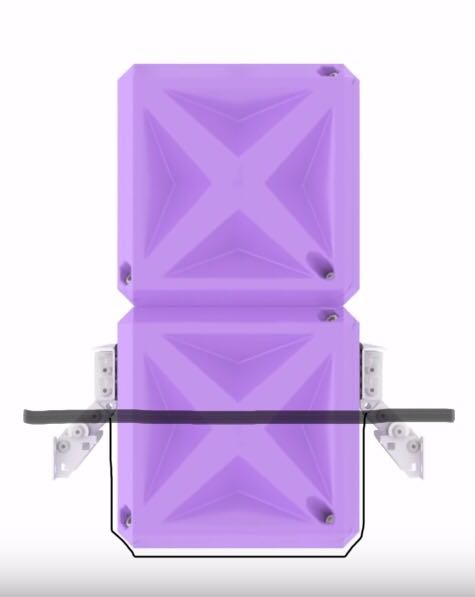
How many cubes do think you can stack before the intake will give in and a cube will slip out?
Since each cube stacked puts more weight on the bottom one, the intake has more strength the more cubes there are. Therefore, in theory, this will never happen.
Hey I really like your idea and I want to go into a little bit more detail, so is that a cad mode file for it that I could get. And Great job!!!
Anyone know what program they are using to animate?
They use blender. (20 character reeeeeeeeee)
Are you being sarcastic?
That’s assuming the force is a 1:1 ratio. If what you said is true then there would be no need for the mesh, but obviously the cube would fall with just a few more on top of it if there was no mesh. It is very possible that the amount of cubes before the friction lock breaks is beyond what the linear sliders can fit, but I don’t know how you would figure it out other than testing it.
no @jack202020 i just havent had time to see all vrc software
You are right, VCS is fresh, but it’s already not being updated. Also, there’s a widely accepted consensus that if you don’t use blockly, there are much better options as of interface. If you plan to use anything other than blockly, then your best bets are PROS, RobotMesh(not standalone), or VexCode
@Deicer i plan on using blocky for my driver program just for eficenty and having me and my friend co code on robotmesh/c/code as i learned using modkit the program is simply incapable of handling complex things such as gyro or a lot of forever loops. would that be full prof?
I don’t want to go into this again but don’t use VCS.
It is undeveloped, low-quality, and very limiting.
Search on this forum.
There are a few alternatives that are much better and are not any harder to use - RMS and VEXcode.
VEXcode is solely C++.
RMS has a bunch of languages, including blockly.
Blockly is pretty versatile but larger codes quickly become awkward and hard to maintain. I don’t think there are many things it can’t do, but it does not do them well.
C++ ( C ) or python has the full flexibility of syntax programming.
If you want to have a good program and you want to learn good programming, ditch the blocks and learn syntax.
Can anyone shed some light on how the stack of cubes is rotating from the center out to place the cubes down. I know the release has not yet been designed. Just wondering how the stack pivots out.
I believe There is a small four bar that moves the stack outward from the center of the robot.
I see the 4 bar that moves, just can not figure out the motor gearing to make it move like that.