Is it better to place the gears for a drivetrain facing the inside or the outside? I have seen teams do both, but have always done inside. Are there any benefits for making them face the outside?
I think most teams do gear out just for looks, but ig it technically makes your robot turn faster due to the wheels being closer together.
It makes your turning slightly faster because the arc the wheels have to cover is shorter. It also has smaller benefits like supporting your robot’s weight closer to the middle and of course looking better.
Thank you! That makes a lot of sense, actually.
Just remember that this year’s game is a staking game. Most teams who’ve done the inverted wheels/gears did it on games like high stakes and spin up, for those games things like faster turning and weight distribution, as Eli mentioned, are important and to be prioritized. But this year, robots will have to expand vertically to stack, and putting your gears on the outside and wheels on the inside will make your robot more likely to tip sideways. This year, I would recommend getting your wheels as far away from the center of the bot as possible to prevent tipping.
Ahh, I didn’t think about that. Even with more light weight lifts do you think that it would be an issue?
I would say so, yes. Depending on how fast your drivetrain is and how much defence the other teams are playing, lighter loads can still cause you to tip sideways. Think about it like this: imagine the center of mass on your robot is represented by a dot, and think of the area where your robot has contact with the floor as a ‘zone’. As long as your COM dot is in the zone created by your robot’s contact with the floor, you will never tip over. But, once the dot leaves the zone, in any direction, it will start to tip and your robot will fall. I’ll try and demonstrate for you.
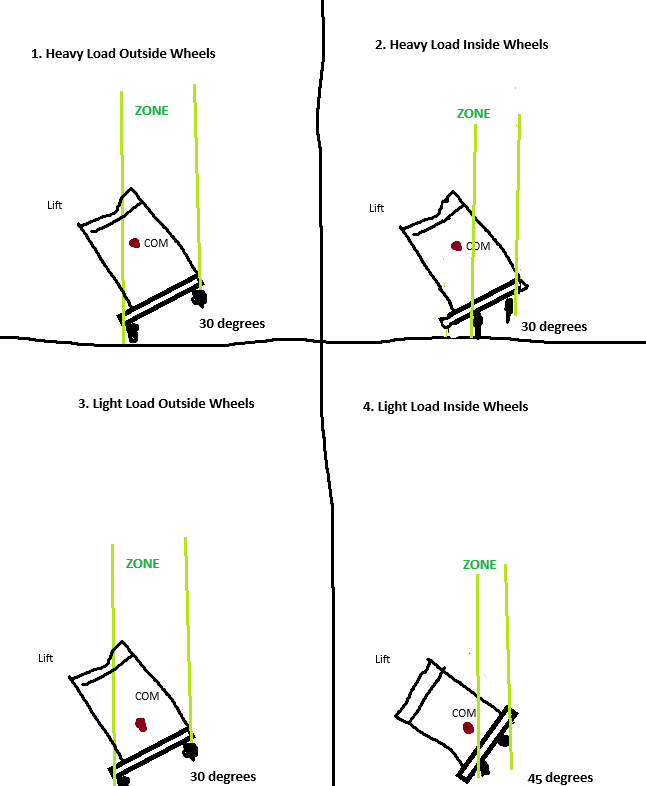
As you can see, the Center of Mass is inside the zone in both 1 and 3 the dot is in the zone, so those wouldn’t tip. But, in drawing 2, with the inside wheels the COM falls outside the zone at 30 degrees. Additionally, in drawing 4, the robot with the light load and inside wheels tips at 45 degrees. Because of the lighter load, it takes more of an angle to tip Robot 4 than Robot 2, which only needs 30 degrees to tip it.
So, it would be more difficult to tip a robot with a light load and inside wheels, but it is still possible.