Nylon and Aluminum Screws now Illegal

From the post, I don’t think it is Foster that was asking all these questions?

In fact, he is against the idea of “added here not added there” approach.

Just feel that it is caused by a small group of competitors that want to get their opponents DQ for using “illegal” parts.

It is sad to see things going this direction. I still prefer that bit of “wild wild west” approach back in the beginning years of VRC.
As long as it is not stated in the manuel, that means it is allowed - don’t need to put up a Q&A.

making a rule change that specifies screws can only be used to fasten parts would cause a ton of problems and would be a horrible idea to make, especially with the world approaching quickly. Not only are nuts washers used commonly as endgame weights but screws and nuts are also commonly used to add weight to flywheels. Screws are also often used for mechanisms such as ratchet pawls and even joints to mount wheels. Banning nuts as endgame weights on the premise of added functionality would cause a lot of questioning to arise as to what is considered to not be added functionality, is it only used to hard fasten one part to another? can it be used as pivot points? Let’s say that all of the examples of functions are all now banned, no screw joint drives, no ratchets, etc. If that were to happen almost every team in the world would have to do major redesigns on their robots and be ill-prepared for the worlds competition and essentially ruin worlds for the majority of teams. As for the term added functionality, I believe that the current statement is pretty easy to interpret: To have added functionality, the hardware must have some quality of the design that makes it unlike what has been labeled as legal. A washer with a wider radius than most washers would not have added functionality because it fits within what has been labeled as legal, but a 3" screw would have added functionality because it can be used to secure parts at a longer distance than the legally allowed 2.5" screw. This is about all I have to say on the matter.
TL;DR: Changing hardware rules could ruin everyone’s designs and ruin worlds, added functionality is hardware that is unlike what has been labeled as legal hardware (wide washer not added functionality, 3" screw is added functionality)

Hi Sylvie, not sure if you read the entire posting, but I’ll break it down to bite sized chunks using different words.

Take the washer in question. Use those washers on the frame of the robot. Is that legal? I’d like to think yes it’s legal. The GDC has waved around “Is it adding any extra functionality?” to determine if a part was legal. I don’t think the fender washer has any “additional functionality” in this case.

So now lets build the device for the end of the string. Is it legal? But wait, now it has additional functionality because of it’s weight and location (tied to the end of a string)?

OK, I get it, can use it here (on the frame) no new functionality. Can’t use it on the string, because new functionality, the weight.

So now lets apply the same rule to the SMC nuts. Can use it on the frame, no new functionality. But applying the same “weight of the washer rule” can’t use it on the end of the string, because of the new functionality, the nuts weight.

To be clear, I’m not asking for this “new functionality” rule, I’m against it. But if the GDC is going to use “new functionality” like the did in screwgate (and remember I was in the room at the EP Summit when the “new functionality” phrase was used. ) It has become the new litmus test.

I’d like to agree. Do we also agree that washers are legal for any use on the robot. (You used the word “pretty” and that is also an escape word. What are the cases where the nut would not be legal?

I’ve been here since the start. I love the innovation that has happened in morphing parts into something else. How roboteers have taken something and using it in a different way has “added functionality” to that part and it’s been a great thing.

Yes it does matter. It either forces the GDC to become more explicit on the “additional functionality” of parts, when, where and how to apply that phrase. Or to drop it as being impossible to manage and inspect for since roboteers are very inventive, and this program is about thinking outside the box.

So there is a benefit for doing this. @Colin2114R did a great summary about how the “added functionality” is a mess.

Hope this helped!
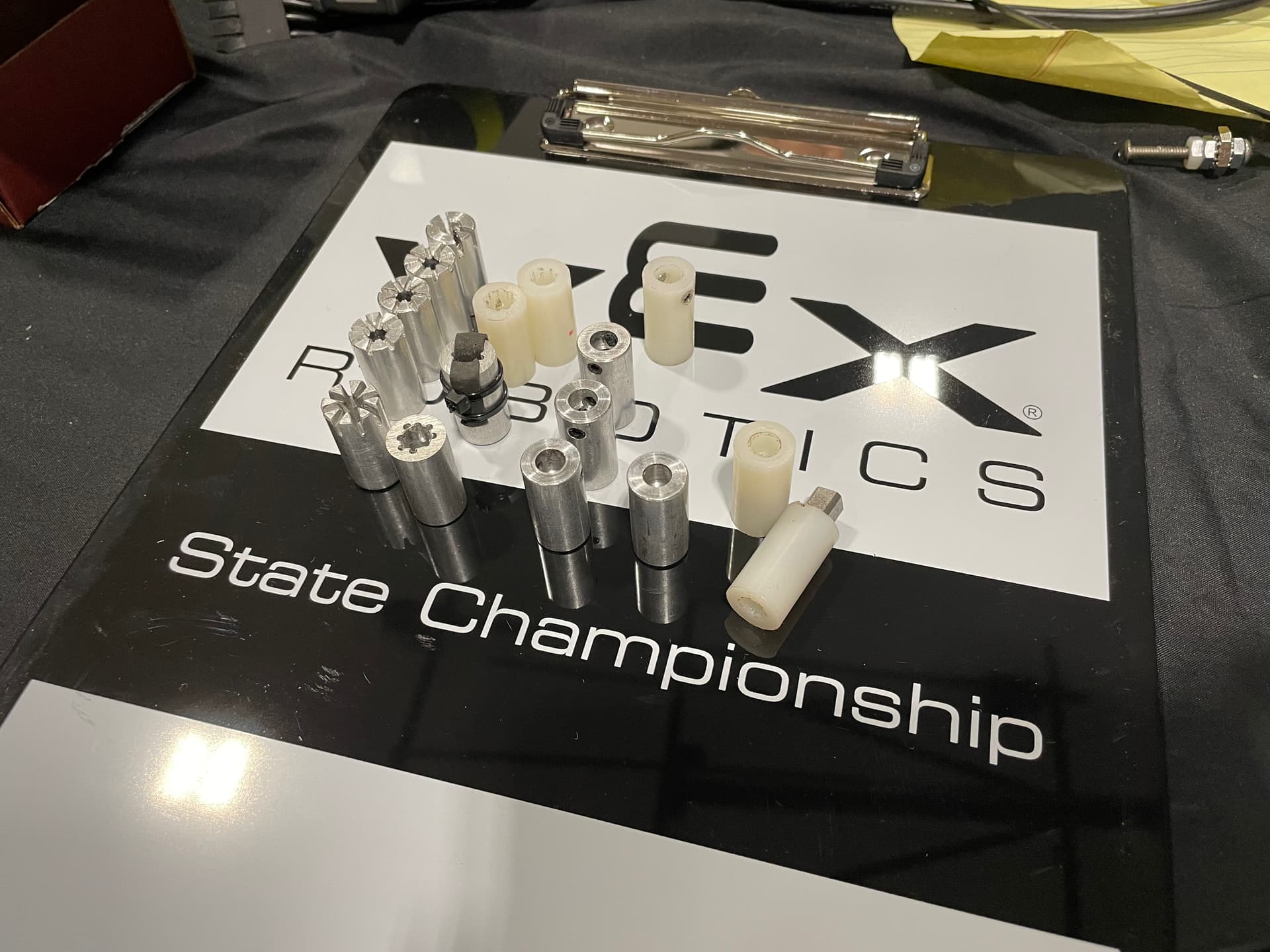
At the last competition I reffed/inspected, we ran into this absurdity. Teams who used commercially available NUTS (thinking them equivalent to the SMC Air Reservoir nuts) of random sizes (that clearly could NOT be used by a legal screw) were barred from using them on mechanisms. Teams who used commercially available washers that a legal screw could pass thru were allowed to use the item.

A lucky bunch.

Same thing happned at LA states with us, but with our custom internal motor cart which was machiend from a spacer. Saddly the ruling came back that it was not legal.

I’ve found that the most fun i’ve had in vex has been innovating parts into cool new uses.

IMG_5273.mov - Google Drive

Similar to Mentor_355v’s experience… we wouldn’t pass a team with large washers for their endgame weight. They were probably 5/8" or 3/4" SAE washers, not a fender washer that could be used with VEX legal fasteners.

There needs to be a simple list of legal parts or a range of specifications (length, diameter, material, etc.) for each clearly described legal part type. There will always be “added functionality” beyond the intended use of any part.

To keep things simple, consistent, and easy for inspectors, referees, coaches, and roboteers the legality of a part should not be open to interpretation. If there was an accessible list of legal parts and the illegal discontinued parts, there would be a lot less confusion for everybody.

I’d have given you an amaze award, that’s pretty cool.

We won the create award, and no world qual.

There is also a turret

20230302_115916.mp4 - Google Drive

Will be a new mentor to VRC next year (graduating from IQ), are you using the GPS sensor to keep the turret pointed towards the goal?

I mainly used that to exclude modifications that would be illegal (welding, melting down and casting, etc.). Secondarily, depending on whether the nut would be considered part of a pneumatic part (the reservoir), it might not be legal to cut the nut. Would be a good Q&A (oh wait, its closed).

Hold on here. Are you saying that the GDC was contacted privately mid-event to get a rules clarification? If so, this is in direct contradiction to well-established GDC policy:

7. This system is the only source for official rules clarifications.

  • Please do not privately contact the Game Design Committee to ask for rules clarifications. They will simply point you to this Q&A system or ignore the inquiry entirely. This includes via email, social media, forum private messages, etc. This policy exists primarily to make sure that all rules clarifications are posted publicly for all Teams, Head Referees, and Event Partners to learn from equally.

https://www.robotevents.com/VRC/2022-2023/QA/guidelines
This policy is designed to ensure all rulings and clarifications are publicly available and transparent, and not conducted opaquely behind closed doors (or phone calls). If this policy was violated then that is extremely troubling. The last time this occurred from my memory (also in California…), we got this disaster.

I’m not on Sean’s team but for my turret I used a combination of the vision sensor and odometry.

/snort, like I have the GDC on speed dial. My Head Ref called our RECF contact, they did their thing. Think NFL calling NY for help. But to say there were more than one set of eyeballs on it.

Q&A 1149 (Point #4) states that a miniscule weight reduction in a commodity fastener counts as additional functionality. This is irrespective of if such a weight reduction is beneficial or not. It may follow that the more significant increase in weight (relative to the standard vex washers) of a large fender washer would be considered additional functionality. Suppose that you used a bunch of fender washers as ballast, in my opinion it would be additional functionality as, depending on the implementation, stock washers are too small/light to do that efficiently.
The washer also provides functionality by its geometry. Specifically, our team found that the smooth round edge would permit the use less actuation pressure upon release than a 24 tooth gear or pneumatic nut since the retaining bar wont get hung up on corners. It may be possible to machine such a similar geometry from vex parts, maybe a base plate if the holes don’t interfere. However, this doesn’t necessarily make it legal, as can be seen in the aforementioned Q&A which covers a similar situation (pre-drilled screws). Extrapolated to this situation, it would be “pre-machined base plate metal”.
Lastly, the red box states that the spirit of the rule is not to introduce additional functionality. Whether or not this situation meets that standard is up to interpretation, but it seems probable that this does apply: a stock vex washer placed in the same situation would not work. It would be too small and too light.
In any case, I find the “additional functionality” language to be excessively vague. The common-sense definition varies with how the part is used in wider context of the robot. It doesn’t account for what exactly the functionality is additional to, nor what counts as functionality. It may be unpopular, but the game manual could benefit from a certain level of “lawyering” to reduce uncertainty. From a cursory inspection the FRC game manual is a good example of this, but correct me if there’s ambiguous language in there which I’ve overlooked.

Relaying what Foster said, and from my understanding of what happned: Judges → Judged Advisor → Head Ref → EP → REFC regoinal manager → GDC/someone who is allowed to make a call.

Just my interpretation, but I think we are reading into this too much. The rule simply states:

Any commercially available nut, washer, standoff, and / or non-threaded spacer up to 2.5”
(63.5mm) long which fits these screw

It doesn’t say anything about added functionality here. If the washer is a screw size (#8 in the robosource one’s case), and less than 2.5" long, then it is legal.
My interpretation.

I disagree with this approach.

It is not about popularity vote, but it is about having too much and too specific rules that hinder creativity and innovation.

If the students can only do what is stated in the rules (else it will be considered as illegal), then you can throw out that spirit of exploration, e.g. trying different ways of using parts, etc.

And going by this “added functionality”, is there any legal VEX parts that is meant to be used as a weight (for endgame)?
From what I know, there is no VEX parts that are made or designed to be used as a weight for endgame. So technically speaking, any parts that are used for this purpose is introducing added functionality.

And btw, zip-tie enough stock VEX washers and it will be heavy enough - so is that added functionality now?

Hope you get what I am driving at - when the rules become too specific, it will end up being too stifiling and too restrictive.
Extrapolating, we will end up grooming a generation of engineers that will only do what they were told.

I fully agree that we want engineers who are willing to be creative and think ‘outside the box’.

Students here are effectively saying “We can’t find a good weight from the universe of VEX parts, so we will look for a heavy commodity part and use its utility in another area to bootstrap it in as a weight.”

I would argue that allowing non-VEX parts to be used for added functionality does not necessarily encourage creativity.

I absolutely agree that it should be generally legal to mis-use VEX parts in creative ways never envisioned by their designers. At present, there are two major exceptions to this premise:

  1. Pneumatics
  • Modifying a pressurized system requires more knowledge than a referee is expected to have to determine safety.
  1. Electronics
  • I think this one falls partially under safety, but more under fairness.
  • It is too difficult to verify what is actually being done inside of electronic components, so a blanket ban on modifications is used here as well.

I believe the commodity hardware allowance is not intended for expanding the legal universe of parts. It is intended to make it easier for teams to obtain parts in a timely and cost-effective manner.

If you run out of 3/4" screws, it is much easier to drop by the local hardware or home-improvement store and pick up a bag than to make an order from VEX, wait a week for it to arrive, and pay $15 shipping…

Having spent more time with BEST Robotics than I have with VRC, I have no problem with a list of legal parts. The list specifies specific sizes and types of all parts. You can get most of them from whatever supplier you like, but they have to fit the specified definition (for example: “#10-32 x 1 1/2" machine screws, steel, round head, phillips”)

Having this list of allowed parts feels restrictive at times, but all teams must deal with it. BEST considers this design restriction part of the challenge. After all my years with BEST, I have to admit that I like this very specific list of parts. It is very clear to all teams what parts can be used. If forces a lot of creativity as teams only gain an advantage with the materials by how creatively they use them. There is no concern for “added functionality” as the functionality of any part is up to the team to discover.

Note: a few years ago, BEST started to allow 2 “team custom parts”. There are restrictions on size, manufacturing techniques, and stock material, but it allows some 3D printing or machining. This has boosted creativity even more.

Since I haven’t posted here, I’ll say what my opinion is on this subject.

I 100% agree.

I feel like this is an out of touch point of view.

In my opinion, material choice and materials engineering should be a big part of VEX, especially since it is an example that applies to the real world. Students should be able to make a design choice, as they learn the Engineering Design process. We cannot use any aluminum screws now. There is not a legal option. If VEX wanted to lower the skill cap, they have done the absolute opposite.

If the argument was to make inspection easier, I feel like limiting the options available will never make anything easier. This has opened the door for teams to find any and every loophole in the rules to have the best advantage.

In my opinion, this is extremely out of touch. Rather than explaining the ruling to judges, you make the ruling more defined, limiting the design process for students. This has not made judging any easier.

From my experience, we have to explain to the judges that thumbscrews are legal, and show how we cut thumbscrews for our drive.

It is a different situation.

Having a list of allowed parts is not a bad thing.
But the current situation has evolved to restricting how the parts can be used. And that’s silly.

I can understand if it is due to safety considerations.
And I fully support the reason of restricting parts due to fairness, but restricting how the legal parts can be used, that’s take rules and regulations to another level.