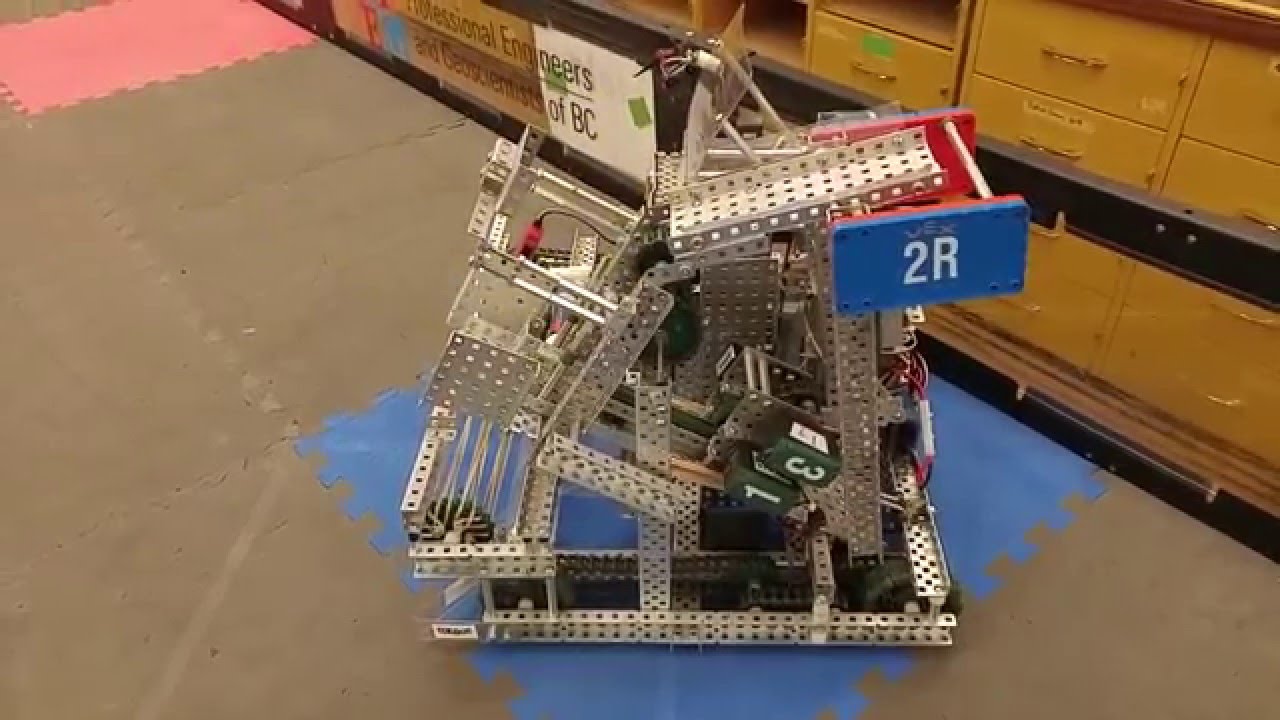
Not sure if @Stanley Shi(2R) was going to do a reveal, but since the video was public, I just couldn’t resist linking it here:
I’m sure everybody who builds a puncher will want to read his comments on achieving the speed and accuracy you see in the video. And since those will be the first questions asked, I’m just reposting his comments from the YouTube page:
I was wondering what the smallest configuration possible of a puncher that can shoot high goals from the low goal. My robot is a full high-lifter and when I was building it I did not work in any sort of launcher, so I am trying to work one into it now. I have already tried prototyping some ideas and have come up with a working puncher. Because I already have a fully built robot, I only have two motors left to use, so I am going to use one motor for the puncher itself and the other for some kind of intake/feeder. The slip gear is a 60 tooth gear with around 25 teeth cut off. Sadly, it is extremely inefficient as I can only use 3 large rubber bands before the motor fails to pull the arm back and with that it can barely reach the high goal.
Yes, direct driving 60t gear with a single motor doesn’t give you enough force. @TitaniumNyanKat is correct that you need to use gearbox to increase the force. If you look at the picture of our launcher few posts above you will see that 12t gears on the motor axle are driving 36t gears which are coaxial with 36/6 slip gear. It is a very common design and works for many teams.
I’ve seen a youtube video when somebody was trying to combine a scoop intake with a puncher. I couldn’t find it now but if you know what I am talking about or you are the one who made it, please, post a link.
Essentially, you would scoop up several balls, raise it and punch them one at a time as they roll to the side of the scoop where the puncher was.
So you would have a single motor both doing the intake and changing the angle of the puncher.Not sure how reliable that could be but it is, certainly, a very interesting idea.
We use a central piece of the rubberized tank thread . Another team in our club uses folded conveyor belt inserts (flaps) similarly mounted on the end of the linear slide. With light piston, they both seem to last long enough and take the damage instead of the green inner slides that hit them. Also, the metal slide itself is mobile and acts as a damper.
Rubber bands accelerate the launcher. Lets call this acceleration (a). This acceleration over a distance (d), the distance the launcher is pulled back from rest (last possible point of contact with ball) creates a velocity of the launcher (v1). Taking the mass of the launcher (m1), we can figure out the momentum (p1) of the launcher is p1=m1*v1.
Integrating this formula for velocity gives us kinetic energy of the launcher (kE1). kE1= .5 (m1(v1)^2).
Now, however, we run into a little problem. We know the kinetic energy of the launcher is kE1, but we also know that the kinetic energy of the ball, kE2, does not equal the kinetic energy of the launcher, kE1.
This is because some of the kinetic energy is lost upon impact with the stopping mechanism, or upon being withheld by a stopping mechanism like string.
So now we know that the kinetic energy of the ball is roughly equivalent to kE1 minus the energy lost on the stopping mechanism. This gives us a useful relationship, but is overall not useful if we want to know how much energy is imparted onto the ball.
This is difficult to calculate, and therefore we won’t. Instead, a good idea is to establish how much kinetic energy of the launcher it takes to shoot the ball X distance- 1, 2, 3, 4, 5 ,6 feet, and then using that data to interpolate a graph and determining the function of the graph using a program like LoggerPro. The kinetic energy of the launcher is easy to figure out- using the formula of kE1-.5(m1(v1)^2) Taking slow motion footage of the launcher shooting forward will let you find v1.
This graph should give reasonable estimates of the kE the launcher requires for different shot distances.
Now, take the mass of a ball, and find the velocity of that ball using distance = velocity(sin(angle)time- 4.9t^2, and you can fine the kinetic energy of the ball.
Subtract that from kE1, and now you know how much energy your stopping mechanism will need to absorb.
I hope this help!
I suggest string. Using two pieces, and vex approved nylon string, will easily and securely stop the shooting mechanism when you need it to. Plus, it’s easily scale able.
@Team241F thank you for adding actual formulas to the physics thread, which I completely forgot to do.
I agree with you that analytically calculating energy requirements with all the losses due to impact, friction, and air resistance would produce only rough estimates. And the best method is to do a slow motion video and experimentally graph the values. If anyone is going to do that I will just add that looking at spikes in the audio stream will give you easy way to time key events like slip gear release, ball strike and piston stop.
My team have abandoned linear puncher in order to concentrate on the single flywheel but our sister team, that I keep mentioning in the thread, is doing very well with their LP. When they had two motor LP they kept beating our two motor flywheel by about 20 points in the skill runs.
The reason we stick with flywheel is that we see how much maintenance LP requires and we simply don’t have that much experience with LP to keep it in a top shape.
When they switched to three-motor LP they managed to score an above 200 skill run (which is quite good for MS), but it cost them ruined backstop which they had to repair in the middle of competition. And, of course, they do replace all their elastics every few matches. They have a small cache of pre-tested and pre-tuned rubber band sets sitting in the little bags in their tool box.
On the other hand we built our single flywheel a long time ago and just keep improving software that drives it. Now we have a code that runs three motors (mixing ports 1&10 with MC29 is not that trivial) and could score above 200 in our best practice runs.
However, I am sure our sister team will still beat us next Saturday, because they are now experimenting with nylon string and it seem to hold pretty well.
It looks like LPs are slightly better in the skill runs, but flywheels are more versatile for the mix of preloads and fielding. In any case, performance of the specific launcher seem to be primarily a function of how much work team puts into it, regardless of the launcher type.
From the physics of collisions it would seem that the hard balls would have a more elastic collision with the puncher head, while squishy balls would have a more inelastic collision. Given that more kinetic energy is lost in the latter, a squishy ball should launch with a shorter range.
In our linear puncher, the exact opposite is true…the squishy balls fly further.
Any thoughts on what might explain this? Perhaps the compression/decompression of the ball actually acts as a secondary spring?
Actually the squishier balls weigh a lot less- as much as 10% less. As mass is a massive part (pun intended) of the kinetic energy formula, the lower mass would mean a higher velocity- KE given to a hard ball and squishy ball are roughly the same. This means that the energy is now going somewhere for the squishy ball- the velocity, giving it a higher velocity and therefore more distance.
You are correct about physics of the collisions, and yes compression-decompression shockwave traveling through the ball plays big part in the way ball interacts with the puncher.
Our puncher behaves as expected - softest ball makes funny sound, but doesn’t fly far.
What is the difference in the flying distance between those balls?
In our experience moving point where piston starts interacting with the ball is the first thing to try and if it doesn’t give you more range then @Team241F suggestion that you may not have enough energy / exit velocity in your puncher is the best explanation.
You would need to add more elastics for more energy or try to make piston lighter for more piston velocity with the same amount of energy. Hope this helps.
In my experience, the angle the launcher impacts the ball at makes a massive difference. The higher the angle, the more likely the soft ball will fly further. Wider punchers that cover more surface also do the same.
The first prevents the ball from simply dropping out of the barrel, while the second prevents complete compression.
It’s a weird graph, but mass, in my experience, seems to play a much larger role than compression does, and this I attribute to a launcher with a higher emphasis on surface area. That, and we tilted the end of the puncher so it scoops the ball more, preventing loss of energy from complete collision.
By the way we have confirmed that ball weight is not the issue. Our “squishy” balls are less than 1gm different from the hard ones…just another data point.
I can, yes. I’ll take a picture when i get to the lab later.
We also noticed our ball had a pretty consistent back spin… If not much, however, as it only spins a few times in flight.
Im curious to see if squishies spin at a faster rate…
Rav; thats strange, our squishies vary slighlty more…
I think im going to try to get some high frames per second footage to see what the ball does…