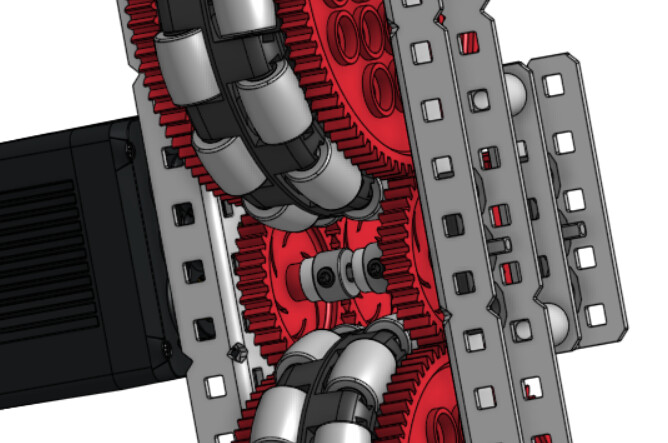
My team is planning to make a screw jointed drivetrain but we haven’t done it before. If we use standoffs on the joints do we have to add a washer before the wheels so the standoff doesn’t contact the circle insert, or does it not matter?
In general, it’s good practice to have a washer or spacer between a rotating part and metal. Having no washer would increase both friction and wear between the insert and standoff, neither of which are good in a drivetrain.
Ok, you’re right, a reduction in friction is probably negligible. My screw-jointed drivetrain did free-spin longer than my all-axles drivetrain, but that’s probably a product of a difference in build quality.
In this diagram, I think you could replace the nut with a spacer or something, the screw is already screwed into the stand-off so nothing on it will move
The problem isn’t that the screw needs to be tight, it’s that the wheel needs to be free-spinning. If you tighten the screw too much without the nut, the spacers, wheel, and standoff will all be rubbing against each other, causing a lot of friction
The motors are connected to the axles (on the 36 tooth gears). They spin the 84 tooth gears on the screw joints (the 84 tooth gears are fastened to the omni wheels)
Yeah, but if it isn’t screwed in, everything on it will just wiggle around and maybe the screw will even fall out. But, what I meant was that the nuts there are unnecessary since there is already the standoff. If you replaced the nuts with spacers or washers, it might decrease some friction since metal isn’t rubbing against metal.
Backup redundancy. Since we don’t like cutting parts (except aluminum, we have a lot of that), and we wanted to screwjoint our wheels, we opted to not drill out expensive VEX gears and instead utilized 3d printed PETG ones (modified to have a screwjoint hole).
Needless to say, we were kind of wary about it snapping (especially since the filament was kinda old), so we put two gears for redundancy in case one side failed.