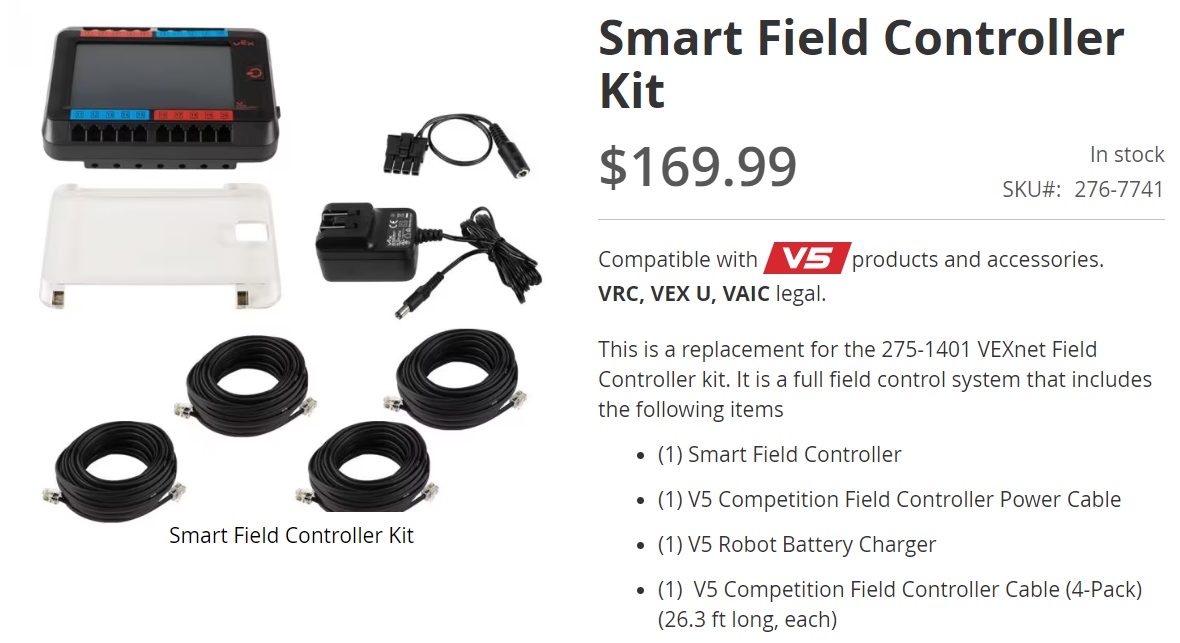
Quick questions about the “Smart Field Controller” V5 brain (SKU# 276-7741):
What is the power draw and what is the input voltage range (can it be powered by a 12V 1A supply?) Asking because trying to streamline field control, use PoE and reduce amount of wires and power bricks.
What exactly was stripped from the full robot brain? This is for pure personal curiosity, no need to answer if corporate secret etc.
For 1, it can run from the normal V5 battery charger using the adapter cable, or from a V5 battery connected to a charger.
The later is required if charging mode is enabled (i.e. it charges any controllers connected to the field).
With justbthe charger and no battery, it is best to disable charging mode.
The Smart Field Controller uses a standard V5 Battery Charger attached to a power cable adapter. The battery charger is 16V 1120 mA. I do not believe that is a standard POE output voltage, so it may be tricky to find something that would work for that. You could maybe throw a step up transformer in there, but after all that I don’t know if you are getting any further ahead then just making sure you have a power splitter at your field display.
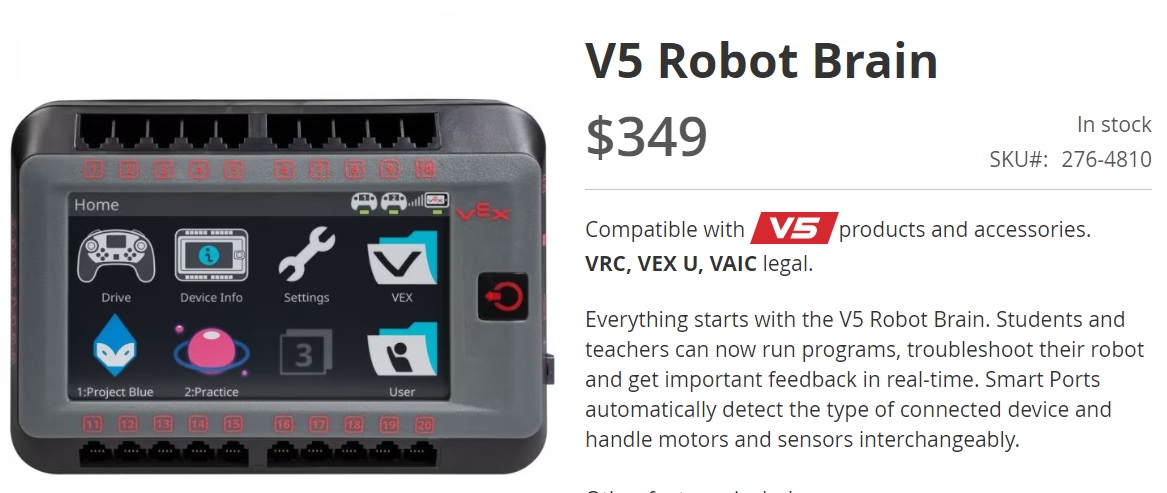
My understanding is that the Smart Field Controller is identical to a V5 Brain but is hard-coded to only have the V5 Smart Field Controller firmware/software on it.
If you bypass the battery with only a radio connected, a normal brain runs on 12V at ~0.3-0.4 Amps. I don’t think the power draw would be significantly higher running as a field controller, but you might want to take your own measurements.
Thanks. Confused why it is better to charge controllers from battery while being charged vs just charger, is it because the charger shoots only 1A while those cells inside the battery pack have a menacing discharge rate? Also, those LiFePO4 cells run at about 3.2V-3.6V (4V when fresh off the charger) meaning the usual input from a battery to the brain hovers between 13-16V. As we drain those batteries down the cells can go down to 3V (yes, that is bad, but common) which gives 3x4=12V to the brain. As far as I’ve seen, brain does not shut down even when battery is almost dead so there is some wiggle room. I’ve seen 15V PoE splitters, maybe I’ll try one of those with a simple buck 5V for the Pi.
Actually I was totally wrong. Fresh off the charger, according to the Battery Medic, every cell is no more than 3.3V for a total of 13.26V. There’s a cap somewhere (charging circuit or firmware). So the whole myth about a battery fresh off the charger giving you an advantage because of those extra volts that settle in time after you pull it off the charger? Hm.
I was also wondering what was changed. Would it be possible to modify it to run user code for non-competition use? Has anyone taken one apart to see if anything has been changed with the hardware?
From what I understand from EP summit last year, all the motor electronics have been removed. As for running User Code have not tried it. The firmware is current, but with a nice orange background color when you open up Devices to inspect the Brain.
Thanks! I never thought that would work on just the brains.
Solution
For others, the solution was found here, or on the website.
App Installation
Connect Smart Field Controller (brain) directly to computer via USB
Open VEXcode, turn on Smart Field Controller, ensure it is running the latest VEXos firmware (must be 1.1.1 or later)
Go to: https://vrcfieldapp.vex.com/
Follow on screen instructions to download Field Application (Match and Skills)
Or you disable core functionality so EPs can run events using match controller that offers a lot of possibilities that old control system does not.
I would recommend teams that were at Worlds look at their V5 Brain Event logs - lots more going on to help EPs debug field issues. I know I will not go back to old VEXnet field control system.
I think this is the right approach to get more adoption of V5 for field control and using SBC like rPi … nimble and effective on all fronts.
They could also view it as a loss leader. How many Brains will EPs buy in support of competitions that bring in teams who buy full feature and full price brains.
That isn’t a smart buisness decision. I would rather believe that the true cost of V5 brain is less than $169 and an ethical choice would be to sell it, like, for no more than 20% markup, plus s&h. Not a 50% markup for a product that is notorious for burned motor ports, that for many teams becomes unusable around the time when the warranty runs out!
Imagine buying a $169 kit. Then swapping out the power board to an old V5 brain with a bunch of burned ports.
I think VEX has in the past provided V5 hardware virtually identical to production for free - it was called BETA Units - they had same hardware but different color cases. No one complained about smart business decision - it was a business decision to validate the platform before producing lots of them. This business decision is to allow EPs adopt new field control platform at same cost as previous system. Having different packaging and VEXos verify that the unit is to be used for field control is a good one (vs Beta which inspectors had to check if burnt in branding BETA UNIT was present).
I do not have the three versions of V5 Brains in front of me - so I can not say 100% certainty what is inside. What I can say, V5 Smart Field Controllers were more stable for match control than using V5 Brain with Field Control app.
The good business decision was to have clear marking on device and VEXos checking the device to determine if V5 Robot Brain or V5 Smart Field Control.
Vex already gives EPs a discount on field kits, I believe of 50% (perhaps that’s just for one kit per EP, I’m not sure), but that’s pretty close to the discount they are offering the “Smart Field Controller” compared to the V5 Brain. My guess is some number of these SFC are RMAed / warranty-replaced Brains that Vex may be recycling after replacing burned ports, reskinned, re-burned, etc.
There are fair criticisms out there for Vex, I just don’t happen to think the SFC Kit is one of them.
Even if my analysis above is wrong, many smart businesses use “loss leaders” all the time to drive customers to products that ARE profitable.
That’s a strong statement to make with no insider knowledge of VEX’s costs for manufacturing the V5 brain.
While you can “believe” whatever you choose, that doesn’t make it true. For example, let’s take a look at the cost of a component used in the V5 brain, the Zynq 7000 series processor/FPGA. That single component can cost between $80-$100 alone. There are thousands of components inside the V5 brain, all with wildly varying prices and supply chains. I would be shocked if the smart field control kit was being sold at anything better than a significant loss.
A 20% markup on what, exactly? The bill of materials cost alone? What about assembly? What about manufacturing logistics? What about shipping/transportation? And how do you plan on recuperating the years of development costs? Electronics margins do not work the way that you would immediately think, especially very specialized products like the V5 brain that, while they may seem like they sell a a lot of units to us, ultimately are barely a drop in the bucket of the volume that the Apples and Samsungs of the world can push every single year. VEX is not getting preferential contracts with their suppliers over Apple.
Seems a lot more expensive and complicated to me than simply sending the damaged brain back to VEX to be fixed for their standard $80 repair fee:
I don’t think this price reflects some kind of grand product segmentation plan by VEX. I think it’s as simple as, the old field control system cost (and costs) $170, so to make sure EPs don’t have to redo their budget and to drive adoption of the new system, the new system costs $170 too. The system would be DOA to EPs if it reflected the true costs of manufacturing and cost $350 a pop, and it would be unsustainable for VEX to sell a fully functional V5 brain for $170.