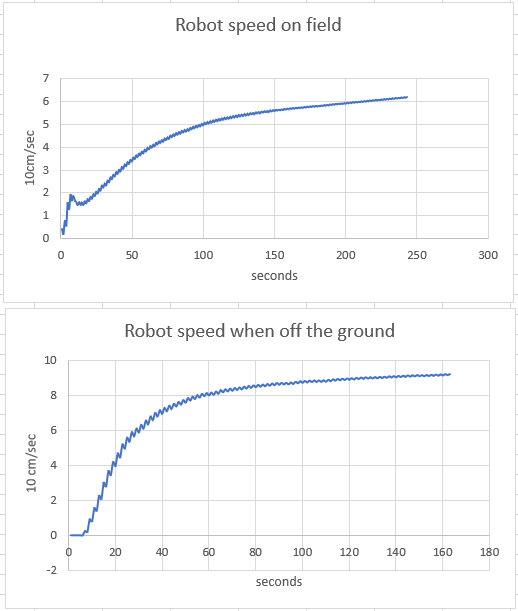
So I have a *slightly* heavy robot (~11.2 lbs). We have a 2-motor omni-wheel drive with a 2:1 gear ratio. After doing a few calculations and test, I discovered that the free speed (wheels not touching the ground) of the drivetrain is ~34.85 in/sec while the speed on the field is ~22.27 in/s. (this is driving in a straight line for 1500 mm).
A few questions:
Is the robot too heavy?
How would I graph the acceleration of the robot’s drivetrain
I would say it’s too heavy especially for two motors as unless it’s like 2ft long I don’t think it should be that bad but if it’s a normal size bot
It’s would say so.
Your robot is likely too heavy, but I would suggest increasing the gear ratio first to see if that would work (i.e. 5:3 gear ratio, which is a 60-tooth gear spinning a 36-tooth gear)
In my experience, removing unnecessary bracing and being more efficient with connections can lower the bot’s weight by over 1lb, which in your case would mean your bot can accelerate almost 10% faster. To graph acceleration, you can take a video of your robot moving across the field. Later, look at the change in the bots position every 1/2 second. Theoretically, if you compare the distance traveled every 1/2 second to the previous 1/2 second, you should be able to display acceleration.
The robot is wayyyy to heavy. I would try and keep weight to under 10 pounds but realistically for a 2:1 speed on 2 motors anything more than 7.5 pounds isn’t great.
Yeah, it is heavy. We are currently worknig on designing and building a lighter, back-roller robot.
I did a few calculations of the robot driving on the field for 1500 mm and “driving” in the air for 1500 mm and calculated the speed for it:
maybe try removing some gears and make the robot smaller, and try in code setting the wheel diameter smaller (smallest is 100) if you want a faster and swifter bot, cause yours is way too heavy