Shoulder screws are screws with a smooth shoulder, often used as axles for shopping carts, but they’re legal in vex. They’re still screws, and they’re available in vex sizes and diameters close to that of the bearing. They can be used without a second bearing or a collar, reducing space requirements. They’re available in stronger materials and/or lower friction materials; TiCn coated stainless steel is low friction, strong, and wear resistant (though it’s likely that neither of these will be necessary in your application), while brass is low friction, may or not be stronger than vex axle steel, and is not so wear resistant (about the same as teflon), but it is very cheap (~$3/screw), stainless steel (uncoated) is also available.
Because they are round, they allow bearings to rotate much more smoothly. They can be screwed directly into c-channel (although you’ll have to put them somewhere without a hole there already because the screw is smaller than the .182" hole), allowing easy cantilevering. They’re perfect for pneumatics mounting, where a regular screw is normally used.
Useful sizes are 6-32 (.15625" diameter) and M3 (.15748" diameter), although 6-32 is more useful because it has a longer thread (.1875" vs .15748"), allowing for more thread engagement. Make sure to use a screw that’s a little longer than needed, so that there’s no chance of the head pressing and rubbing against anything.
The lower priced shoulder screws are 1" and below, while there are some precision metric screws up to 45mm (the 50mm is illegal because the total length is >2"). I’m not trying to sell shoulder screws, but I think they could be used in more places where axles or screws are normally used.
Attached is a picture of a shoulder screw being used in our flip down intake.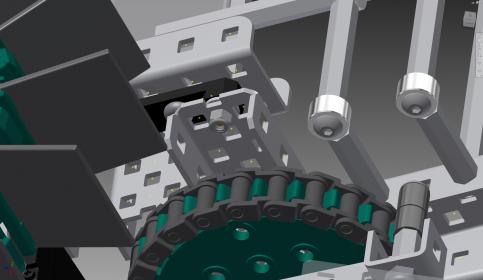
 I started using them every time I mount a pillow block bearing, because those always mount crooked or twist out of place, since they lack the small corner tabs which the regular block bearings have. The shoulder screws keep the holes lined up very nicely. I also use them whenever I need a secure connection between two pieces of metal, but would rather not have to use a triangle support, or when it isn’t an option. They are also useful with standoffs, to keep them from shifting, and hold them centered on the square holes on the metal. Plus, they have nicely thin heads!