I just got my parts shipment from DigiKey with a spool of 1/4" of Flexo Anti-Stat braid and SM712 TVS Diodes. The funny thing is that diodes came in the anti-static bag. 
Some teams considered copper braiding, which is cheaper, but I find copper more suitable for shielding of the cables that are not suppose to move, because once it is bent it tends to stay that way. But that may depend on the thickness of the wires. Also, according to TechFlex comparison table, nylon anti-stat braid should be able to expand much better.
In any case, I was hoping that stock pre-made cables with RJ11 connectors could be pushed through expanded 1/4" braid, but that didn’t work. Unfortunately, they are too large and too square to be either pulled or pushed:

However, there is no problem pulling 1 or 2 strands of the bulk cable through the braid. Here is the ~900mm cable that I custom made with this sleeve:
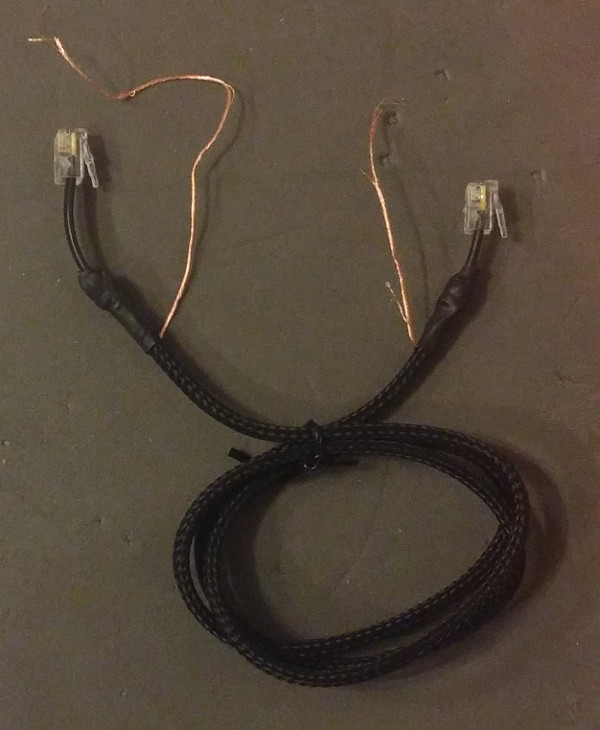
The resistance between copper leads is about 6k ohm (2k/foot), which should be enough to drain any static charge.
I was told by one team that they used to burn a port every 3-4 days, but once they applied anti-static spray to their practice field, they only lost one additional port in about a month. So having additional line of defense against ESD would make sense.
It is still not 100% clear where the static electricity accumulates, but the main suspect is that every time the claw or another end manipulator (that is not electrically connected to the chassis) touches floor tiles it picks up some additional charge.
Then, when charge and, as a result, voltage difference between the end manipulator and the rest of the robot is large enough it could discharge through the motors and cables into the poor 485 driver chips on the V5 brain killing them.
Similarly, if the robot, that somehow accumulated large charge on the chassis, runs into the field perimeter with its end manipulator then it could discharge into perimeter that presumably has very large surface capacitance (or is grounded) and could sink a lot of charge.
The final hypothesis is that static electricity could somehow accumulate on the non-conductive surface of the V5 cables… and the robot could receive ESD while it is being off the field.
In all cases conductive cable sleeve protects the surface of the cables and you could electrically tie all metal parts of the chassis and end manipulators together and to the V5 brain’s ground.
This all is perfectly legal under <R7j>:
[quote]
Commercially available items used solely for bundling or wrapping of 2-wire, 3-wire, 4-wire,
or V5 Smart Cables, and pneumatic tubing are allowed. These items must solely be used for
the purposes of cable protection, organization, or management. This includes but is not
limited to electrical tape, cable carrier, cable track, etc. It is up to inspectors to determine
whether a component is serving a function beyond protecting and managing cables.
[/quote]

