Oh, I see. Looked at the wrong thing then…  Woops!
But what’s the big thing directly opposite the battery? Same mounting location, just on the right. That’s what I thought he was saying the radio was, and that’s what had me worried…
Nothing mounted in the same location but on the opposite side. Here’s a screen shot from the video:
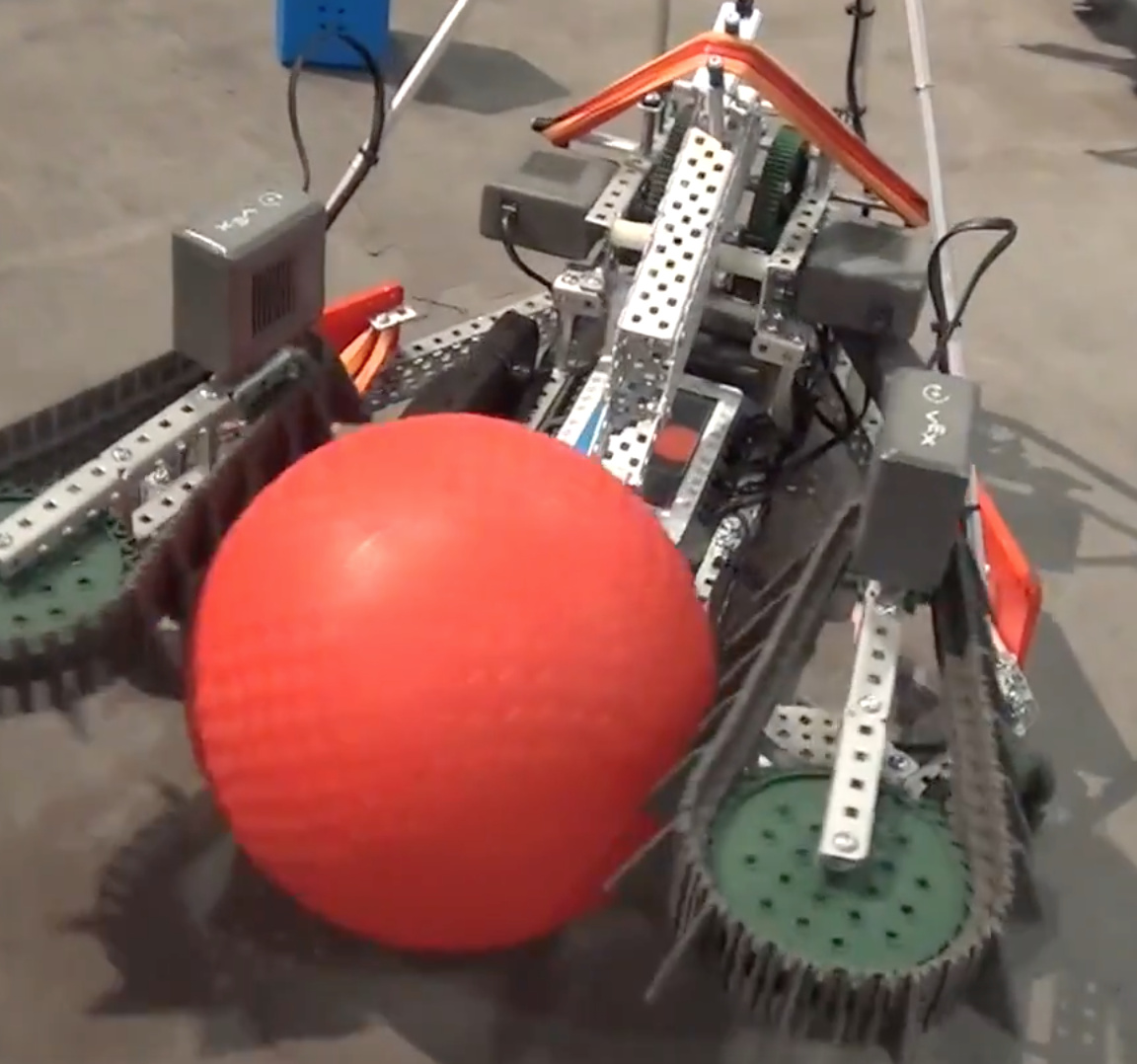
Not sure why the picture @Max_Johnson03 included looks that way.
Edit:
Watch a few seconds of video from the 1:00 point; it’s clear nothing is attached in the “mirrored” position to the battery.
You may have to change playback speed to .25 to really satisfy yourself, but you can tell nothing is mounted opposite the battery.
I can’t see that it will ever be an issue in VRC.
I don’t know the capacity of the V5 battery but let’s assume it is the same as a single Cortex NiMH battery so 3000mAh, I recall someone saying it was pretty much the same. A VRC match lasts 2 minutes so that means in theory at you could draw 90A constantly for that 2 minutes before the battery ran out. I have no idea what the C rating of the V5 battery is but in practice, nobody will ever draw that much. Given that the VRC motor limit (initially) will be 8 motors, that means 11A per motor constantly which just won’t happen.
Again, I don’t know what the V5 motors are limited to current-wise but it will be a lot less than that, and you don’t use motors to their maximum 100% of the time anyway.
The bottleneck with the Cortex seemed to be two-fold. Firstly the way that the Cortex had to be protected for over current in banks of 2 (ports 1 to 5 and 6 to 10) and secondly because of the drop-off of the battery during a match making repetability more difficult. Remember, motors on Cortex are effectively connected directly to the supply rail so see actual battery voltage which won’t be true of V5.
Sure, but consider one of your default assumptions. You’re assuming a team has a large number of back-up batteries already charged so they can swap out whenever needed. More realistically, this isn’t the case. You have to consider charging time as well as usage time. If you have two batteries and it takes an hour to charge one, then the other needs to be able to go for an hour, not 2 minutes. Now, you won’t be driving constantly over that hour. But you may have four rounds and some practice between them. Let’s call that (4x2 min) x2 = 16 minutes of driving time in that hour. All of a sudden you’re 90-Amp calculation drops to 11.5 A. Let’s say you’re running 4 motors at a time on average. Now you’re under 3 A per motor. I’ll need to look up V5 motor specs to see how 3 A max on average per motor would do.
I totally get that, but if teams were using a power expander before they had to have at least 4 batteries, probably 6 as a minimum because the all needed to be fully charged to be any real use. Two will probably do with V5 for many people. And, because the discharge curve is flat, chucking any charge back in them between matches just tops you up unlike with NiMH where you needed to get back to full capacity to get consistency. The proof of the pudding is in the eating as they say, but I suspect this will become a non issue for VRC.