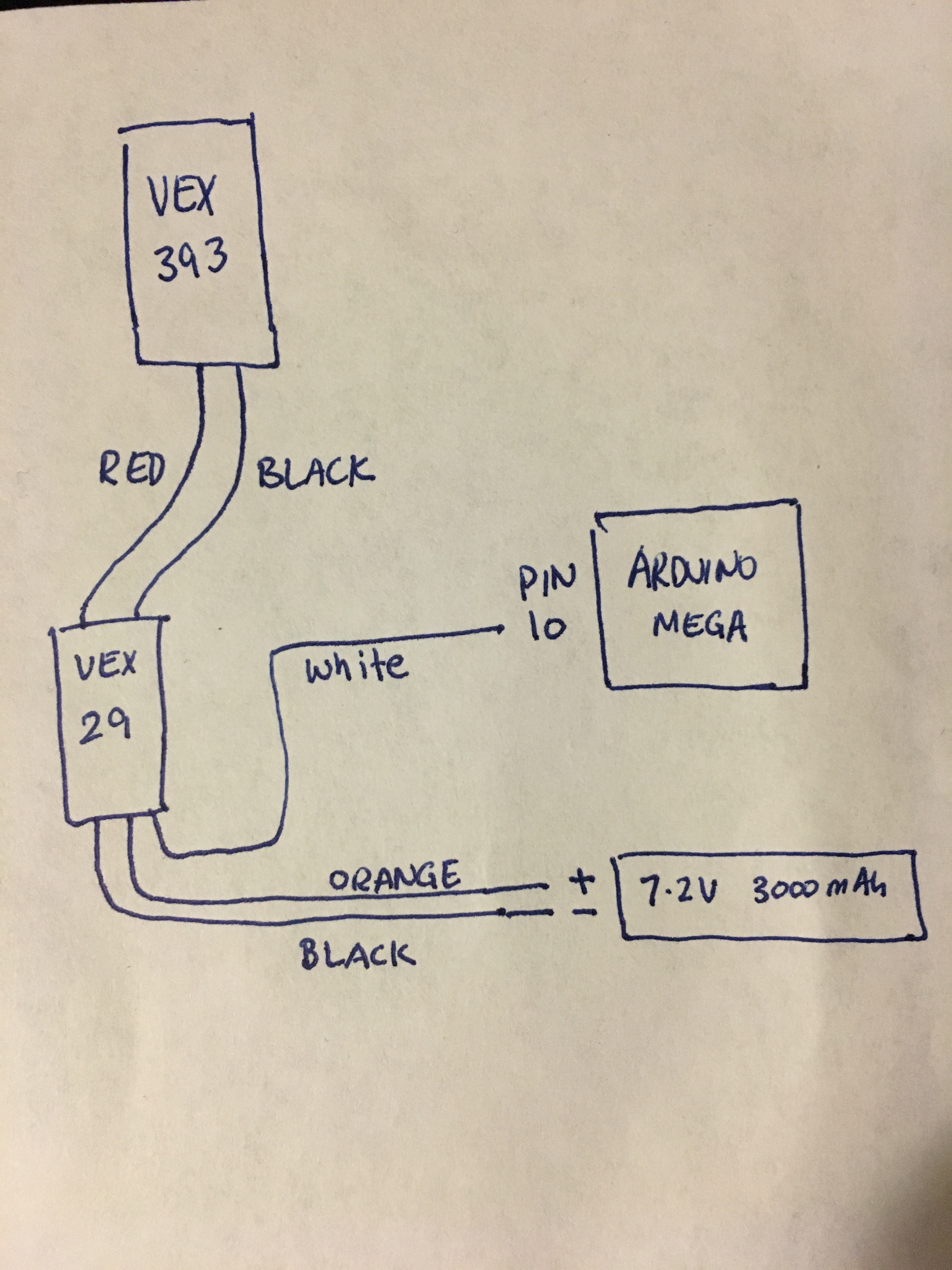
Not via software, you are effectively running the motor at a lower voltage (via the motor pwm), lower voltage means lower current means less torque. You would need to use different gearing between the motor and whatever it is driving to increase torque.
You are effectively giving the motor 2% power here so you can’t expect all that much from it, I’m surprised it even turns. I would suggest gearing so that about 2/3 power goes the speed you want. That way you can raise and lower speed accordingly without too much effort.
ok, I understand that gear system would be the only possible way to achieve torque.
So any suggestion on how much gear ratio I need to be able to move 270 degrees in about 4 seconds while I keep the current at “myServo.write(120);” ?
Or if not, how can I find out how many rotations the motor makes per second when i keep the code at 120 or for that matter any correlation between motor speed and current?
NOTE: I am assuming that Servo.write goes from 0 to 180.
So, you want to be able to do 3/4 revolution in 1/15 minute. Calculation: you want to be able to do (3/4)/(1/15) = 11.3 rpm
VEX 393 motors have 3 speeds - Normal (100rpm), Fast (160rpm), Turbo (240rpm). If you did not open up your motor it is at standard gearing.
For going from 100 rpm to ~11 rpm, I would recommend a gear ratio of 1:7. This gives you a max speed of ~14 rpm, and your desired speed of ~11 rpm at a duty cycle of 80% (servo.write(160)), roughly in line with what @tabor473 suggested. Also, this is really easy to do with VEX: take your smallest gear (12 tooth) and attach it to your motor shaft, then take your largest gear (84 tooth, lots of holes for VEX screws) and attach it to your output shaft.
Here’s how to calculate motor speed from the code. What happens when you write a speed is that you are switching the motor on and off really fast. Speed is (mostly) directly proportional to time on, so the graph of speed is lines connecting full backward at 0 to no rotation at 90 to full forward at 180. Torque does mostly the same thing.
The 393 is a DC gearhead motor, that comes from the factory set for a maximum speed of 100 RPM. The motor also comes with a different set of internal gears that give you 160 RPM (the kids usually call these “high speed” gears). You can order (for extra cost) another set of internal gears that offer 240 RPM, which are called “turbo gears.” You use a small screwdriver to open the motor case on the side with the output shaft to change the gears. The gears themselves are press fit (you can use your fingers) and do not have any kind of fasteners.
Since you do not need anything like even 100 RPM, I would suggest that you don’t need to open your motors or change internal gearing.