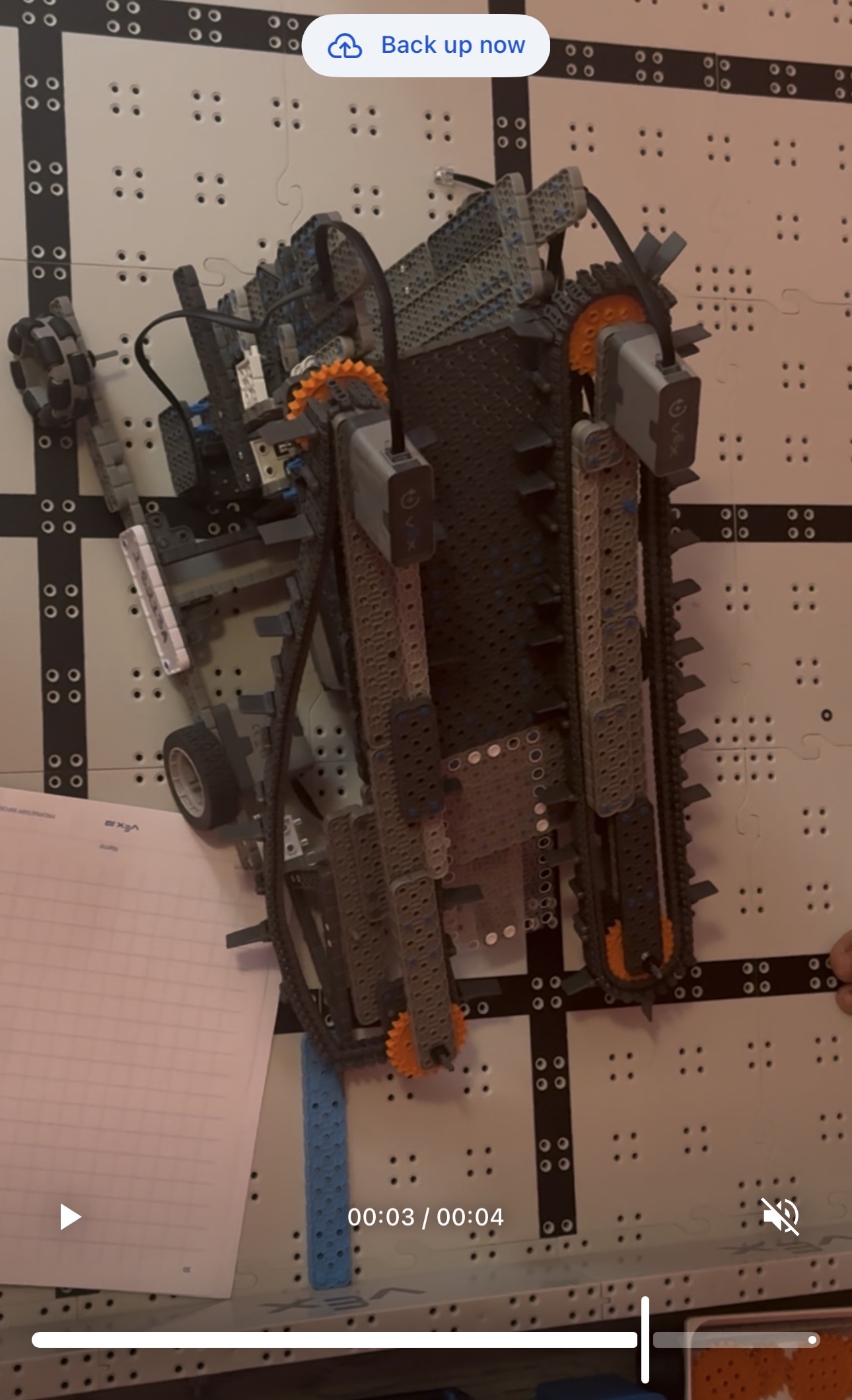
One issue with chains/sprockets is that chain tension against the pins in the middle of the sprocket path is less than at the sprockets themselves. We have a few teams in our league who have struggled with this. Strategically-placed standoffs can help with this. A chain tensioner involving a shock absorber is possible too, albeit pretty advanced, at least for an elemtary school team.
One of our more advanced teams (6th grade, everyone coding and building, very much invested in their conveyor/revolver bot) was having this issue. Their coach was at wits end. The team and I had (coaches family are family friends) a discussion and we discussed methods to affect the chain’s path other than adding or removing links. Turns out they had thought of adding pieces to affect its path, but were worried about friction against any pieces they added that contacted the chain/tank tread. So we discussed which pieces might have less friction if the chain was rubbing it continuously. They immediately went to the round standoffs. They made quick progress after that.
I attempted to have a more detailed discussion where I asked if there were any VEX pieces that might be capable of varying the amount of pressure/friction appied in real time. Deer-in-the-headlights looks (probably my fault with a bad line of questions, as this team is really bright), so I didn’t pursue further. I was hoping at least one of them had heard of the concept of a chain-tensioner, but apparently not.
Regardless, the conveyor/revolver is proving to be a nice challenge for our more advanced elementary school teams. Lots of bright kids and good ideas. Any of the moderators here feel free to disallow this post if concerns over G4.
Regarding G4, I don’t expect elementary teams to be able to spontaneously think of more complicated ideas like chain tensioners. But I feel it is worth hinting around the idea to see if they pick up on it. For instance, my 9-year old son and I have discussed (many years ago) that one purpose of bicycle derailleurs is to change the position of the chain in regards to the gears. This is what everyone thinks of. But we also talked about the extra hanging piece (on the rear derailleur of course) that handles the chain, effectively “taking up the slack” of the chain whenever the gears changed. His bike only has a single front sprocket, with an 8-speed rear sprocket. We worked through how the chain length is always the same, but the distance between the chain sprockets changed witht the size of the rear gears. He quickly realized something needed to happen with the extra chain. I pointed at the derailleur hanger and had the immenesly-satisfying feeling when his eyes lit up and it was clear he “got it”. We then discussed what would happen if the “extra” chain were not compensated for. He was already explaining how the chain would slip or fall off before I got the whole question out. It helped that his chain had occasionally fallen off and he and I had played with the deraileur hanger to get it back on. This was when he was 7. So the concepts are clearly understandable at that age. I grew up with chainsaws and 2-stroke dirtbikes, so learned chain-tensioners from my dad, grandpa, uncles, etc. Not sure how many kids gets this type of mechanical experience nowadays given the prevalence of digital mechanisms, e-bikes, etc. I am not pining for the “old days” here - moving to digital vs analog has seen significant advancements in so many aspects of daily life. But VEX participants could do with more exposure to everyday mechanical engineering.
On a related note, the concept of counterbalance weights recently showed up on a bot in our league. This helped their motors to deal with a lifting arm dealing with a heavy pintake-style intake. The kids came up with the counterweights on their own, which was a real stroke of genius, imo. I told them as such, with several other teams around. “Counterweights” are something a few other teams are now exploring.
Our local airport has clear glass walls for the elvators in the main terminal. Everyone can see the counterweight traveling opposite the elevator car. All I had to do was mention the elevators at the airport and how there was a weight that moved opposite the elevator car for several kids (and some adults lol) to also get nods and murmurs of understanding. I feel this is an appropriate coaching approach, as it may involve concepts that might be foreign to the younger kids, yet simple enough that they are more than capable of understanding when exposed to a real-world example. If they can figure out how to incorporate it into their robot, if appropriate, is of course totally up to them.
Any of us growing up with teeter-totters intuitively understood the counterweight concept due to all the bruised butts we got when our “counterweight” abruptly vacated their position. Or when they weighed considerably less than us. If they weighed more, they could “launch” us off our seats too. In fact, it was game around which “counterweight” could trick the other, resulting in aforementioned bruised butts or undesired “launching”. I haven’t encountered a teeter-totter in the US for years, probably for the reaons I just mentioned lol. Again, digital is great, but some basic mechanics is nice to possess for the bot builders.
Apologies for a long post. Moderators feel free to reject.