Could someone ask if refs actually need to wait for flywheels to spin down to score, please?
I mean, do we really need this level of hyper-precision? If the spinning flywheel has no ability to change the field, does it matter if refs start scoring before it stops in the interest in keeping the event on-time?
Game elements come to a stop. Not caring about your robot. Well there are the hanging games, but not this time.
Note the rule states specially to wait for robot to come to rest. I am ok with flywheels spinning as long as no interaction with game objects or displacing itself on the field.
No need for Q&A.
I noted that and went "Umm, not going to wait 30 seconds for your flywheels to maybe spit out a disc.
I’ll wait for the GDC to rule on “flywheels must stop before scoring” as a must and then I’ll re-campaign on BO3.
Expansion while driving over the barrier
Both robots A and B pass inspection and fit within the size limit. However, robot A is very close to being 18 inches long, and robot B is being very close to being 18 inches tall. As these robot drive over the barrier, they change there angle and orientation. As robot A drives over, the bottom front of the robot and top back of the robot are now more than 18 inches apart in the x (horizontal) axis. The same thing happens to robot B in the y (vertical) axis.
To start, this q and a seem to give the impression that the legal size does not rotate with the robot. Is this correct?
https://www.robotevents.com/VRC/2022-2023/QA/1119
< SG4 > Horizontal expansion is limited until the Endgame. Robots may not expand beyond a horizontal area of 18” x 18” at any point during the Match prior to the Endgame.
Would robot A be expanding beyond the 18" x 18" area and violating rule SG4 even though they are not physically expanding?
< SG5 > Vertical expansion is limited. Robots may expand vertically within the following conditions:
a. The Robot must not be contacting the gray field tiles in either Low Goal.
b. No part of the Robot may exceed an overall height of 24”. This height limit is a “virtual ceiling,”
meaning that no part of any Robot may ever exceed 24” above the foam tiles, regardless of
Robot orientation.
c. Any extensions or combinations of extensions above 18” must fit within a vertical cylinder 2” in
diameter.
Would robot B be expanding beyond the 18" high limit and violating rule SG5 even though they are not physically expanding?
Should inspectors check and see if teams are at risk of violating either of these rules during inspection? If one or both of these robots is committing a rule violation, how should the referee know if such a violation occurred Especially considering it would be a small expansion beyond allowed tolerances, and it would not last long. And finally, would this be considered a major violation? The argument could be made that it is a teams own responsibility to know the size of their robot, and the team would be making a conscious decision to drive over the barrier thus intentionally violating the rule intentionally. Also, this violation would strategically impact gameplay as it would likely save the team time rather than driving around the barrier.
Also, would the answer be changed at all if it was a robot driving over a disc instead of the low goal? And would the ruling change if the robot got stuck outside the legal size limit while driving over the barrier/disc.
Below is an image showing the scenarios. The barriers are in red, the tiles in light gray, the robots in dark gray, and the legal size area in light blue.
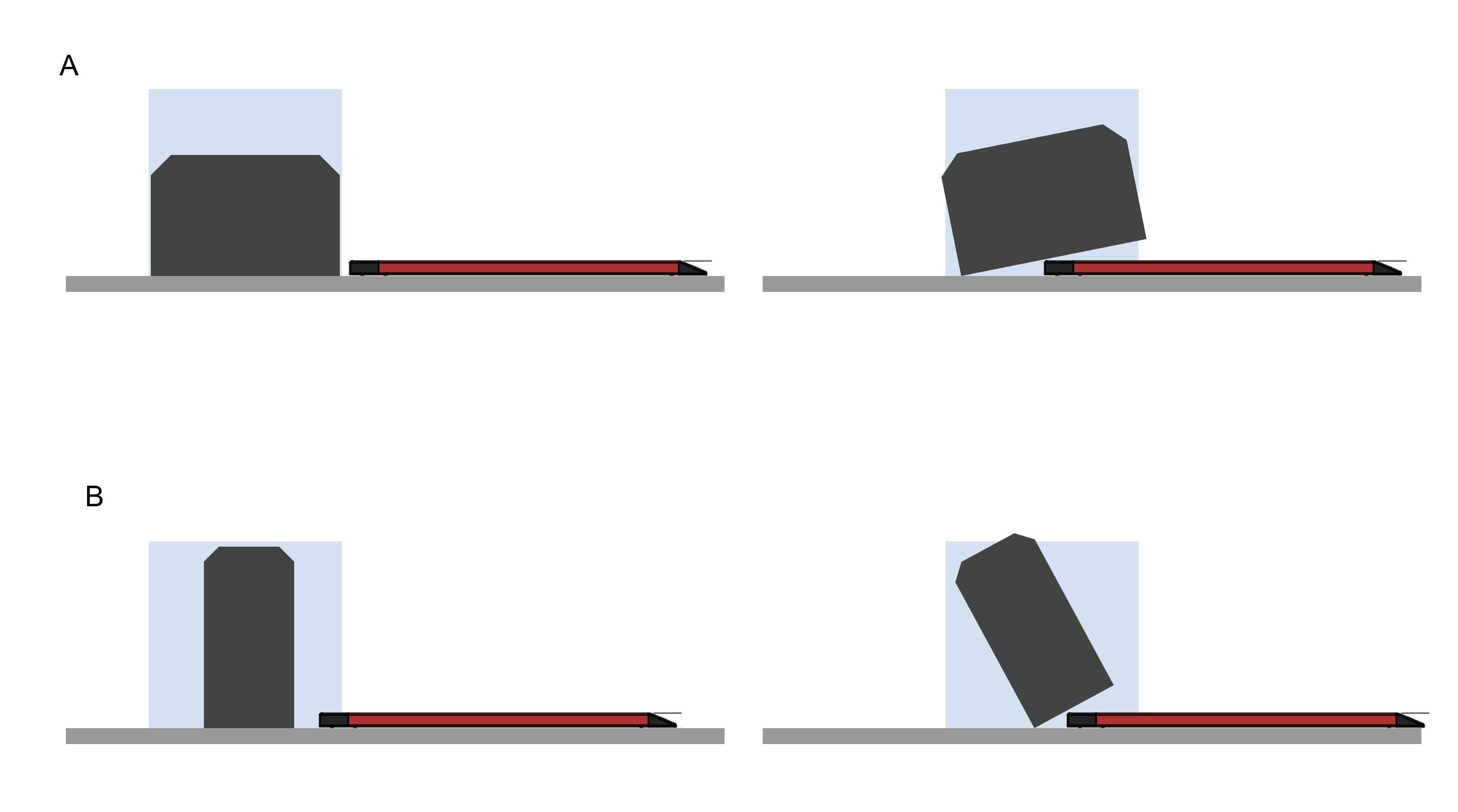
Thank you for taking the time to answer these questions.
I will be posting this later in the q and a, just thought I would show it to the forum as you can’t view unanswered questions. Personally, I feel these would both be violations, but it would be very hard to enforce these rules.
Also, if you have any thing that you think would be useful to add, I can add it on before I submit.
First, remember that these are not official answers, but the quick answer is that referees do not look at these incidental and unintentional bits of expansion that occur when a robot bounces over a barrier or comes to a quick stop and rocks up onto its front wheels, etc, and momentarily but unintentionally breaks the expansion limit.
I know that. However, driving over the barrier is not unintentional or incidental. That’s why I think it might be illegal.
One question I would ask is, “Due to SG5A banning expanding in the low goal, Would the robot in figure B not be in violation entering the low goal but would be in violation by exiting?” or something of that nature. It is just so that if they do rule it illegal, it could be a fallback to preserve some rights.
I think in the way the rules are written and the situation you described that the robot does violate SG4 and/or SG5. Another example of this could be driving over a disc which lifts you up slightly, and to that point what happens if you get stuck on a disc?
I don’t think that these situations should be legal and that some clarifcation is necessary.
I’m going to assume that it would all illegal or all legal as either way all vertical expansion must be beneath 18 inches unless you do the weir cylinder thing.
I’ll edit the original post, but I think that would be less likely to be ruled illegal.
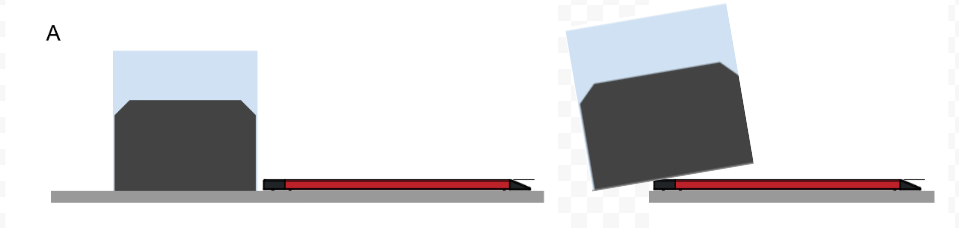
Except it very clearly doesn’t do this. The GDC has explicitly stated that the sizing box is parallel to the ground.
Good point, however this case seems a bit different. The robot does start within 18x18x18 parallel to the field at the start of the match.

I think you are right here - so ask the Q&A does the sizing box check be parallel for this situation and should teams be warned at inspection that they risk violating rules by climbing over barrier …
But your bot would really need to be pushing the 18" cube to be at risk. Although I’ve seen plenty of “cubes” for some games, most teams don’t build to the cube, and thus would have leeway to cross the barrier and the question becomes a moot point.
Literally, too many novice and middle school teams take this path of building structures that hug the constraints…
thanks for clarification from GDC which of three sizing tools to use!
When I was building my first robot in Turning Point, I didn’t really yet understand key aspects of the design process, and thought “oh the size limit is 18”? they make 17.5" c channels? i should just use those". Since then I have realized that the optimal chassis size depends entirely on the game, and that it’s usually better to err on the small side.