Oh yeah, I agree that the dr4b is better, it’s just not what I want to do, I don’t have a goofy clone I just used a motor for that cuz may aswell
Please have private conversations through DMs.
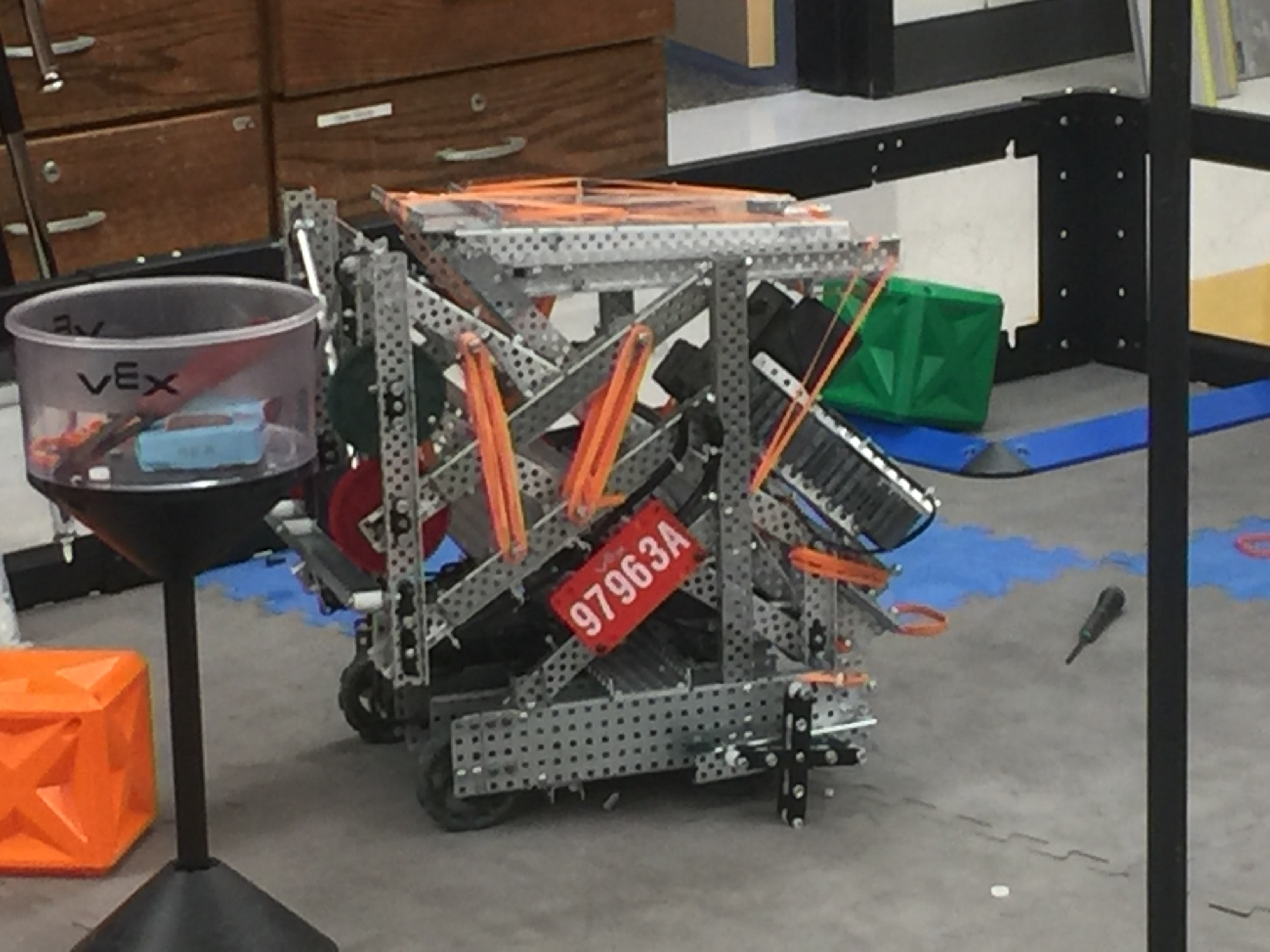
@Flip_Gunderson , don’t waste two motors on a lift if it is not a DR4B. If you gear it right it can work just as well as a two motor one. And if you are having trouble with it lifting up, just add some rubber banding.
there’s a easy way around it
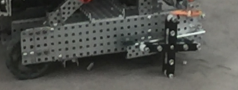
These wheels look pretty interesting to me, are they made out of ABS? It somewhat reminds me of the old VEX Leg-wheels that were advertised for “outdoor use” back when they were brought into the store.
Yes those are abs wheel legs. We need anti tip mech (our drive wheels never enter the goal zone), and we don’t want our robot to be lifted up while crossing the goal zone. Wheel legs can achieve that easily.
Even a dr4b works fine on 1 V5 motor.
you need to gear it down a lot though
1:7 won’t work unless you make it really light
if you use a 100 RPM cartridge it should.
I’m aware that we are talking about the 100 rpm cartridges. well maybe but in my experience 100 rpm with an external 1:7 gearing struggles to lift even a 2 bar in a goofy style bot
-
That’s y u use two motors on an rd4b
-
You can’t rubber band a two bar (glad to see some one try tho)
-
Code will always be the reason y robots are good. Simple P loop can keep the lift up
Edit: Some of this is wrong, keep reading
EXACTLY
20 character s
You could simply extend a pin above the point of rotation and rubber band the bar to that way, or you could turn it into an offset 4 bar and rubber band that.
rubber banding a single arm is actually quite easy if it’s range of motion is small enough. goofy arms don’t lift very far, so all you gotta do is add a little 4 bar attachment to the base of the arm, and you can band it there, and it’s a great place to add supports as well.
I find a lot of this to be quite misleading. You definitely dont need 2 V5 motors on a rd4b. It is really easy to rubber band a 2 bar as seen with 99% of starstruck robots. P loop is not a very good solution for a lift, you would need atleast a PI loop and most likely a full PID loop to make a lift run effectively. P loops can easily overheat a motor if their tuning is too high, and if you go any lower than that your movement becomes very slow. P loops work fine for small lightweight mechanisms, but quickly fall apart when tested on something load bearing.
First off, I say two motors specifically for this year because of the heavy load that will most likely be carried. Ik that 1 motor dr4bs can and have been done (1320 tp). Second, the rubber band thing is my bad. I haven’t really looked at starstruck too much considering I started vex in ITZ. Lastly, I probs shouldn’t have said anything abt the code  . Personally, I use a full pid loop but I heard somewhere that you could just use a p loop.
Sry for any misconceptions caused by my misunderstanding.
Thank you for your clarification.
So how much of the robot is aluminum, and how much is steel?
Also, what advantages did you see with using the 5-hole-wides on the base as opposed to regular c-channels?
There are some things I agree and disagree within this thread.
This really does depend. The main reason why my robot worked so well with one motor with 200 RPM and 1:7 gear ratio is because the lift, although looked bulky, was incredibly light (Seen in the reveal, they are using C-Channel Box bracing rather than X-Bracing, because it’s lighter and smaller) and the banding was tuned explicitly to be near linear with only two points. So, if you want your lift to be fast and only use one motor you need the following:
- Light field elements and in low numbers
- Lift that uses KEPS screw joints, in all places possible (Even through the gears)
- Lift has no more than 2 axles for its support, so you can track the position of the lift with a potentiometer
- Rarely use X-Bracing, as it is heavier and there are alternative, lighter methods that provide the same support (Such as C-Channel Box bracing, as seen in the video)
- Drill out the holes out of C-Channels that any axle or screw will go through, if the hole has a bearing flat screwed onto it
- Use regular bearing flats, with the joints and axles located in the middle of the 3 holes, as much as possible between two anchored points.
- You don’t need triangle bracing for your lift to be linear. In fact, triangle bracing, for the most part, makes the lift have more friction which will not be good if you are planning on doing one motor. You should be doing two point bracing in a manner that makes the lift linear.
If you lift up 10 of the cubes, you will be lifting up roughly the weight of TWO mobile goals, or 1 Mobile goal and 10-12 cones if you know the struggles from In The Zone. My cap bot only lifted 0.6 Ibs of weight. So if you’re planning on doing one motor you should be either doing 100 RPM 1:7 with one motor or 200 RPM 1:7 with two motors, and even that will likely be more or less a struggle for most teams. If you wish to copy my method of gearing if you’re attempting one motor, it will not work, as the HS gears are plastic the HS inlet will strip from all of the stress/momentum shifts.
Very intuitive thinking! But considering the repetitive shaking motion while moving how does it affect your autonomous? I cannot see the extra sensors on the robot, but I’m assuming you have tracking wheels?
It is definitely possible to rubber band a two bar. Look up StarStruck season and you will see plentiful examples on how teams rubber banded a two bar.
And most importantly, anything is possible with the right gearing or right support 
^ Agreed. And if you look in “In The Zone” you can even see methods of rubber banding for two bars that are capable of extending past 250 degrees of motion.
Considering the delicacy of handling cubes into towers during the matches, I have to agree with this.
I partially agree. Motors can even overheat even with PID because it doesn’t consider momentum/inertia compared to the force applied. This is where motion profiling comes in, but to be frank your robot should be built in a manner where the motor would never overheat even without motion profiling.
To be honest, even if the mechanism is lightweight you should always use PID. If the mechanism is light then it would be very easy to overshoot the position, hence is why PID exists to compensate and re-adjust from the overshooting.
I agree, and I would definitely suggest teams to do a 2 motor lift if they are incapable of following build quality techniques.
I used a P loop in StarStruck for my two bar, primarily because:
- My knowledge of coding was still developing
- I didn’t know what PID is
- The elements were massive so there wasn’t a need for something so precise