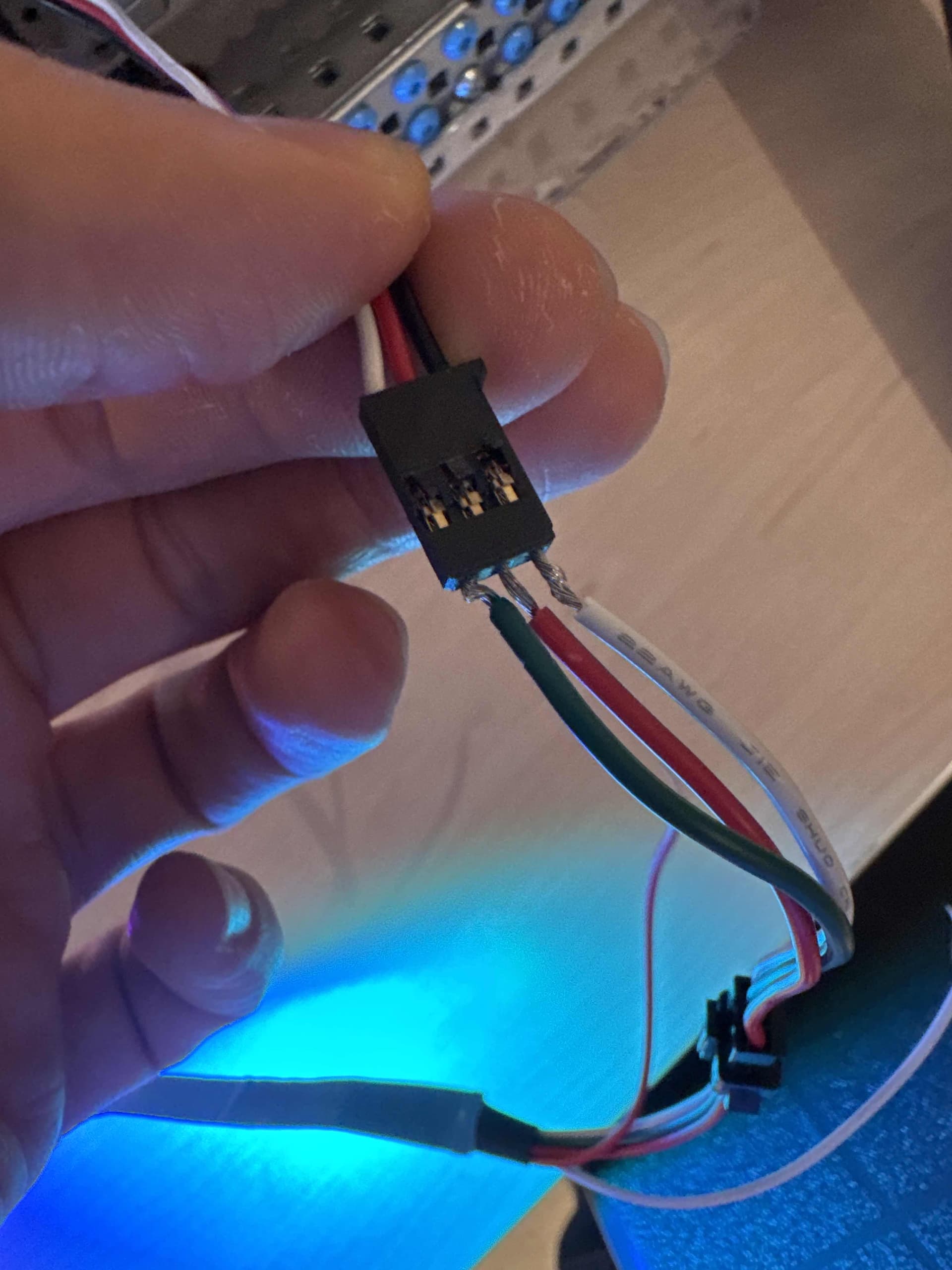
Would someone be willing to submit a Q&A asking if this style of solderless 3 wire LED connectors are legal? I wrote some text below, but our team isn’t currently registered so I can’t ask the question.
Google doc link to the same text, if that makes it easier to copy: Legality of Attaching Addressable LED Strips to the v5 Robot Brain, Without Soldering - Google Docs
Legality of Attaching Addressable LED Strips to the v5 Robot Brain, Without Soldering
In previous seasons, teams have been seen to use addressable LED lighting strips on their robot as decoration and to provide driver feedback, under Rule R24g; “Decorations which provide visual feedback to Drive Team Members (e.g., decorative lighting) are
permitted, provided that they do not violate any other rules and serve no other function”
Under Rule R8, “microcontrollers or processing devices [other than the VEX V5 Robot Brain] are not allowed, even as non-functional decorations.” Per this rule, teams previously directly soldered addressable LED strips without microcontrollers to 3-wire wires, plugged into the brain. The VEX V5 platform supports addressable LED controlled by 3-wire, as described by the official VEX API reference site; https://api.vex.com/v5/home/python/AddressableLED.html
Q&A #2652 states specifically soldering LEDs to wires or other components is not allowed under Rule R27.
Rule R28d which states “3-wire electrical components may be repaired by soldering or using twist/crimp connectors, electrical tape, or shrink tubing such that the original functionality and length are not modified in any way,” which is an exception from Rule R27e.
Provided the use of addressable LED strips is allowed for the VEX v5 Robotics Competition, if soldering to connect addressable LED strips to the brain is not allowable, would any of the following scenarios be allowable?
Scenario A: A team uses an off the shelf “3 Pin Solderless LED Light Strip Connector” as a connector between a 3-wire wire and an addressable LED strip. The brain is then used to control these LEDs.
This is not expressly allowed under Rule R20, which allows certain non-VEX components to be used.
Scenario B: A team uses tape to attach the ends of a 3-wire wire to an addressable LED strip. The brain is then used to control these LEDs.
Rule R22a allows the use of tape to secure connections between any 2 VEX cables, or Rule R22d allows the use of tape in any application that would be considered a non-functional decoration.
Scenario C: A team uses zip-ties to attach the ends of a 3-wire wire to an addressable LED strip. The brain is then used to control these LEDs.
Scenario D: A team trims and modifies the ends of an addressable LED strip to interface with a 3-wire port on the brain. The brain is then used to control these LEDs.
Scenario E: A team purchases off the shelf, pre-assembled addressable LED strips with a 3-wire connector already attached. The brain is then used to control these LEDs.
Scenario F: A team attaches an addressable LED strip using any of the fastening methods listed above, but instead of attaching said LED strip to a 3-wire cable, the strip is attached to a V5 Smart Cable. The brain is then used to control these LEDs.
Rule R21c states “V5 Smart Cables may only be used for connecting legal electronic devices to the V5 Robot Brain.”