Are H drive trains good for push back?
I personally dont think so. An H drive generally does not have much strafing power, and in this game it has real potential to be overpowered while being pushed.
In VRC for so many games it seems like H- (or X-drives) and ability to adjust/line up very exactly would be very helpful, and might be dominant in skills (I mean, the VexU team that maxed skills uses X-drive), but it seems like they’d just get massacred in teamwork matches in V5.
dont you need 7 motors for a H drive anyway? if so thats way too many.
Well not necessarily. You can have a wheel free that is horizontal from your drive train wheels so your robot will “drift”
I feel like you don’t want drift around since it will make guarding the tubes much more difficult as you can get easily pushed around.
But then why would you want a h-drive if you didn’t want to move sideways? A unpowered omni wheel in the middle perpendicular to the drive would also not also you to strafe either. Friendly reminder that an all omni drive can drift on its own and also an all traction drive won’t drift any more necessarily with the free wheel in the middle perpendicular to the drive.
where are you. there is no need to specifically annotate on that image.  and no you cannot put the traction wheel there
Complexity is a pain.
Avoid complexity.
Embrace simplicity.
For the sake of the argument, I will be turning off friction like your everyday physics teacher.
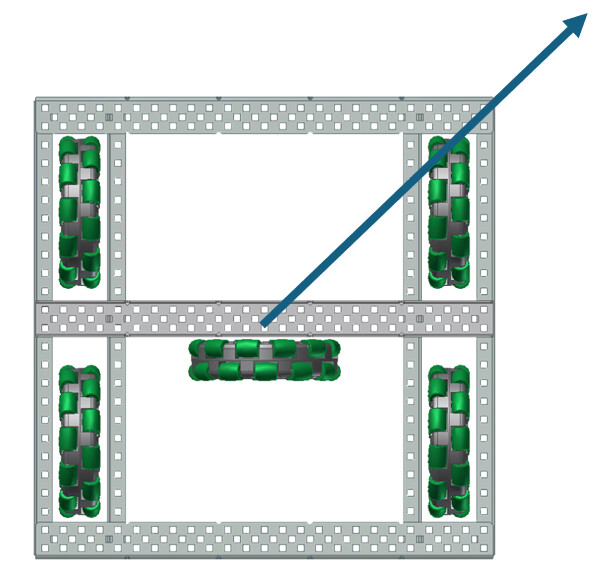
If you have a forward speed and a sideways speed, the diagonal speed for an H-Drive is sqrt((forward_speed)^2 + (sideways_speed)^2)
If we assume that the robot is going forward 3 m/s, and also strafing 3 m/s, the resulting would be sqrt(3^2 + 3^2) = sqrt(18) = 4.24 m/s that direction. This is an increase in speed that designated direction compared to the laterals.
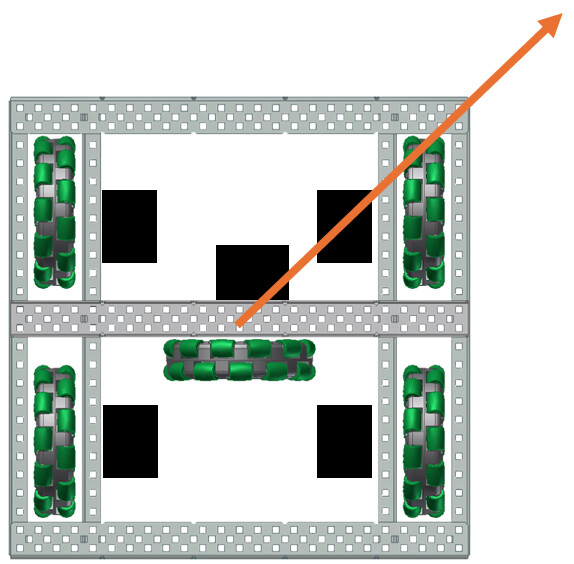
For the sake of testing, I will assume that adding a motor for a wheel will contribute 5N of force the designated direction for the chassis. I am assuming this applies for all motors for the sake of testing that they contribute 5N for a speed of 3 m/s. It is important to note that I am not taking friction into consideration, for now.
From this, the forward direction would contribute 5x4=20N of force, with the sideways direction contributing 5N of force.
The force that direction would be sqrt((forward_force)^2 + (sideways_force)^2)
Therefore, the force that direction is sqrt(20^2 + 5^2) = sqrt(400 + 25) = sqrt(425) = 20.61 N of force diagonally.
Now, let’s compare that to a 4 motor X-Drive. For testing, I will rotate the design 45 degrees to match up to the H-Drive:
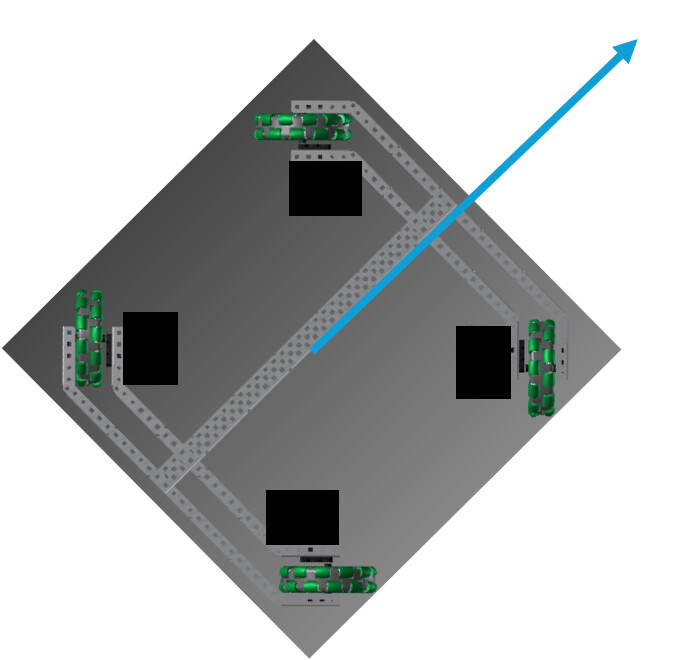
If you have a forward speed and a sideways speed, the diagonal speed for an X-Drive is sqrt((forward_speed)^2 + (sideways_speed)^2)
If we assume that the robot is going forward 3 m/s, and also strafing 3 m/s, the resulting would be sqrt(3^2 + 3^2) = sqrt(18) = 4.24 m/s that direction This is an increase in speed that designated direction compared to the laterals.
Now, let’s compare force. For this, we have two motors and two motors, which means 5x2=10N forward and 5x2=10N sideways:
The force that direction would be sqrt((forward_force)^2 + (sideways_force)^2)
Therefore, the force that direction is sqrt(10^2 + 10^2) = sqrt(200) = 14.14 N of force diagonally.
If on paper, H-Drive looks better, why is X-Drive preferred?
Think about the major factor of the X-Drive. The primary direction it moves. Let’s un-rotate the X-Drive to what we should percieve it as:
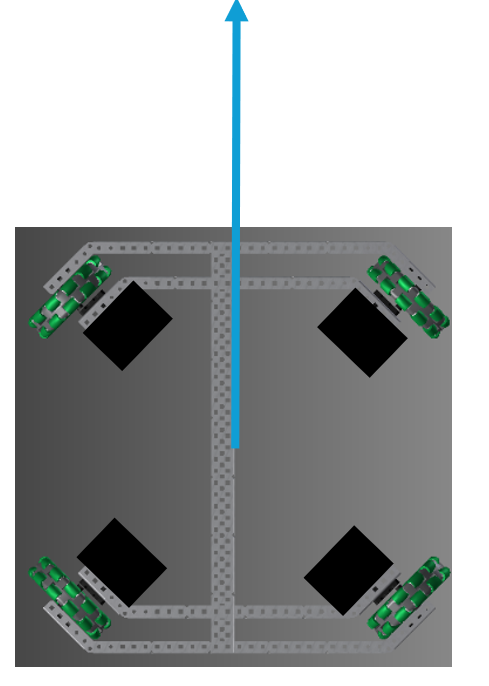
If we have the X-Drive going forward, it will be going a speed of 4.24 m/s with a force of 14.14 N.
It has a force-to-speed ratio of 14.14/4.24 = 3.33
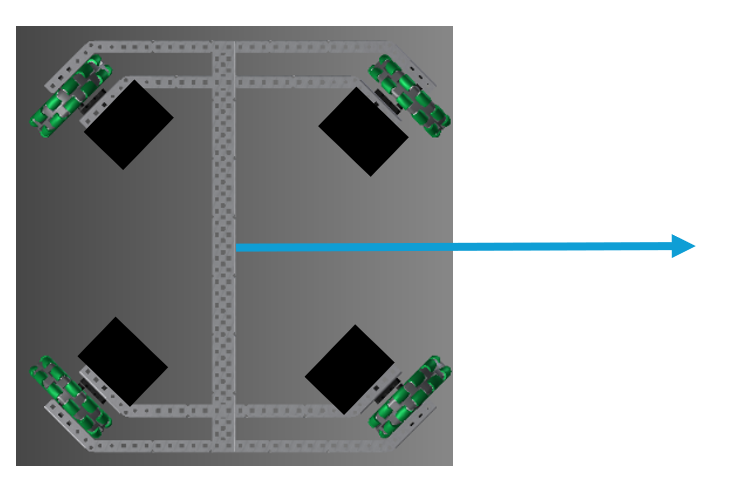
If we have the X-Drive going right, it will be going a speed of 4.24 m/s with a force of 14.14 N.
It has a force-to-speed ratio of 14.14/4.24 = 3.33
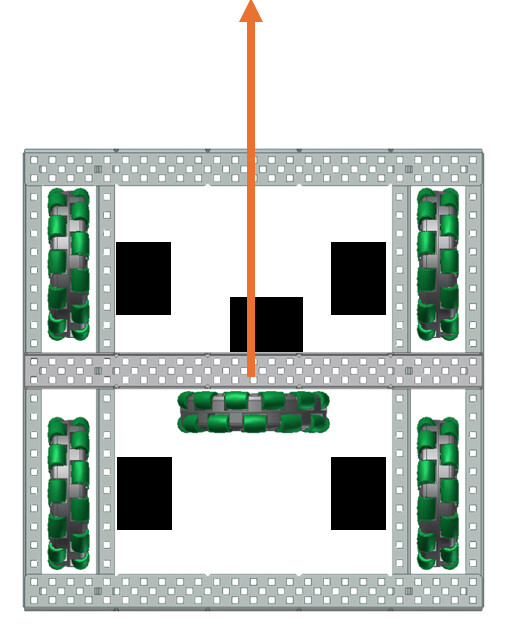
If we have an H-Drive going straight, it will be going 3 m/s with a force of 20N
It has a force-to-speed ratio of 20/3 = 6.66
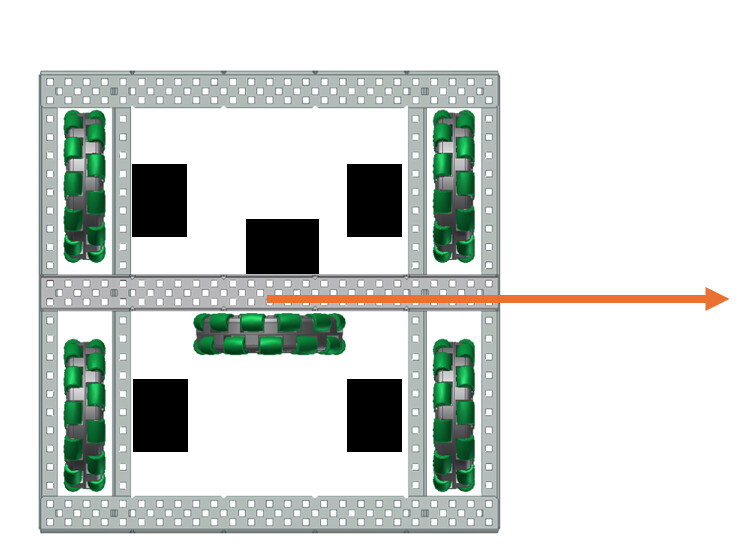
If we have an H-Drive strafing, it will be going 3 m/s with a force of 5N
It has a force-to-speed ratio of 5/3 = 1.66
Under these circumstances, we can deduce the following:
- A 4-Motor tank drive has roughly twice the amount of force as a 4-Motor X-Drive
- A 4-Motor X-Drive goes 41% faster (
3m/s versus4.24m/s) than a 4-Motor Tank Drive with similar gearing when traveling forwards - When you now consider friction, an H-Drive has an uneven force profile forwards versus sideways, which may cause a programming issue with acceleration and sideways motor burnout from defense. To increase the force, either add more motors or make the strafing have a slower speed via smaller wheels or gear ratio.
My Suggestions
X-Drive:
- The game demands strafing large distances
- You have 4 or 8 motors to dedicate. Any multiplier of 4, essentially.
H-Drive:
- The game requires fine-tuning adjustmenets (like shooting in Turning Point, or Spin Up) → Strafing one inch is easier than trying to turn half a degree long distances.
- A free motor must be available to use for strafing
- There must be space for the strafing motor
- Should act like a tank drive most of the time and has the power of a 4-Motor tank drive.
Tank Drive:
- Defense is a necessity
- Strafing has negligible impact on the game
- Highest space efficiency for adding more items
Note that if the game does not require fine-tuning adjustments or strafing long distances, and you are able to obtain two free motors instead of merely one, it would likely be better suited in a Tank Drive format and make the Tank Drive stronger.
It is also important to note that adding more mechanisms to the Drivetrain can compromise adding odometry pods or powerful systemt that can make autonomous programs greatly better and more consistent.
Correction:
Power = Force * speed
- A 4-Motor (
20x3=60W) tank drive has the same power as X-Drive (4.24x14.14=60W) - A 4-Motor tank drive has
20/14.14=1.41= 41% more force than an X-Drive when traveling forwards. - A 4-Motor X-Drive goes 41% faster (
3m/s versus4.24m/s) than a 4-Motor Tank Drive with similar gearing when traveling forwards
Can’t you use 6 motors, with each wheel being 16.5w of motor power? Or am I misunderstanding?
Yes. Are you referring to the Asterisk drive? I think it would be worth looking into or even trying out. However historically I never saw such a design flourish. I believe it is likely because teams either didn’t consider it a viable option or teams believe in keeping drivetrain designs simple. Or maybe it is due to motor limits playing a key role in certain seasons.
If a high quality team team is able to crack and exploit the benefits of Asterisk drive, they may have similar success like 7K, 5225A, and other world class teams who found advantages of mecanum drives:

Only time will tell. Experiment and see how it goes! 