Yeah, that’s the thing. I think many teams just used pneumatics for their transmissions, which should be a viable option next year.
Make a mechanical system that turns an axle backwards if the motor is at half speed and forwards at full speed. The you can turn the motor in reverse to switch the transmission and forwards at different speeds to control the direction of that axis. It’s foolproof
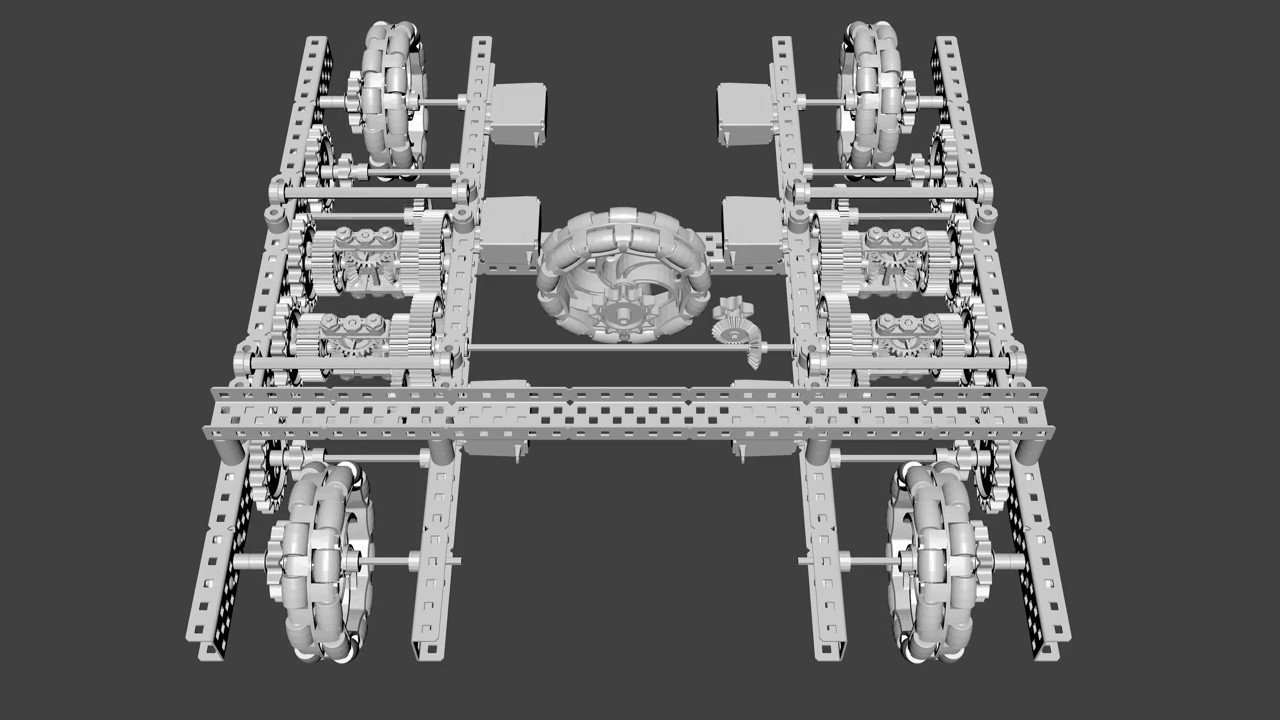
designed by @Mr_L_on_Yoshi
I highly doubt the 4 motor drive will ever go extinct. In all honesty, there will be probably years where teams manage 6 motor drives. I know on some IQ boards I’ve gotten away with only one motor manipulation systems, and I doubt we’re going to see any more complex boards. I also think passive intakes will start to prevail more with V5’s as one lost motor to an intake is a huge deal now.
What do you mean by “boards”?
Mr. Copioli just posted again on the “V5 render release thoughts” thread and mentioned that if you use pneumatics your motors will be reduced from 8 (much like the existing rules).
Although pneumatics aren’t necessary, they can be super helpful. However, with less than 8 motors I think people would really struggle to create robot using a holonomic drive.
In other words, I doubt pneumatics and holonomic drives will mix with V5.
Please consider that IQ teams are routinely assigning 3-4 out of their 6 motors to the drivebase. Some even using X drive.
So 4 out of 8? Any day…
And it should be possible to make an h drive with three motors using a torque in the middle. I don’t see any reason a holonomic drive isn’t an available choice if it is valuable for the game.
But, they are playing iQ games and we are playing EDR. Not all the teams can spare 4 motors for a drive. This year we are using 6 because we have 6 ports left but v5 is limited to 8. But honestly, it all depends on the competition we have next year.
Of course, 2 or 4 motors in direct drive configuration are always the most simple and efficient drivetrain options.
However, I think the next season everybody will be excited to figure out and learn how you could allocate arbitrary number of motors to the drivetrain: 2, 3, 4, 5, 6, 7, or even 8.
What @Mr_L_on_Yoshi did (video a few posts up) is just one example of many creative designs (although large number of axles requires very good build quality to avoid tons of friction).
For instance, there are multiple options to use 3 motors and not all of them are as inefficient as a kiwi drive.
Direct motor output range from 100 to 600 RPM offers very interesting possibilities that do not have to sacrifice a lot of efficiency.
Was it ever 8? I competed as far back as elevation but can’t remember the rules then. Cleansweep allowed 10 motors. (they were ■■■■■■ 3 wire motors of course)
I was thinking of the PIC (0.5) micro-controllers, they only had 8 motor ports. I checked the manual from my first year (Hangin-a-round) and they allowed up to 10 motors/servos. But I don’t think back then we used more than 8 motors. – Sorry for the confusion.
You are right, those little motors were a pain, but I still have some and use them in low powered projects.
We still use those 3 wire motors on our claw, since they’re lighter and it doesn’t need much torque
Not that it would be easy with VEX parts or probably in general, but just looking at the theory, consider the following. Set up two ratchets working in opposite directions. Your motor spinning one way drives the robot. Rotating the motor a certain amount backward switches transmission modes (+x, -x, +y, -y, +rotate, -rotate). It still wouldn’t give you all options available with four motors (such as moving in any x-y direction), but you could get forward-backward/strafe/rotate all off of a single motor.
@Not12G please don’t spam this everywhere
@DRow help
+1
Wait… no y cables?
I think it will occur, but only with teams really skilled at motor management.
Or maybe if the new game makes holonomic drives and pneumatics really good/useful, maybe a lot of teams would do it. That’s something I’d like to see