Unfortunately, the livestream was taken down, and videos are no longer available. If anyone has any interesting moments captured off line, please, chime in. There was a lot of very good play there.
Flywheels were, clearly, the optimal design choice for Nothing But Net season because you had to shoot stream of balls at a single target. (I think there was only one puncher that made it into the Worlds’ finals).
This season, it was the goal of the GDC to make the game, where there is no obvious preferred design choice. You have hard constraint of possessing only two balls at a time and you need to hit different targets.
All double catapults, angle changing punchers, and adjustable angle flywheels have their own pros and cons. Each design have its own believers and it all comes down to whether you like to spend more time perfecting your hardware or your code.
Flywheels certainly demand both good build quality and sophisticated program to run them. But in return they seem to offer some very unique capabilities not possible with the other launcher types, since you could control both balls’ exit angle and exit velocity with flywheel’s RPM.
To target two flags from a fixed location, it is enough to tune flywheel’s moment of inertia, backplate compression, and its speed (RPM) such that it loses just enough kinetic energy after launching the first ball to hit the second flag at the reduced speed.
However, to be able to doubleshot from an arbitrary location, in addition to variable ball’s exit velocity, you need a second tunable parameter such as ball’s exit angle. This could be done by tilting entire robot, tilting only its flywheel assembly, or simply adjusting angular position of the backplate around the flywheel.
This will, also, let flywheel run at the higher RPM to target flags on the ascent segment of the parabolic trajectory, which allows higher ball’s kinetic energy and more force to flip the flags. Without some sort of the angle changer it could take so long to slow down the flywheel, that most of the teams just choose to drive forward to hit the mid-flag.
As the bonus of the adjustable exit angle, you could tune the flywheel for a Tripleshot from one specific distance from the flagpole. And, although that would be awarded with an instant DQ, that would be an amazing feat of engineering! An attribute of the truly excellent team!
Yes, with the lack of evidence to the contrary, I would agree that 91A and 6121C are at the moment the best flywheels in the world for this season.
If the unfortunately taken down videos were still available, you could see that both 91A and 6121C’s double-shot works great and fast for the autonomous and skill runs, rivaling double ball catapult, but is vulnerable to the same limitations as the 2BC during the ordinary game play. You need time to aim and shoot from the specific location which is not easy when defense is pushing you around all the time.
The main constraint of the VRC designs is the limited number of motors. If you need more powered functions in one subsystems you have to take them from another subsystem or find a creative way to share the power between several functions.
Here is a great example of employing ratchets to build an angle changing puncher with just a single motor:
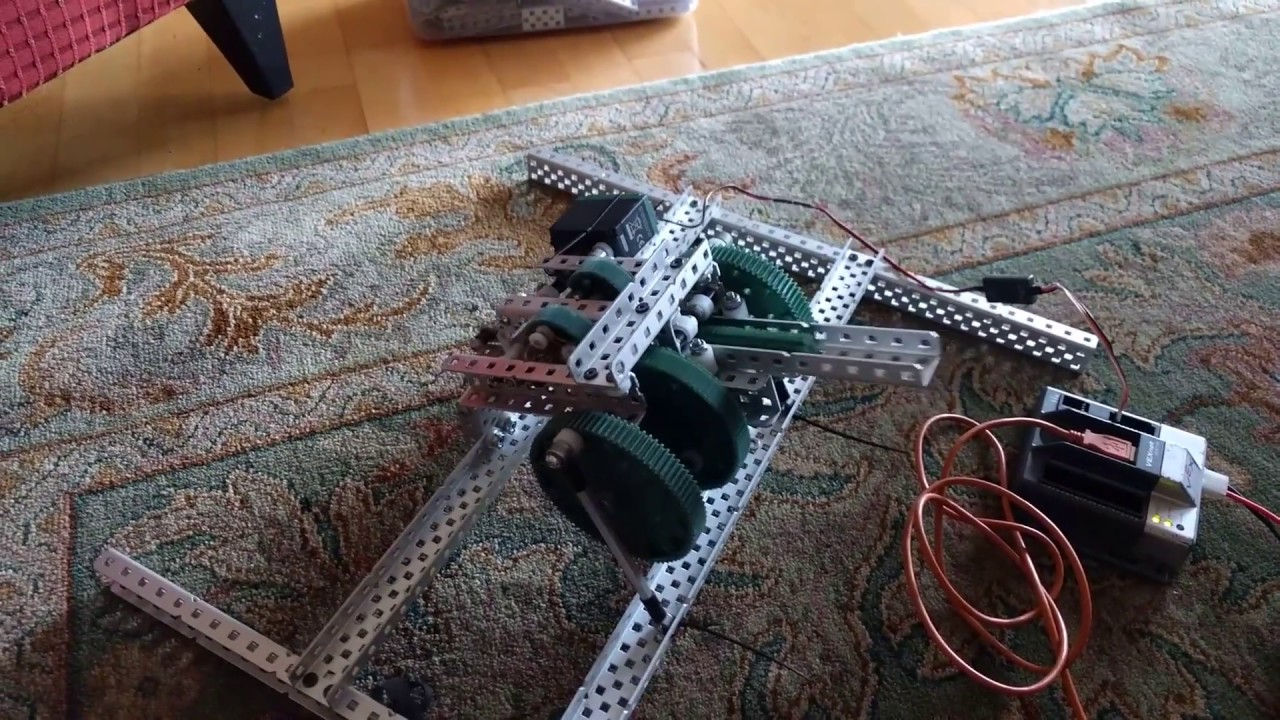
However, you have to be cautious which functions you connect to the shared motor. In the above example you would first need to set the angle and then wait for the puncher to pull back all the way before shooting. This seems like not a big deal, but during the match every fraction of the second counts. You would need to add another ratchet that could keep the puncher pulled back at 90% and only needs to go remaining 10% of the way when it is time to shoot.
Ideally, angle changer for either the flywheel or puncher needs to be powered by the motor shared with the function that is idle while you are launching the ball.
For example, you can allocate one motor for the intake, one for flywheel, one for indexer, and one for the angle change. However, once balls are in the robot, you no longer need the intake, so you could share intake motor with one other function.
Here is an example of sharing intake and indexer motors :
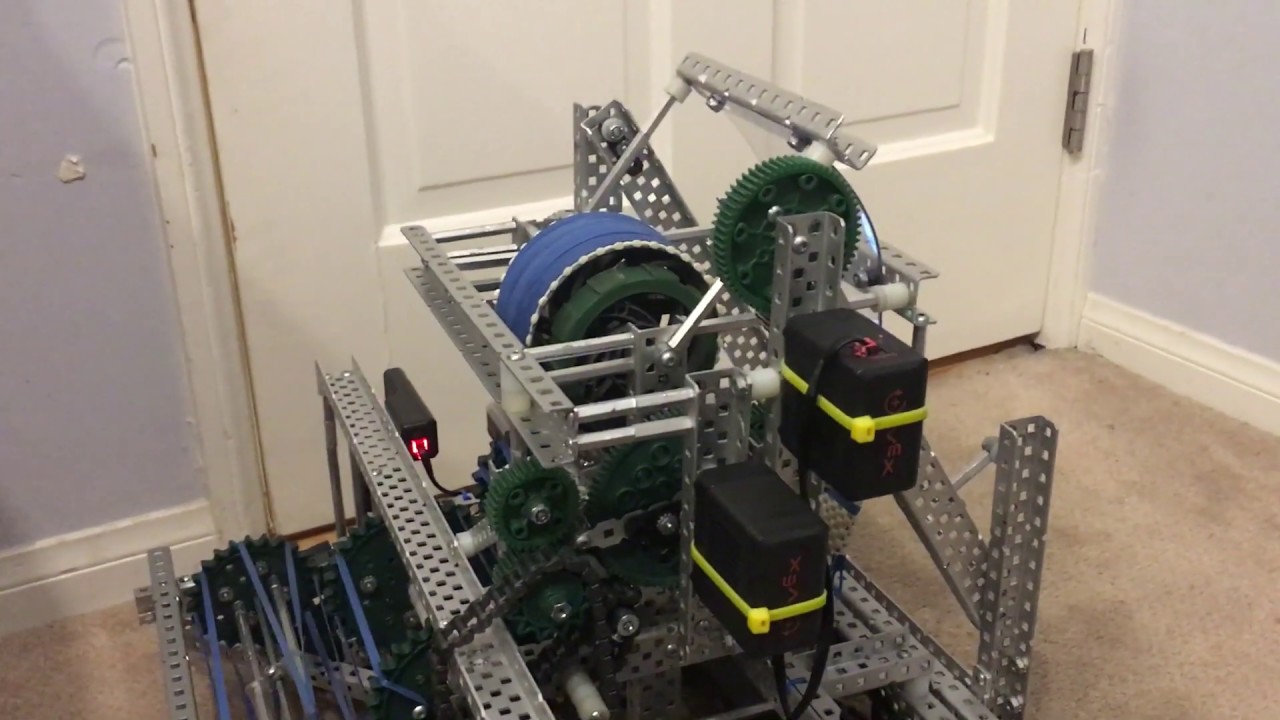
But this could get complicated fast and you may lose your ability to flip caps by running the intake in the opposite direction.
The alternative could be to share the motor between intake and the angle changer. You could permanently link the intake with the angle changer cyclical motion. When you run intake you don’t care which angular position the backplate is in. Then when you ready to launch the ball you just stop intake when the backplate is at the proper position and launch the ball.
There are some creative ways to implements angle changing puncher or flywheel using only total of two motors for all functions, including intaking… I will leave it as an exercise for the readers for now and post my version at a later time.
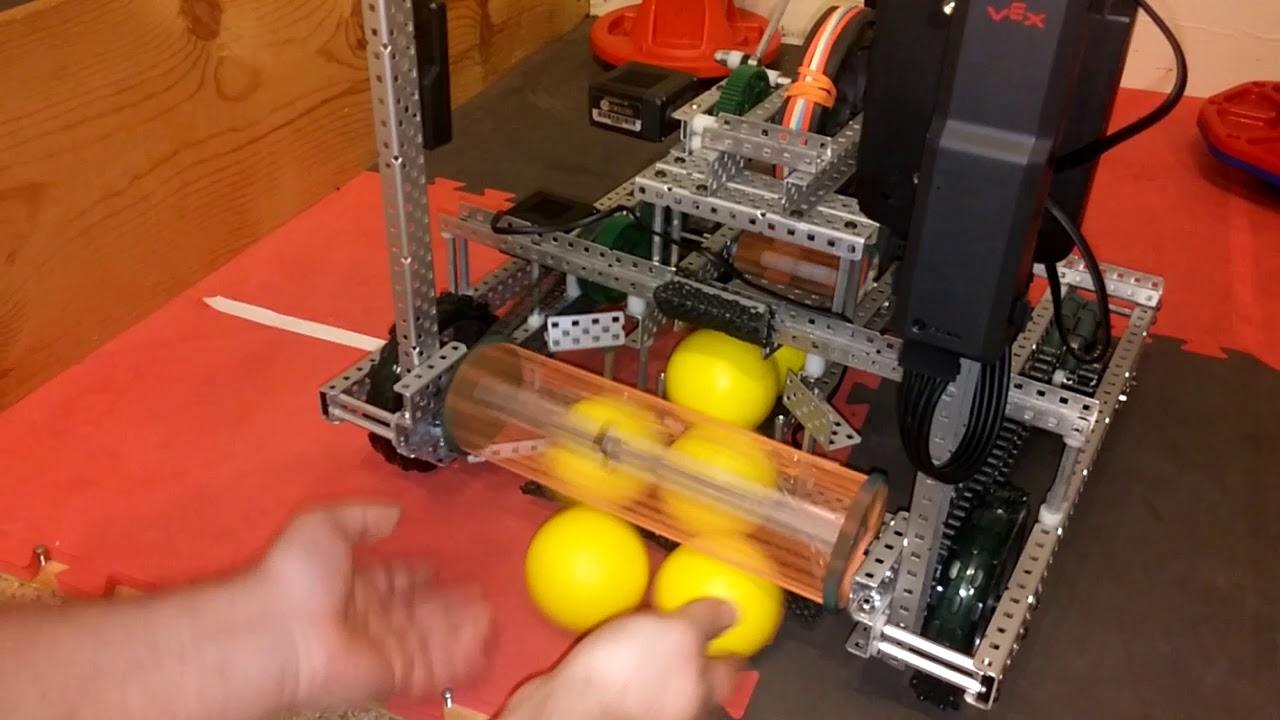
If done correctly, you could also ensure hardware limit of the two ball possession as seen in this early prototype (don’t pay attention to the indexer - it was an early variant):