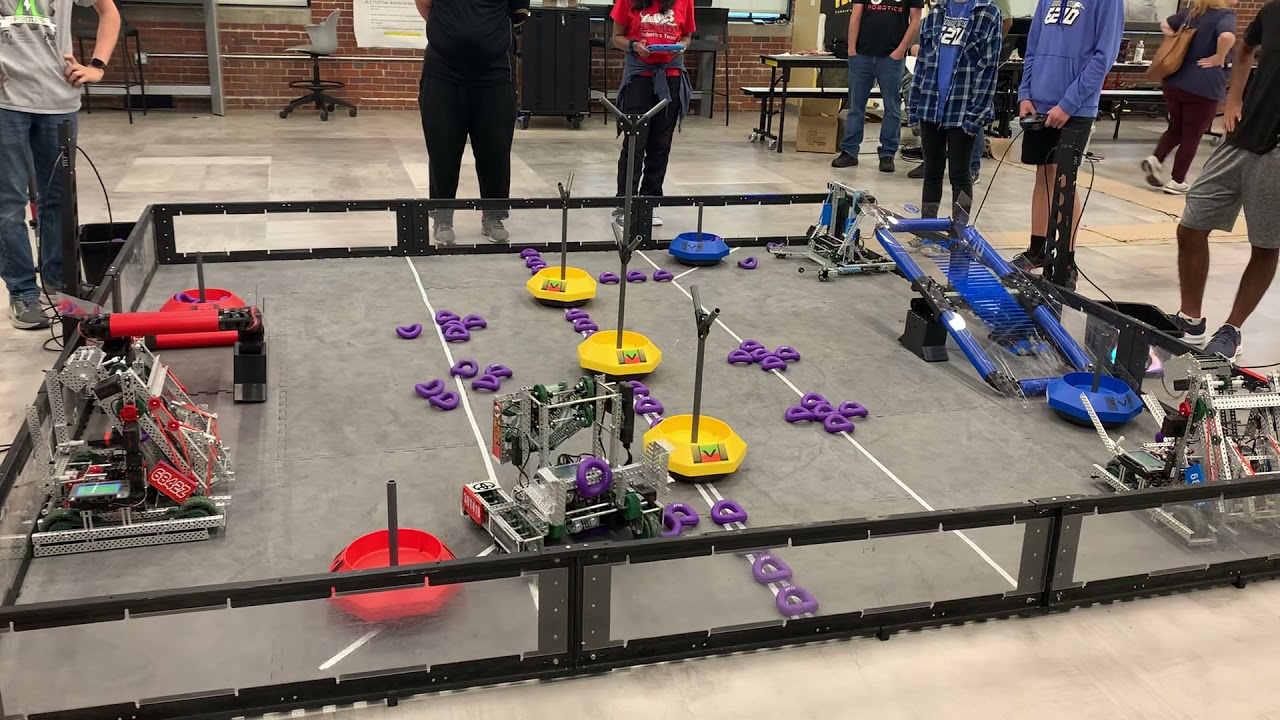
Is <SG3> still too harsh?

Yes, that is why a flat DQ regardless of the affect on gameplay was too harsh. Not only do you decrease your chances of winning, but you also don’t get any AWP, Auton Bonus, SPs, or (if you still manage to win or tie the match) WPs from that match.

This is pretty spot on.

I see your point here. I don’t doubt that at times during the season, a partner will cost an alliance a win by violating SG3. There are lots of ways any team can cost their alliance a match. I think over time, as the game becomes more intuitive to teams, they will understand that they should stay away from these areas.

Okay, so I believe they could do one of two things to help fix this case, which I believe does feel a little strict. They could either lower, or completely remove the point swing penalty when there is a non gameplay affecting penalty. Really they could do something such as specifically say that it’s up to the referees to decide if the move was intentional or not, if it was intentional, applying the DQ and if being intentional but not gameplay affecting, instead just apply the point swing. So really with a change to this it’s down to whether or not you would want pressure put onto the referees to make very tough calls. Personally, I believe VEX could do something like change it to a ten point swing in the opposing alliance’s favor because then it adds much less pressure on the referees with making the call, but still encourages alliances to not stray near the opposing balance beam because they could get docked a small amount of points that could even result in a loss for their alliance. As it’s been said before, I don’t think they will make the change, but I believe not cutting it completely, but lowering it would be most effective for making this rule a little less harsh.

Okay, so for this rule, I just had a scrimmage this weekend and so many teams accidentally bumped into the Platform while trying to get mobile goals on the opposing side. I don’t know if it’s just because my region is bad, but it happened so much. One of my school’s teams was matched in with an alliance that the only reason why they lost was because their alliance bumped into their Platform. I don’t think at high level that will ever happen, but still it really mattered.

I believe it happens at all levels.

It cannot be overstated, Robots near the opposing Platform are always at significant risk of significant penalty. Teams need to be aware of the rules and take ownership of this responsibility. Ignorance of the law is no excuse.

If teams were on the opponents’ side of the field near their platform, contact is going to happen. I don’t think the region is going to make a huge difference in that regard.

Yes, that point was made earlier, with most matches being decided by less than 30 points, making the penalty nearly identical to a DQ (obviously excluding AP and whatnot, we’ve been over this once already.) Like it or not, I think the stance has been made very clear that the penalties will not change, and teams are going to have to mold their strategies around it.

I do kind of agree with this, solely because I believe once we get to that point later in the season, teams are going to have more fleshed out robots that will be able to balance themselves, goals, and score rings, to where there will be little need to make a last-ditch effort at taking a goal from the opponent’s side, since you’ll have other things to worry about.

I’ve seen this penalty already affect both semi-finals and finals matches, which are presumably “high level”

In my mind, high level is the regional/state tournaments and worlds, more end-of-season type stuff.

Early season rookie mistakes - I think what is at play is inexperience driving their freshly minted robots early season, and as you point out, teams are going to have to get past the hurt of losing matches because they can’t execute the equivalent a three point turn near a platform :slight_smile: (just joking … all you new drivers know the stress of first solo drives.

The thing that makes the rule seem egregious to me is the transitive property. If you are touching a mobile goal that is touching your platform and also touching the tall neutral goal after it has fallen over, you are basically restricting the opposing alliance to an extremely small area of the field. If you made a line of mobile goals and rings to your platform, you could make it impossible for the other alliance.

one thing I noticed at clash in the canyon last saturday, was that it’s actually very easy to avoid any infractions. Just stay clear of your opponent’s platform and make sure you get out of there around 40 seconds left.

But despite that, there were many disqualifications of teams that knew they didn’t have the points to win at 30 seconds left, so they risked snatching a goal from the other side, knowing full well that they’d have a good chance for disqualification.

The root of this risk taking behavior I think is that once the match hits that 30 second mark, most goals are pretty locked down on or touching the team’s platforms, leaving all 4 teams with no way to score any points that doesn’t involve risking a dq. I never took that risk, so I typically did nothing during the last 30 seconds of most matches (sometimes a goal or two were still being contested away from any platforms, but not often was this the case)

It seems that there’s very little a goal-only robot can do during the endgame period. I think that once we see robots getting more adept at rings, we might see teams opting to put rings on the goals they have on their side for extra points, rather than simply sit there or risk a dq by snatching goals back. Scoring rings on the neutral goals might not be worth doing while goals are still available for snatching, but once you have nothing else to do, those points could provide a way, in some matches the only way, to turn the tide of the match in the last 30 seconds.

I’m fairly certain this rule will plague teams through Worlds. I’m pretty sure we had late season issues with the Tower Takeover protected zone. As many have noted, the transitive nature of the contact can be killer (though also easy for refs to miss).

I’m on record as not a fan of the rule (as both a ref and a spectator), but it is clear this is an intended part of the game and not an accident of language.

Looking at it from the half-full side, this rule enables drivers to show off their precision skills by avoiding this penalty.

I mean one good side of sg3 is that you can have spin offs at the end of games

[All edits are minor grammatical corrections]

Hello, another SG3 post. A new topic This years rules have more grey area than a fresh box of anti-static tiles was created about grey zone in interpretation, this post is about the harshness of SG3, that topic just sparked my drive to finish this post. Anyway,
I’m writing this post in conjunction with and on behalf of a group of Colorado teams, consider it a community post.

A few weeks ago (Oct 23), Colorado had its first tournament of the season. We had a great time, socializing, rookies enjoyed themselves, it was just fun. Of course there’s a caveat, “Chaos”, “What the heck”, and “regular vex: controlled chaos — today: just plain pure chaos” are real quotes from competitors during and after the tournament.

Disclaimer- All calls by the head ref were correct and executed calmly, none of this is saying he was being unfair. This is also not against any of the teams indirectly mentioned. This is about SG3.
Other disclaimer: (I’m writing this after completing the whole post, it was written and thought in a confused and flustered manner, because that’s simply where we are even after these weeks)

Here’s what we think is wrong: SG3, along with other issues regarding it. Some about transitive, some about the plain old platform. This tournament was full of penalties, but also missed penalties. While the platform was being watched, hoarding calls were missed, outrageous platform penalties were called, and we realized how flawed SG3 is from new tournament perspectives.

Basic transitive

What the heck? A tall goal tilted over touching the perimeter invalidates everything else on the platform? If you can remove this goal from the platform, should nothing change, don’t you think the rest should count? We definitely think even the slightest change in “platform angle” can invalidate, but if it’s proven that the object has no effect then it shouldn’t hurt the rest. After all, the rules of vex have always been match effecting and gameplay effecting, but the side of a mobile goal post gently touching the platform, not effecting anything, costs major score to the alliance.

What the refs can see

Mentioned earlier in this post, calls were missed for various reasons. Sometimes hoarding was missed because the platforms were being watched, sometimes a platform contact was missed because the touch was either so minuscule, and more. Alliance mogo rings, what all 4 bots are doing in those final 30 seconds. At best 4 bots are being watched (2 in close proximity to each other being watched by 1 ref, 2 other bots being watched by other 2 refs). But in reality, it’s easy for the refs to all be looking at one bot. The head ref has to see it all, the platforms are on opposite sides of the field, something about that just doesn’t add up.

So, it’s been generally covered in this post what transitive is, and what the refs can see. Now for the grand point.

Did that really happen?
Did I just get penalized for touching the “platform” while still in the neutral zone? Did the offensive robot get penalized for nothing? Was that actually missed?
We just want the readers of this to understand it from our eyes.
-A robot pushing an opponent that’s carrying a goal into the opponent’s platform (platform to goal to robot to robot transitive), the pushing robot backs away the moment they realize they made contact and is penalized.
-Teams trying to take their own alliance goals get penalized.
-A finals match with a missed penalty.
-A robot with no intention to balance, sits against the platform touching two other goals. A robot goes to take a goal and is penalized even though there was not an ounce of intention to balance from the other alliance. The crazy part about this match is that the penalized robot was in the neutral zone when it made contact, that’s how far out the transitive touch reached, and not just a corner of a wheel, most of the robot was in the neutral zone.
-An opponent pushed into a violation. (More on that at the end).

-The red note indicates that it’s not feasible for a head referee to track the exact movement of every object, so why is it being called like this?? We had people coming to us after the tournament saying they saw team A touch the opponents platform but it wasn’t called. These are people from the bleachers, and around the field. We penalize a goal touching a robot touching a goal touching a robot, but if a direct touch is just barely missed by the ref, there’s nothing.
-Maybe it should be considered that the robot defending goals in their zone are the defensive bots and the teams trying to make a 40 point swing are the offensive robots. Make a case for the other alliance’s goals, make a case for the neutral goals, but we firmly believe an alliance trying to reclaim their own alliance goals should always be the offensive team. An alliance trying to take any goals should be offensive, any goal steal edges the score in their favor. Hasn’t it been mentioned that a robot carrying goals should expect heavy contact from opponents? This competition is filled with so so so much grey area, why can’t this be part of that then? An alliance attempting to balance goals or robots on the platform is to be protected, but in all other cases it’s a free field. Which robot actually deserves the benefit of the doubt.
-Another thing, drivers can’t see that side of the field. Especially when in most cases, they will never see the gap between their robot and the platform because I don’t know, the robot’s in the way? They can’t see the contact until the motion changes, or the platform jiggles. Grey area, perhaps backing off after that can pass. Make the accident the unspoken warning, the second infraction comes punishment.
-Should a robot in the neutral zone be penalized for transitively touching the platform? We don’t think so. Not to mention an offensive robot trying to take goals. May as well build a wall of goals through the field if this is how it’s going to be.

Maybe we wouldn’t rely on what the ref sees so much if something was different. What was seen at this tournament left jaws dropped and hands scratching heads.

:white_large_square::orange_circle::white_large_square: If this is all too much to read, I hope you at least read this last part.
I write this from me, not a community post.
In quarter finals I was against two rookie teams. One was tasked with managing points on their side, the other was tasked with defending us. This was definitely defense because they had no means to drag goals, and had a very clear driving style of getting in between me and the scoring elements. During the last 30 seconds, they kept pushing, wedging the robot in front of me and not letting me proceed. I loved this, a real battle to the end testing our alliance’s skills under live pressure, not imaginary stress. And let me tell you, this was some of the best defensive driving I’ve ever seen from a rookie, 4 wheels and some bars putting it all out on the field facing elimination, there was nothing better than driving against that. I digress. I pushed to grab a goal behind them, during that I also pushed them, I pushed them right into our platform. I want it to be heard clearly,

I pushed this team into my own platform.

They never intended to prevent the balance (as we weren’t trying to), they had every ounce of strength on the field, and because I pushed them into our platform they got disqualified. G14 is superseded according to SG3, nothing prevented forcing that penalty. They did nothing wrong. How is this okay? That can’t be okay. Hear it once more,

I pushed this team into my own platform. I made this team violate a rule. This team was disqualified for nothing they did, but because of me.

For a game that’s so proud of heavy and hectic autonomous battles in the neutral zone, it sure is scared of determination.

I really like the points made here, and I think that the things mentioned should be thought about more. Our team has also had strange, and hard to understand encounters with SG3. Personally, I think the biggest fault of SG3 is when offense gets penalized because a team grazed the platform, incidentally had transitive contacts while playing offense (EX: trying to grab their own alliance mobile goal), and so forth.

As a team that scores tall post rings, I greatly appreciate this rule. In fact, if I’m trying to score 4 rings on the tall goal while contacting my own platform in the last 30 seconds, then ramming me to stop me from doing this will actually still benefit the other team, preventing me from scoring 40 points while only taking a 30 point penalty. So to some degree, I think this rule isn’t harsh enough. I think that’s what this rule was intended for, anyways; as the season progresses, teams should/will learn to just simply stay away from the opponent’s platform in the last 30 seconds. There are some cases which are pretty dumb, such as a tall goal tilted over, touching a platform and laying in the neutral zone. Personally I think they should give an immediate dq for direct platform contact in the last 30 seconds, and a 30 point penalty to any transitive contact that does not include the posts of the mobile goals. This would help get rid of those annoying situations and make it easier on refs to identify transitive contact (because it’s a lot easier when mogo posts aren’t involved imo), while still providing a solid enough penalty to teams who are being overly aggressive in the last 30 seconds.
The GDC clearly doesn’t want teams going near the opposite platforms in the last 30 seconds. In fact, I think that if it weren’t for the dumb situations you are talking about, the rule would have been an instant dq for any transitive contact. So I sympathize with teams early season that are experiencing these dumb situations, but I also think its important that teams learn to stay away from the platforms in the last 30 seconds.
I think what the real issue is here is how these dumb situations that are more or less outside of your control that can affect matches so drastically. I feel like implementing a clause that makes mogo posts not included in transitive contact could mostly fix this issue.

Look at Q&A 880:

https://www.robotevents.com/VRC/2021-2022/QA/880

If an opposing robot makes contact with the platform while interfering or delaying your attempt to score rings on the high goal they should be DQed… Not assessed the 30 point penalty.

I have seen way too many referee’s not using the DQ when it is warranted.

They only time the 30 point penalty should be used is when no other robots or mogos are around… So many times have I seen where a opposing robot steals a mogo and bumps the platform, and the ref only gives the 30 point penalty, meanwhile the team that stole the mogo changed the score by 40 points…

When a team can do something illegal and it helps them win, then there is something wrong!

The way I see it, as long as the goal wasn’t touching the platform, there was the possibility of the team getting out without touching the platform. This would mean that the touching the platform is separate than the goal grabbing, so the contact did not interfere with gameplay. But that is just my interpretation

I don’t think referees should be asked to keep track of whether the mogo is touching or not? If the mogo is close enough to the platform that the robot makes contact with the platform while stealing the mogo, then the referee should side with the alliance that is not partaking in the risky behavior and issue the DQ to the offending team.

That is probably true, there are already so many things for them to keep track of, but this goes back to the op and the difficulty to call these unclear scenarios with such harsh punishments as a DQ

just a side note, I was told by someone qualified that this was also the case with the tall goal scoring scenario.