In VEX IQ, we use a 6-pin cable and plug. While IQ is I²C and V5 is RS485 communication protocols, the two extra lines in IQ allow us to implement plain digital and analog sensors using the same cable for everything. In V5, we dropped the cable to only power, ground, and the two comm lines, and then spit off plain analog / digital devices onto 3-Wire ports to maintain backwards compatibility.
We only make sensors in V5 connect via Smart Ports if they have advanced telemetry data, need a processor in the sensor anyway, and/or have a need for two-way communication.
Honestly I was a bit worried, given all the new smart sensors, that you guys would stick with making everything “smart” even when it wasn’t really necessary.
I have used all the old vex sensors on arduino’s and it was amazing that they did everything using standard digital/ analog sensor convention. I can’t imagine it has a gigantic impact on the total VEX sales but you can see that people do appreciate that
There is a time and a place for a smart motor/camera. But there is room for a simple and elegant potentiometer that just does what a potentiometer does, change voltage based on rotation.
This may have been covered before, but can you walk us through the design process of why V5 went for RS485. I vaguely remember that it had to do with sending I2C packets and getting status packets back like IQ vs shorter turnaround since it’s a custom protocol. Or or I’m thinking of another controller. Thanks.
OMG, a common way to organize parts. I have 40+ IQ teams and we all strive to have the same sorting / organization strategy. This was so calming until the last box of everything dumped into the bottom.
On that topic, why is there no good way to prevent the V5 motors from overheating? It makes sense that that the motor would overheat given the loads sometimes placed upon them but I feel like there could easily be a simple Vex Metal heatsink for the motors. Maybe even a fan could be powered by the 3-Wire ports? Allowing us to cool down the motors could really increase the possibilities of them.
What is preventing this from being produced? Is it not commercially viable? Is it not deemed not necessary? Are there other solutions to this issue?
I apologize if this has been brought up previously. I have looked throughout the forums can could not find a good solution to this issue.
The only way to actually make the motor never overheat would be bigger restrictions imposed by motor firmware on how much power the motor can use. If the same 11W motor was limited to say 8W it would likely never overheat.
There will always be a balance point for any motor where its cooling performance and its heating characteristics equalize under max power. You realistically will never find that balance point without imposing large limitations on how much of the “total possible power” you actually are willing to send to the motor. A reasonable balance(what VEX does) is to limit the max power you send to the motor at any one time, and monitor the temperature of the motor and impose harsher restrictions if the motor gets much harder.
Yeah, that makes sense. While I understand the restrictions on exposed metal, the current solution seems like designing a computer without a CPU heatsink and then throttling to avoid overheating. It just seems like there could be some physical way to avoid the overheating phisically.
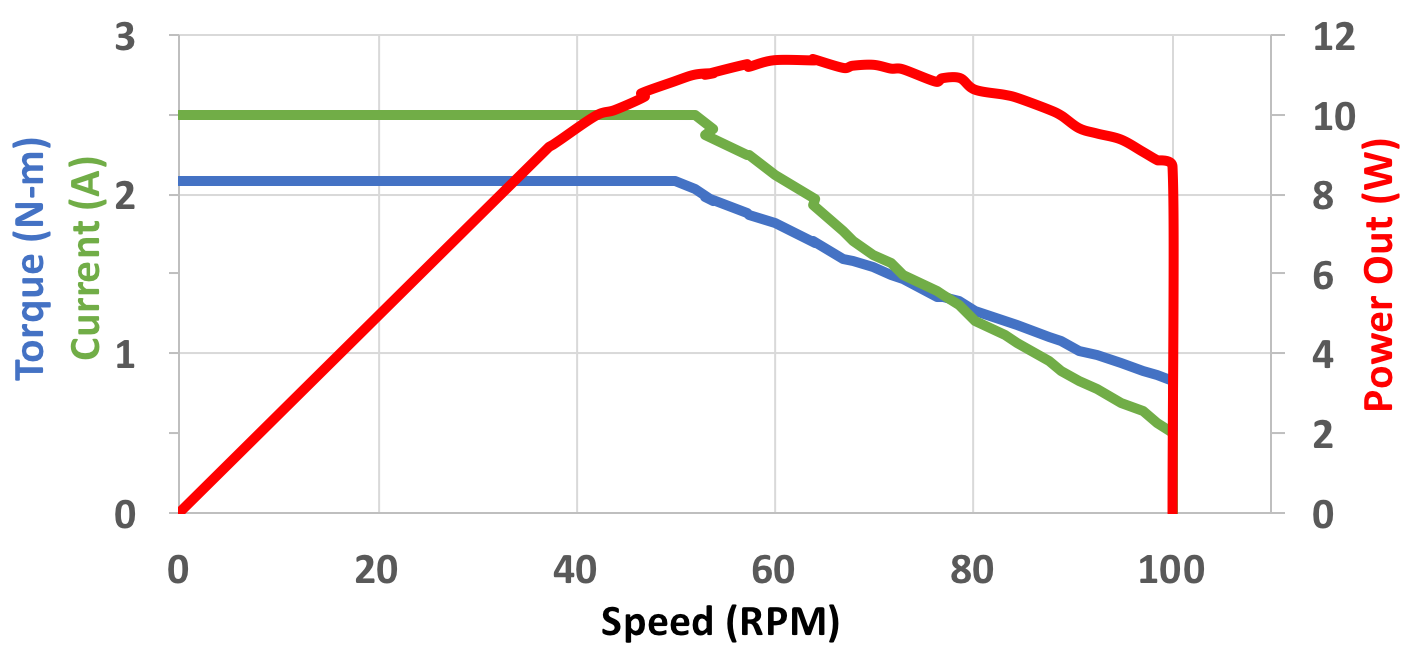
Don’t overload the motors. If you’re finding your motors are overheating, then you need to adjust your external ratios to compensate (assuming your build quality is up to par). The torque load profile of the motor can be found here:
These values get scaled based on what cartridge you’re using.
In the real world, you’d simply buy a higher-performing motor that can handle the load without external ratios (or as close to it as you can get). But that isn’t possible here. Sometimes you’ll even need to use compound ratios to compensate.
A good example is with Tilters last year. People either did a compound ratio, geometric optimization, or elastic assistance (or combo of all 3) to gain mechanical advantage. Otherwise, it’d be physically impossible to place large stacks in one go. This is one of the challenges of Vex (for better of for worse depending on how you see it).
I’m sorry but I don’t really understand what you’re suggesting. The motor in question on my robot is blue, driving a rubber band turbine with a 3:1 gear ratio (1800 RPM at the roller)
We do this to launch quickly into the goal as fast as possible.
In this scenario, there is no way to reduce necessary torque (Except reducing friction)
Could you clarify what you mean? Thanks.
This is a perfect way to gain mechanical advantage. The torque load on the motor is a function of the radius from the center of rotation to the load point and the force applied at that distance. That being said, decreasing the radius of the roller will decrease the torque load on the motor (or preserving the radius of the roller, you can decrease the compression instead –– there is a difference).
I’m suggesting that you increase the mechanical advantage of the system along the dimension in which there is a deficit. In this case, the torque load on the motor is too great so you need to increase the torque output of the motor or decrease the load. I’m not sure how much simpler I can make that suggestion
I’m pretty sure it means a different revision of the rotation sensor without the friction problem that many of them had upon release.
I’m guessing the initial issues were because of some design/manufacturing defect, and they implemented a correction in the manufacturing process to get rid of the friction problem.
They are the same product, just a corrected / updated version to get rid of a bug.
That was the way I took it as well, but I should have been clearer with my question. Did any of these original, high friction encoders actually ship to teams? Of so, do you need to call to get them replaced?
The 4 we received have higher friction than an old style potentiometer and much more than the red quad-encoders. Certainly not something that makes them not a good choice for many applications.
Not super related to the new products on this thread, but with the introduction of the hex-hs shaft adapters with the flex wheels, could we be seeing more pro products used for VRC? Such as their mecanums?