Have they released the specs of the v5 electromagnet yet? I might try to prototype or purchase my own so that I can start experimenting with strength and placement.
1 Like
If they can hold roughly 1/2 an ounce, then I can at least make it work for things like intake retention.
1 Like
I don’t anticipate the electromagnets being anywhere near powerful enough to do any lifting. main use I see for them in vrc would be more along the lines of actuating and engaging/disengaging locking or passive mechanisms. still incredibly useful, but don’t expect to use them on lifts or anything that requires an non-negligible amount of torque.
18 Likes
Of course, there will probably a tradeoff between them and motors/sensors, like there is with pneumatics.
I don’t think they’d be that powerful to warrant having to sacrifice any motors. I could see a limit on them for sure, but I’d have to experiment with one before I could guess how good they really are.
I also noticed new turntables that are held together with clips instead of screws. And the large one doesn’t cover the gear anymore.
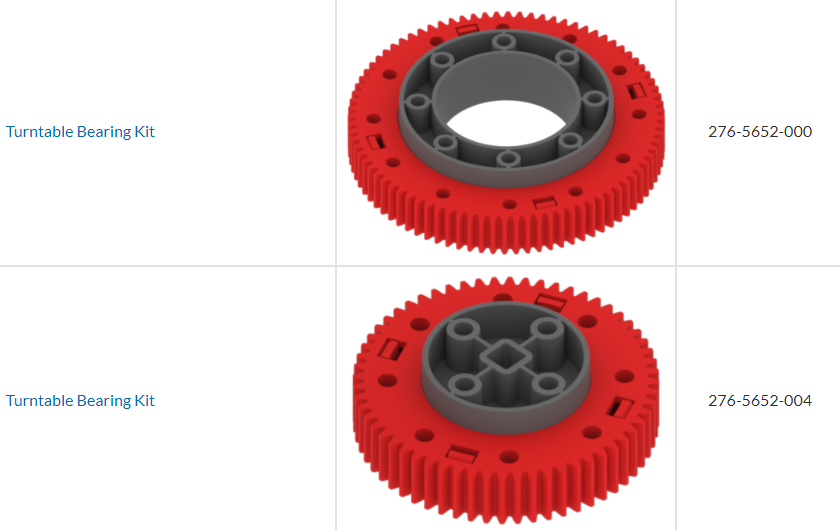
10 Likes
honestly them working with weighted discs is good
because like taran said its acivating and deactivating mechanisms
this maybe could have had a use in TP IF it could resist the load of bands
but imagine the potential for wallbots this could bring
please we need the all powerfull version of this
Not wallbots, a robot that goes and just sticks itself to the steel parts of another robot, and acts like a pushbot.
1 Like
Electromagnets are cool but the functionality they bring isn’t something that can’t already be done with clever engineering. They merely simplify the means to an end. Ferromagnetic materials are few and far between in terms of legality anyway. All you have is steel c-channel (and any other tiny part I’m not aware of) –– not much room for custom parts that give huge advantages. Steel definitely weighs more than aluminum meaning the use cases will be for very small applications. I’m sure there are plenty of applications but none of that will matter until the capabilities of the magnet are released and deemed legal for competition.
Tl;DR An electromagnet of this caliber will probably not be able to pull back a high-velocity catapult or puncher. BUT take what I say with a grain of salt (no pun intended), I’m not god.
7 Likes
I’m in love with these new motors. The biggest problem I’ve seen with the V5 system compared to Cortex in VRC is the low number of discrete actuators leading to less creativity and more design convergence.
PLEASE allow these for VRC, perhaps at a trade-rate of 3/2 between small/large.
15 Likes
12t HS pinions are pretty dense and have an irregular shape, but I could see it working with shafts, especially HS ones.
The most efficient way to transfer energy to a rotating body is with a motor, not a linearly acting magnet. But maybe the shaft could act as like a piston if the magnetic field is strong enough?
3 Likes
The antigravs have become real. Time for a hoverbot.
6 Likes
One additional detail on the new Potentiometer v2 (that was literally its raison d’être):
It doesn’t have any hard stops.
What this means in practical terms is that you can mechanically spin this Potentiometer v2 a full 360° without any damage to the potentiometer sensor (whereas on the current V5 Potentiometer, you can damage the sensor if you aggressively run it into the mechanical hard stops).
The only caveat is that you can only read analog sensor values for ~330° of its range; the remaining ~30° is simply a dead band in terms of analog values.
23 Likes
Just curious - why would one use a V2 potentiometer over the “v2” rotation sensor?
2 Likes
potentiometer is probably very accurate, more so than the rotation sensor
and it seems a bit more slim. The rotational sensors are kinda thicc.
Pros: It’s cheaper, smaller, can easily be installed inline with either Smart Motor, is a 3-Wire device, and has slightly lower backlash (since there’s no gearing; the shaft goes directly through the potentiometer)
Cons: Higher friction (than corrected V5 Rotation Sensors), cannot provide any usable data while its in the ~30° dead band, and more difficult to assemble into a specific mechanism (e.g. you need to align your shaft/mechanism with the ~330° sensor range).
14 Likes
Wait wut. Why not have it use a smart port?
Maybe because it doesn’t need one?
A simple analog sensor doesn’t really need its own processing. It seems the updates are more about updating the physical components.
17 Likes