IQ op
IQ op
That looks awfully familiar 
jkjk
I’ve encountered some problems with the type of ring conveyor I was working on and I think I have a better solution, so I’m going to post and explain the conveyor I had in the case that someone might be able to adapt it and improve it.
In my quest for an efficient conveyor-type ring intake, there were 3 requirements I had in mind. It needed to be able to field rings, and score rings both from the front and back end of the conveyor. I tried many things, but the common problem they all had was a lack of control over the ring’s movement. They all just sort of flung or dropped the rings, without acceptable reliability, because they all just lost control of the rings too early.
So I came up with this conveyor that remedies these issues by locking the rings when they go around a bend in the chain. I do this by having 2 standoffs right next to each other on separate links, and when the links curve around a bend, the standoffs spread apart and lock in the rings. What this let me do was retain full control of the rings until the very moment they fall onto the goal branches. The nature of the standoffs also meant that each prong could hold 2 rings, doubling the ring capacity and scoring speed.
See a video of it in action. (you might have to open this link in a new tab, something funky seems to be going on with the video embedding as an image instead of a video, not sure why)
One issue this design had was that it could not field by itself, so it required an external roller that would grab rings, raise them, and then drop them onto the bottom-most prong of the conveyor. This was prototyped as well, and it worked just fine.
But when trying to CAD a robot around this conveyor system, I ran into a lot of issues.
I’m attempting to make a robot that can do everything the game has to offer at fast speeds, and this conveyor design was severely impacting my ability to do other aspects of the game.
The bulk of it, as well as the requirement of an external intake and a tall lift meant that it took up more than a full robot of space. Which means I would have had to have countless deploys to fit everything in size. It also used a lot of motors, since the conveyor and intake had to be independently controllable, on top of the already high motor cost of a tall lift and a goal rotator. I didn’t think it was realistic for a robot to use this style of conveyer when it also had to do other things, like externally lift goals, so it was scrapped in favor of a different design that accomplishes the same thing but in a (hopefully) more compact and efficient manner.
But maybe this type of conveyor has some application this year, it seems to me to have a lot of potential, and hopefully someone can find some way to make use or at least learn from it.
We tried using a conveyor belt similar to yours. We have ended up using this design:
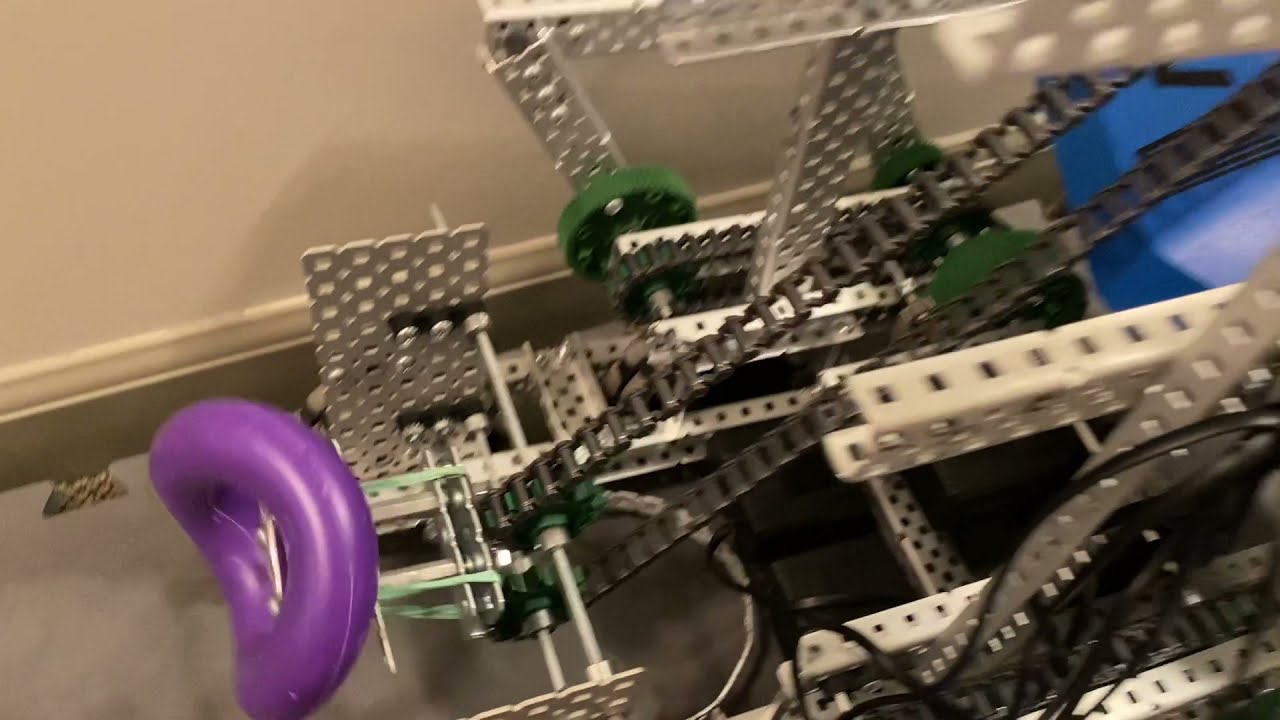
one of the IQ china team’s ringmaster plungers
(i was there too)
imagine accidentally giving away my identity
Honestly, that’s not a bad design.
Design is good, but I feel like the execution should be better. For example, using chain for high-torque scenarios is a big no-no as they can break very easily. If you are using them for high-torque, at least double up and have two chains next to each other for each system in case a chain snaps mid-match.
Looking at how high the mobile goal is, I feel as though the robot will either capsize from all of the weight while turning or from minimal defense or pushing. Not to mention, it looks like the mobile goal can fly out pretty easily too.
Your ring intake is looking very nice. But where the ground is, figure out how to make that area as wide as possible, suggestively try your hardest to make the bottom of the intake spread about as wide as the robot. So that means the intake should be in front of the wheels as compared to in between. You should have as much “wingspan” to scoop up as many rings as possible, otherwise you may actually just be better off intaking a ton of mobile goals and playing mogos-only.
Suggestions:
normally I think I would agree with you entirely, having as large pickup tolerance as possible is typically desirable in games where you need to quickly intake a large quantity of peices.
But this year I question if it’s really that important for your intake to be as wide as possible. Assuming you have an indexing system quick enough to match your fielding speed (which is a big if), my biggest concern is that having an intake the entire width of your robot means you need it to stick out in front of the robot. It’s much more compact to have an intake spanning the width of the inside of your drive instead of the width of your entire robot, and I think the reduced range is worth the additional compact-ness. If attempting to CAD a complicated robot for the last week has taught me anything, it’s that space (particularly lengthwise space) is very precious this year. I do agree with you that a mass-collection system is necessary to be competitive at the ring game, a passive poker stabbing at precise locations on the ground one ring at a time is not going to cut it. And while it is better, a narrow hook system probably won’t cut it either. I think 4610’s robot has fielding about as good as you would ever need. A robot would need a much larger ring capacity to properly take advantage of any fielding speeds faster than that imo.
So basically yes, make your intake wide so that it’s easy to field quickly, but maybe not the entire width of the bot.
We probably will double up the chain or swap to tread, but I am not sure if it would classify as a high strength situation.
So far, we haven’t had any issues with tipping.
This would require us to have a flip out mechanism.
My worry is this would get rid of our ability to climb on the platform and/or cause the back wheel to lift off the ground.
Thanks for the feedback!
We know that our ability to pick up rings won’t be the fastest, but we are planning on making good use of the match loads. The robot also has a 1 by bent as a funnel to help line up the ring, though right now it isn’t in the best spot.
What program did you use to make the prototype sketch? I imagine it’s super useful for creating accurate images to put into the design notebook
That is a cad software, and by the looks of it, it is Fusion 360.
Thanks, that’s a big help
I would recommend joining the vex cad discord server. They have been very helpful to me learning Inventor and how to assemble vex robots in it.
Yeah, i built it on fusion 360.
Thanks! I’ll be sure to check that out too.
Yeah but what about this?
There should totally be a way to mount this on a chain bar atop a single or DR4B, and have it default to a position above the intake roller (with a vertical collection system). From there the chain bar can move this to deposit onto different height goals, and the DR4B can lift it up as needed to score on higher rungs, including onto MOGOs that are already on your alliance platform (while you are on the ground).
how would you let go of the rings or am i just being stupid and its obvious
pneumatics
20 characters
I would, but we dont have a pneumatics set so we cant really make a plunger type of bot.
I mean, if you wanted to you could use motors for the active plunger release. It’s just that pneumatics would be a much more viable method of doing so.
But what if you make a funnel sort of guide along the ground to drive up to the ring, but then the plunger is fixed right over that point that the rings are guided to?
Or perhaps a roller intake brings them directly onto the plunger, and a lift system changes the orientation of the ring stack as it lifts?
o.o
