While there are already some posts explaining VEX in China, I thought that it would be helpful to make this post to summarize the structure/operations of VEX competitions through official resources and my own experiences and give my thoughts (to RECF or VEX China, maybe?) on how the competitions can be improved in China. Being the fourth (and likely last) year that I am participating in V5RC, I feel that there is a significant disconnect between competitors in China and elsewhere, so I hope that content like this can better bridge the existing language and digital barriers.
While in most regions, the various VEX competitions (V5RC, VIQRC, VURC) are overseen by employees of the RECF, with RSMs being the most direct liaison, in China, the competitions are administratively overseen by VEX/IFI employees with ~2 VEX “赛事经理” (literally “Competition Managers”) who assume the role of RECF RSMs in China. Individual events from the qualifying to national level are almost all hosted by educational companies/organizations (with some exceptions) in cooperation with the Asian Robotics League, which, from my understanding, is responsible for the operations relating to VEX and other robotics competitions in China. Some of the educational companies that assist in the operations of the various tournaments also happen to offer VEX-related paid classes both within their own institution/company or by sending teachers to coach school teams. Although the events typically involve many university student volunteers, the business hierarchy for most VEX competitions always seemed extremely commercialized to me compared to other regions (which, to be fair, could be the most efficient way of hosting tournaments with over 300 teams).
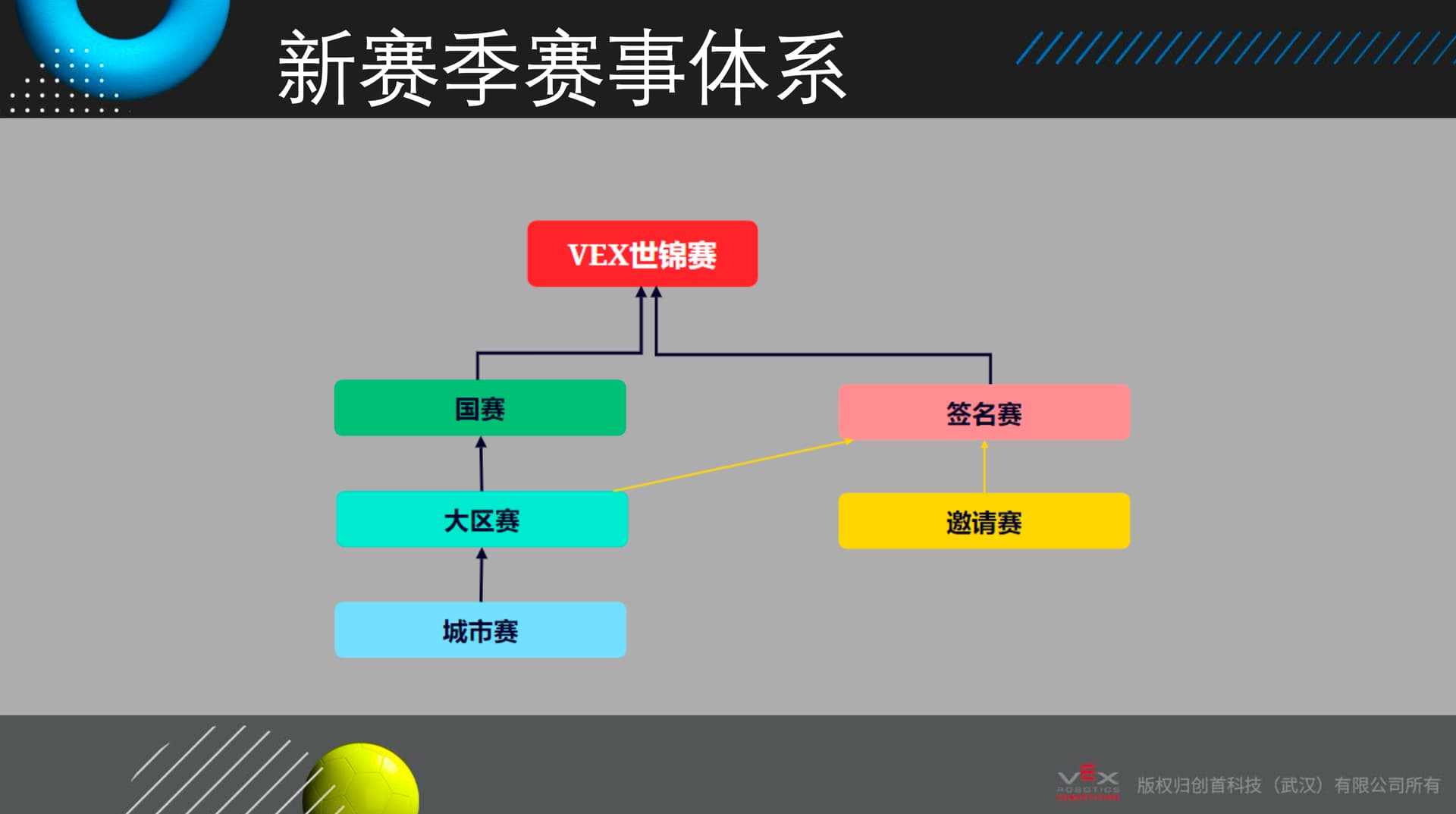
Following reforms for the 2024-2025 season, events are classified at the city level (blue), regional level (turquoise) and national level (green), except for signature events (light red) and invitational events (yellow) to determine qualification to the VEX World Championship (dark red). China is split into four separate regions instead of the previous system. While this new system is an improvement, there are still multiple national-level ERCs (the Asia-Pacific Robotics Championship Xi’an, the Asia-Pacific Open in Taizhou and the Shanghai Jiaotong University Invitational) and regionals (which seem to contradict the RECF qualifying criteria. At the same time, the qualification process between various levels of competition also varies, sometimes differently from RECF policy, with signature events requiring teams to qualify from attending a regional/invitational event AND with registration priority explicitly given to teams not qualifying to national ERCs. Another example of qualifying criteria violation includes part of the qualifying criteria for national-level events (with skills rankings from regional competitions considered independently instead of through a region-wide skills ranking).
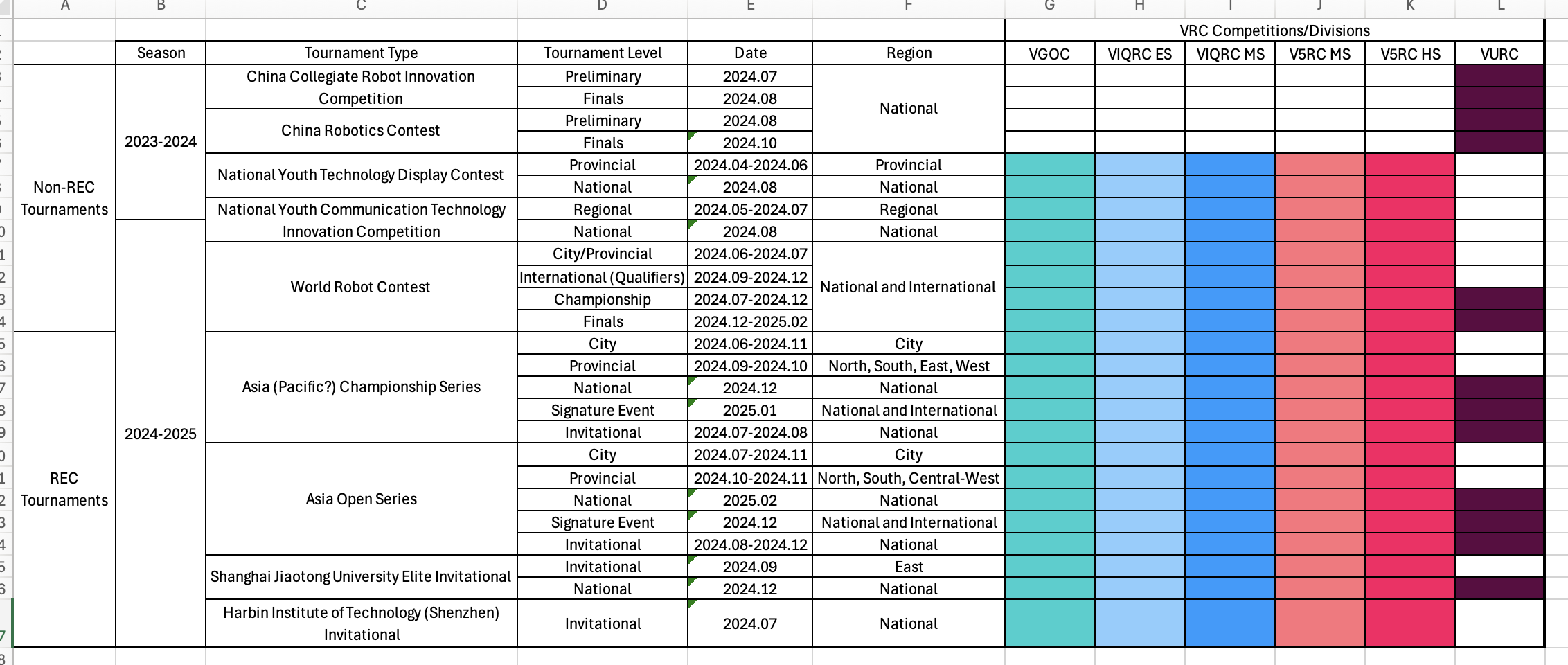
Rough translation of the following timetable by VEX China
The competition season in China tends to start quite early (in July) but ends around January/February, while non-REC tournaments (many affiliated with the Government) are hosted around the summers of 2024 and 2025. For most official VEX events, teams have to register via the Asian Robotics League website instead of via Robotevents, with team registrations on the website costing about 140USD and event fees ranging between 80-110USD per person (incl. coaches) at city-level qualifying events. Regardless of the event’s level, most events are hosted at large venues such as exhibition centers and hotels instead of schools, which, given the current relative size of Chinese tournaments, makes sense.
The only events that I’ve actually seen be managed by volunteer EPs are those organized by international schools in which I participate. The largest of these tournaments are affiliated with school athletic conferences (i.e. the Association of China and Mongolia International Schools, ACAMIS, and the Asia-Pacific Athletics Conference, APAC, both of which have started hosting VEX Robotics tournaments in 2024) but are not recorded on Robotevents as they are unofficial tournaments. The TIS Robotics Challenge serves as a mini-ERC for these international school teams with (usually) one Worlds qualifying spot which, prior to the increase in unofficial events, was the only tournament that teams would compete in within an entire competition season. The rationale for these separate international school events, as told by one of the VEX Event Managers I’ve spoken to, is that teams affiliated with foreign international schools are unable to compete during the regular Chinese season due to summer holidays. Some of the mentors I’ve spoken to also said that the reason that they participate in V5RC/VIQRC (in contrast to FRC/FTC/FLL) is that the excessive prevalence of mentor-building is alleviated within the ‘bubble’ of international school VEX events which is possibly also why the number of international school VEX teams in China are growing, from ~20 teams during Spin Up to upwards of 70 V5RC teams during Over Under.
As much as I enjoy competing and building with VEX, V5RC in China seems so detracted from the original aims of the REC to the extent that competing feels more like a commercial endeavor than one of learning and exploration. Although this does not apply to all Chinese teams, the ones that I engaged with feel more like assembly lines led by the various coaches instead of student-centered. While competing in international school events somehow limits these issues, this is inherently unfair to other Chinese teams who do not have an opportunity to compete in such circumstances. I’m almost inclined to believe that this phenomenon is just a knock-on effect of social stigma within China overall, with educational organizations increasingly capitalizing on the fear and competitiveness of Chinese families while students are caught in this crossfire of conflicting interests, eager to perform well but are enduring the burden from their parents, peers and society.
In my opinion, preventative measures such as programming tests cannot adequately address these problems. I would personally advocate for the ‘decommercialization’ of VEX competitions in China by taking a more community-oriented approach in encouraging schools to host more local tournaments, such as in the US or Australia, possibly providing grants of sorts to not only incentivize the hosting of more tournaments but to fund STEM education within Chinese schools which, unfortunately, is uncommon within schools and commercialized by private education companies. While I doubt that this will happen anytime soon with the current state of the education system in China, I hope that things will ultimately change to make learning more enjoyable and enlightening in the future.

 )