where would the lock-tite screw go tho? @P_Mania
I don’t mean the screws that come with lock-tite. Get lock-tite in a bottle and use it on longer screws before you tighten them.
I guess Vex has to start up those wheels again in that case… they are the best option for position tracking
I’m a bit late, but here’s my (not at all to scale) suggestion. Basically, you want the screw to be firmly attached to the supporting metal to keep it aligned and minimize slop- you don’t want your tracking wheel assembly to be able to wiggle around at all. You also want to make sure that the tracking assembly is fully supported on both sides (you seem to already understand this) while still being able to rotate freely.
I highly recommend staying away from shafts for this sort of thing, as they are not as strong as screws, harder to keep straight, and necessitate bearing flats. Depending on the application, screw joints don’t always need bearings. There aren’t many situations like this, but, if done right, tracking wheels are one of them.
Keeping all this in mind, and taking into account your limited screw selection, I would recommend the following:
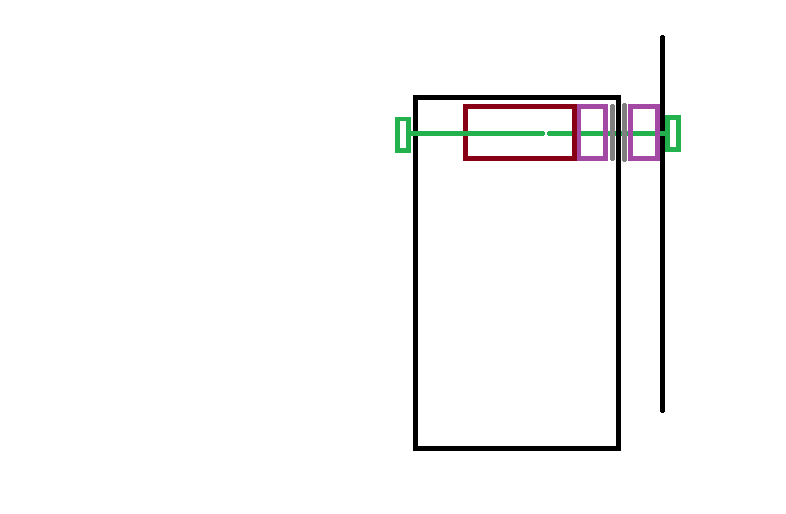
- Green are screws
- Purple are nylocks
- Red is a standoff
- Grey are washers
I’ll explain what everything does, from right to left:
- The first nylock (this could really be any nut) is screwed firmly against the metal, keeping the screw straight and strong
- The washer gives the metal a smoother surface to rotate against, reducing friction
- The next washer does the same
- The nylock is tightened just enough that the tracking assembly cannot slide sideways while still being loose enough that rotating is smooth. Its primary purpose is to ensure the standoff cannot tighten/loosen. While you could achieve this with loctite, it likely won’t be as secure and certainly will make it harder to conduct maintenance
- The standoff is screwed tightly against the nylock, cementing it in place
- This second screw should be screwed tightly against the other inside the standoff such that it cannot easily be unscrewed. Depending on the size of the screw, you may want to add some spacers on the outside of the metal against the screw head, but that isn’t strictly necessary (the second nylock should keep everything in place)
Thanks a lot for this design. Me and my team would definitely be using a design similar to this.
@ZachDaChampion Wouldnt it be better to have spacers besides washer because they are smoother, which will cause less friction?
Where do you get that idea from? As far as I know there isn’t a noticeable difference between spacers and washers; especially the plastic ones, which should be more or less identical to spacers. Nylon washers from robosource (which, sidenote, I highly recommend as they have 1/16" and 1/32", the former being almost exactly the thickness of aluminum) are even the same material as nylon spacers.
Either can work, but washers are smaller and, as far as I know, have a negligible impact on friction as opposed to spacers. The only reason they exist in this design is to give more stable and smooth surface than a nylock for the metal to rub against, as nylocks have a relatively small diameter and the nylon inside can sometimes “creep out” when you screw it in. A washer (or spacer) is larger and consistently smooth.
Tbh you don’t really have to worry that much about the friction here anyway. Unless you do something horribly wrong, the rubber band tensioning should be more than enough to overcome whatever extra friction you have. I’m not saying ignore friction completely, but don’t spend a week optimizing it to be perfect. As long as it doesn’t get stuck anywhere, it’s probably fine.
EDIT: my first sentence might seem a bit aggressive, that’s not what I was going for. Sorry about that
@ZachDaChampion @P_Mania @ranOOm
how did you prevent your metal from bending when you cut the rectangle from the middle of the c channel?
Because we were trying to make the tracking wheels and we were having issues with friction because the metal is bending. Any suggestions or ideas?
I remember our metal bending a bit after the cut as well. I just tried my best to bend it back in to shape, which worked fine for us. I wasn’t sure how it would last after a lot of use though, which is a big reason we switched to the second design. (It didn’t require cutting the c-channel like that.)
If you’re still having trouble with friction, also try making sure everything is aligned properly. If anything is even a little off it makes a big difference. We also lubricated ours a bit, though that’s certainly not a necessity.
Yeah, just be gentle when you set it up and they shouldn’t bend much in operation. You can always bend them back if you need to, but it shouldn’t be a problem. You may have cut it too much; the more metal you leave at the angle, the more sturdy the channel is.
Hey guys i know this topic hasnt been used for a while but i just needed some ideas as to how i could cut the 2.75 inch wheels in half so i am able to use both sides?
i saw some other teams at my comp that have done it but i dont know how they did it.
any ideas or suggestions will be appreciated!
I think many teams just use as band saw.
but is that able to keep the wheel stable, if so how do you push the wheel through the band saw since you cant vice it and push it through because the band saw wont be able to penetrate through it?
The wheel is plastic. Any functional band saw will be able to cut through it. A steady hand is enough to keep it stable. If u want, u can put tape around the rollers so the wheel doesn’t move side to side when ur cutting
keep in mind to get wheels that are more likely to be usable, you’re only going to get one thin one out of each fat one. you can’t cut the fat one into 2 thin ones.
But I have seen teams in my area that are able to cut the fat wheels into 2 thin wheels and use both of the thin wheels
Ya u can. The only problem is that there will be slightly less support
Is it better to have the tracking wheels far from the center or does even matter?
Higher resolution as the wheels turn more in an arc
this means further correct?