People were able to abuse ratchets last year because all three shooting mechanisms only required a motor to spin in one direction. This year however, most mechanisms we’ve seen require motion in both directions, so there aren’t as many opportunities to use ratchets.
It is great that many teams have experimented with various motor saving / sharing techniques over the summer!
Strict power limit of 8 motors in 1 motor increments is one of the best challenges that VRC got to offer for its most inquisitive minded competitors. 
I think, power transmission between drivetrain and tilter might work very well this season, but you have to be cautious which specific differential design to use.
As @Deicer correctly pointed out, the biggest problem with DMD style differentials is that they could introduce a lot of extra friction. Axles of 60T or 84T gears have to continuously rotate transferring your driving power. They also have to carry any force associated with the arms on which the motors are mounted. If those arms twist out of alignment, you end up with double or triple friction cost on the power that flows through the geartrain.
Designs that @1489A and @Anomalocaris have linked above, were used by a number of teams during ITZ and, with a good build quality, worked relatively well for some.
It was easier to do with 393 motors, where not all drive power was going through the differential, and some motors were direct driving the wheels.
For example, most 2131 teams had 4 motors direct driving the robot and only two motors were used on the Mobile Goal lifts, providing extra drivetrain power through the half-sided differential.
Also, 81k had 4 direct drive and 4 differential motors. If you take a closer look at their robot you could also see that motors were not mounted on differential arms and 84T axles did not have to carry extra friction load. Even with reduced friction half of the drivetrain power still had to go through the several extra gears.
With V5 motors it would be very expensive to send all your drivetrain power through the extra gears and axles required for DMD differential. However, there is an alternative solution as animated starting from 0:07 in this video:
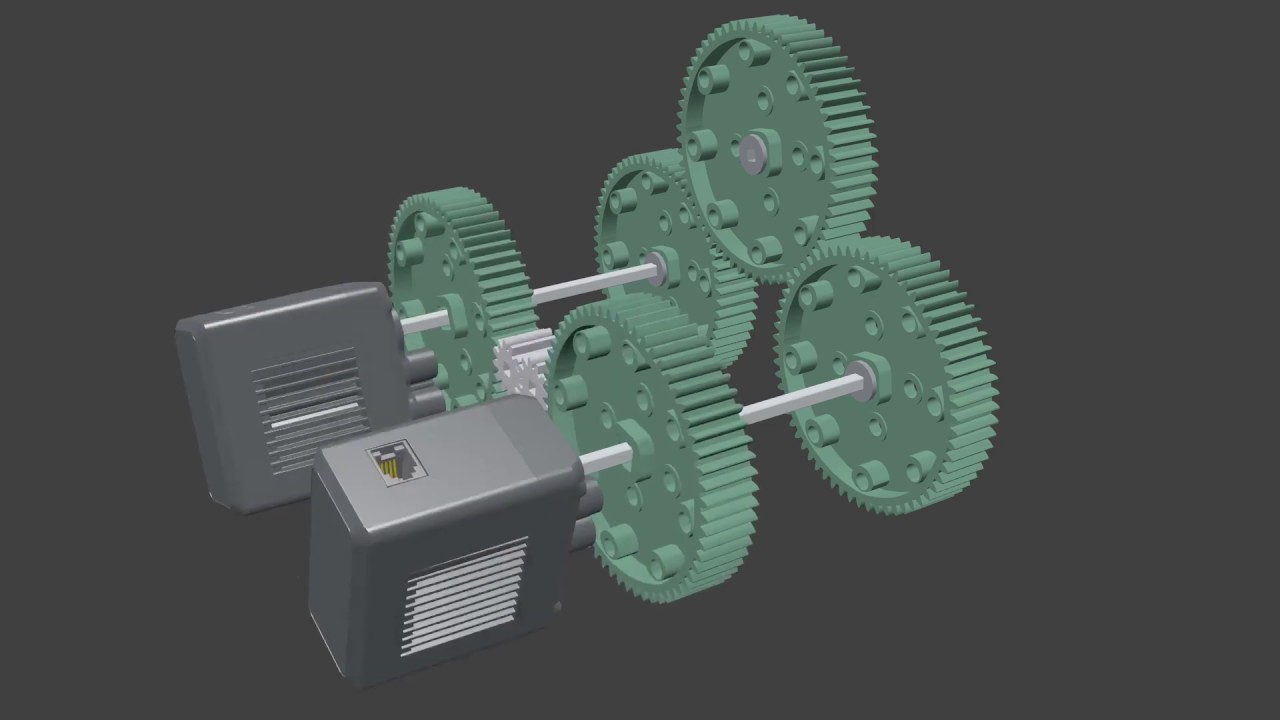
When motors are powering drivetrain there is no extra gearing involved, similar to the regular drivetrains. Only when you power secondary function, then entire motor assemblies rotate, which requires some extra gears. An example of such transmission could be seen here:
@technik3k , can you actually fit that differential inside the profile of 22 holes width-wise? Also, if you’ve had any experience driving these, do you know how much friction these kinds of differentials would have?
Yes, as you can see from the picture above, that prototype design, while being liberal with spacing, could still fit perfectly into 22 holes.
If you cut down on any unnecessary spacing, then this kind of differential with any associated gears could fit in 20 holes width and, depending on the choice of the wheels, entire chassis could be as narrow as 25-27 holes.
This kind of the differential transmission could have friction losses equivalent to the regular drivetrain design, where all 4 motors are located on the back of the chassis, with 2 directly powering back wheels, and other 2 connected by the chain to the front wheels.
The main trick to the low friction is that axles coming out of the motors do not support 60T gears that motors are attached to. Instead, 60T gears with motor assemblies are supported by the drilled out 393 output gears and, when everything is aligned correctly, motor output axles are passing through without even touching them.
Cool, that might make this transmission viable if 3 motor intakes become necessary, and if the differential is done right with little to no extra loss from friction. However, I just have a couple questions regarding the prototype. What is the main point of the plate attached to the 60t high strength gear? is it just to keep the golden motor standoffs from bending/breaking? and what are the standoff/collar assemblies that are also attached to the 60t used for? The amount of thought and testing that goes into these things still amazes me, and often times I can’t catch up 
Yes, the plate on 60T gear is there to provide stable platform for the motor and additional structural support for 6" standoffs connecting left and right sides. It may have been an overkill - simple 1x bar under motor may be enough support to make it stable.
Standoffs on collars were used for power takeoff for the secondary function. For this season it could be used for raising the tilter.